
Stuttgart
Wilhelma 13, 70376 Stuttgart, Deutschland
Wilhelma | Opening Hours & Online Tickets
The Wilhelma in Stuttgart is much more than a classic zoo: it combines zoological diversity, botanical collections, and a historic park into a destination that holds a special place in Germany. The state-run facility describes itself as the only zoological-botanical garden in the country and one of the most species-rich zoos in the world; at the same time, the site, with over 1.8 million visitors per year, is one of the most popular leisure destinations in Baden-Württemberg. Those who visit the Wilhelma experience not only animals and plants but also architecture, garden art, and an extraordinary park landscape with a rich history. This very mix makes the searches around Wilhelma Stuttgart, tickets, prices, opening hours, and photos so relevant: visitors want to know not only when the park is open but also how to best plan their visit and which highlights are truly worth seeing. ([wilhelma.de](https://www.wilhelma.de/ueber-uns/die-wilhelma))
Opening Hours, Admission Prices, and Online Tickets
Those searching for wilhelma opening hours will find clear and up-to-date information on the official site: The Wilhelma is open every day of the year, with entry starting at 8:15 AM. During the summer months from May to August, the park remains open until 8:00 PM; in autumn and winter, the hours shorten depending on the season. Important for planning is also that the main ticket counters close at 4:00 PM, and in winter already at 3:30 PM. After that, day tickets can still be purchased at the machines, but annual tickets are only available directly at the counters. For many visitors, this is a crucial point, as spontaneous evening visits and online ticket purchases can be better coordinated with the day's schedule. Therefore, especially in good weather and on weekends, an early look at the ticket page and the seasonal times is advisable, so that the visit can start in a relaxed manner. ([wilhelma.de](https://www.wilhelma.de/besuch/informationen/oeffnungszeiten))
The pricing structure is family-friendly but tiered according to age and target groups. In the summer rate, day tickets for adults cost 23.00 euros, for students and pupils aged 18 to 28 years 15.00 euros, and for children and teenagers aged 6 to 17 years 9.00 euros; children under 6 years have free admission. Family tickets are also available: For Family I with one parent and children up to 17 years, the price is 29.00 euros, for Family II with both parents and children up to 17 years it is 48.00 euros. The annual ticket for adults costs 78.00 euros, reduced annual tickets for partners, seniors, and people with disabilities are 61.00 euros, and for children and teenagers, it is 29.00 euros. Additionally, the Wilhelma points out a conservation euro, which is voluntary and amounts to 1 euro per adult for day tickets or 3 euros for annual tickets. Those who buy wilhelma tickets online can save on summer tickets, as the website explicitly states that online tickets are cheaper than tickets at the counter. ([wilhelma.de](https://www.wilhelma.de/besuch/informationen/preise))
Directions, Parking Garage, and Barrier-Free Paths
When searching for wilhelma parking garage or Wilhelma directions, the official parking garage is the most important point of contact. It is located on Neckartalstraße in close proximity to the main entrance, is open continuously, and offers 800 parking spaces. Vehicles up to a height of two meters can be parked there. The price is clearly regulated: 8 euros for the whole day or 5 euros for a parking duration of up to 3 hours. Those arriving by car thus have a planable solution right at the destination, but especially on weekends, public holidays, and during school vacations, one must expect that the parking garage can fill up quickly. Therefore, the Wilhelma recommends arriving early if possible or using alternative parking garages in the vicinity. These include Mühlgrün with about 700 meters of walking along the Neckar, König-Karl-Passage with about 750 meters, Wilhelmsplatz/Bad Cannstatt with about 950 meters, and the Mahle parking garage, which is only open on weekends and public holidays as needed. For visitors who want to plan their arrival comfortably, these alternatives are particularly practical. ([wilhelma.de](https://www.wilhelma.de/besuch/orientierung/anfahrt-parken))
Barrier-free mobility is a topic in the Wilhelma because the historic site is topographically challenging. The official site explains that many paths are walkable and drivable, although some areas remain limited due to stairs or inclines. There is a recommended stair-free circular route marked on the fold-out map, which is also available for free at the entrance upon request. Wheelchair-accessible parking spaces are located in the parking garage, and from the ground floor, one can reach the main entrance without stairs. A wheelchair can also be borrowed for free at the park supervision if an ID is left; the number is limited, and a short pre-registration is possible. It is also important to note that the turnstile at the Rosensteinpark entrance is not suitable for wheelchairs or strollers and that this entrance has been closed since September 2025 due to construction work. Therefore, those traveling with strollers, walking aids, or assistance dogs should particularly keep an eye on the main entrance on Neckartalstraße. ([wilhelma.de](https://www.wilhelma.de/besuch/orientierung/wilhelma-barrierearm))
History of the Wilhelma and its Historic Park
The historical development of the Wilhelma is one of the reasons why the search phrase wilhelma theater makes as much sense as wilhelma stuttgart prices or photos. It all began in the 1820s when the royal household acquired the area below the Neckar slope, where the Rosensteinpark was created. After its completion in 1829, mineral springs were discovered, after which King Wilhelm I of Württemberg wanted to transform the pure park into a wellness facility with a bathhouse. This project gradually developed into the historic part of today's Wilhelma. Even in the early planning phase, there was talk of a theater for royal entertainment, and arcades, greenhouses, and other buildings in the Moorish style were created. The architect Karl Ludwig von Zanth significantly shaped the style and design. In 1837 he received the planning commission, construction of the first building began around 1842, and in 1846 the Wilhelma was ceremoniously inaugurated on the occasion of the wedding of Crown Prince Karl with Olga Nikolajewna. ([wilhelma.de](https://www.wilhelma.de/entdecken/park/geschichte))
The history continued in the following decades: In 1851, the Moorish festival hall was completed, in 1853 the core area with gallery building and winter garden was finished, and in 1864 finally the Damascene hall. It was not until 1880 that the Wilhelma became accessible to a larger audience, after it had previously been reserved mainly for the royal family. In 1919 it became state property and was continued as a botanical showcase garden; with the end of the monarchy, the park facilities were finally opened to the Stuttgart population. In World War II, large parts of the facility were heavily damaged in 1944, but in 1949 the Wilhelma reopened for guests. From the exhibition with African savanna animals and Indian jungle animals, the zoological part developed in the early 1950s, and since 1952 the Wilhelma has officially been a zoological-botanical garden. Today, those strolling through the historic park see not only a green facility but a grown ensemble of garden art, reconstruction, architecture, and public cultural history. ([wilhelma.de](https://www.wilhelma.de/entdecken/park/geschichte))
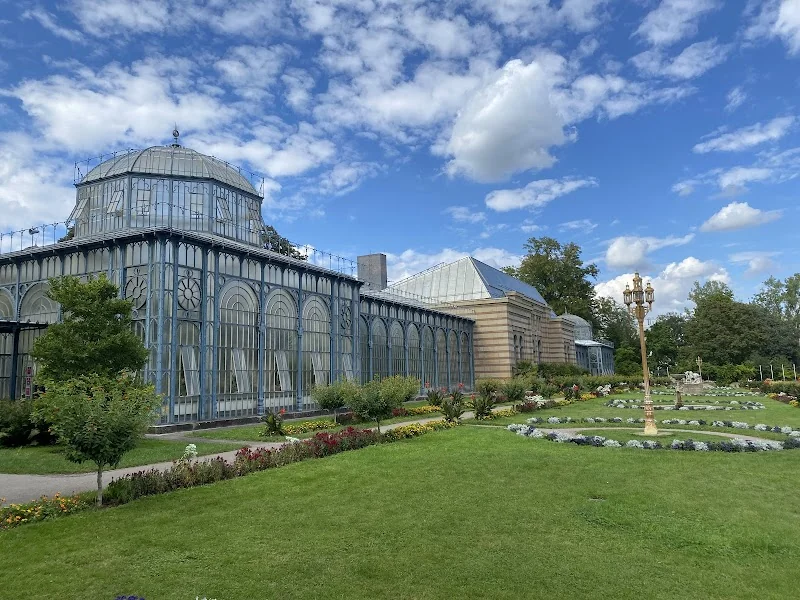
The historic buildings and the park landscape give the Wilhelma its distinctive character. The official description points out that the facility extends over approximately 30 hectares and is part of a contiguous green belt known as the Green U in Stuttgart. The defining buildings include the Moorish country house, the Moorish festival hall, the belvedere, and the Damascene hall. The belvedere particularly represents the representative view over the city and the landscape, while the Damascene hall is the only historical building structure that survived the war unscathed. This mix of preserved, rebuilt, and newly used buildings explains why the Wilhelma is in high demand not only as a zoo but also as a historical site. Those searching for photos of the Wilhelma are often looking for this visual connection of plants, water features, Moorish architecture, and generous sight lines. ([wilhelma.de](https://www.wilhelma.de/entdecken/park/historische-gebaeude))
Zoo, Botanical Garden, and Special Houses
The Wilhelma is fundamentally a scientifically managed zoo with a botanical focus. According to its official self-description, around 11,000 animals from about 1,200 species live there, distributed across 16 territories, including a hospital and quarantine station. The collection includes mammals, birds, fish, reptiles, amphibians, and invertebrates. Additionally, it participates in international conservation breeding programs: The Wilhelma manages 58 animal species as part of the European Endangered Species Program, participates in European Studbooks and International Studbooks, and regularly engages in EAZA campaigns. Particularly relevant for families and school classes is also environmental education: Annually, the Wilhelma organizes around 700 guided tours for school classes and supplements the offer with workshops, holiday programs, action days, and children's birthdays. Thus, the visit becomes not only an outing but also a learning place where animal husbandry, species protection, and research visibly come together. ([wilhelma.de](https://www.wilhelma.de/ueber-uns/die-wilhelma))
Botanically, the Wilhelma is also exceptionally well positioned. The botany department manages the display greenhouses, the water lily basin in the Moorish garden, and the summer planting of the historic subtropical terraces. Behind the scenes, around 6,000 square meters of display greenhouse area face about 5,000 square meters of cultivation area. Over 8,500 predominantly tropical and subtropical plant species and varieties are cultivated, and nearly 90,000 decorative and seasonal plants are grown annually. The scientific structure of the collections is particularly valuable: The plants are categorized into display, collection, and decorative plants, and there are twelve special plant collections. This very mix of botany, design, and research makes the Wilhelma a place where flowers, palms, ferns, and tropical plants are not just decorative but part of a living scientific concept. Those searching for wilhelma dark area or Wilhelma photos often end up in the indoor areas, the greenhouses, and the highly atmospheric transitions between light, shadow, and glass architecture. ([wilhelma.de](https://www.wilhelma.de/en/about-us/about-us/about-wilhelma))
Among the popular indoor areas is the aquarium and terrarium, which the Wilhelma describes as a journey from the North Sea to the Pacific. The house is divided into three parts: a northern area for aquatic animals of the temperate zone, a southern part for tropical freshwater fish and reef dwellers, and terrariums with lizards, snakes, and frogs in the middle, leading to the crocodile hall. The insectarium is also one of the park's highlights: In three rooms, there are insights into the world of small invertebrates, and the house was newly opened in 2002 after a first insectarium existed in 1979. Newer facilities include Terra Australis, the Amazon house, and modern large terrariums that show how consistently the Wilhelma continues to develop its animal and plant worlds. These houses explain why the Wilhelma functions not only as a walking park but also as a weather-independent destination. ([wilhelma.de](https://www.wilhelma.de/entdecken/park/themenwelt-detailansicht/aquarium-und-terrarium?utm_source=openai))
Annual Pass, Wilhelma Talks, and Family Offers
Those who visit the Wilhelma more often should seriously consider the annual pass. The official price list shows that the annual pass for adults costs 78.00 euros, for children and teenagers 29.00 euros, and for partners, seniors, and people with disabilities 61.00 euros. Since day tickets in the summer rate already cost 23.00 euros, the annual pass can be worthwhile after just a few visits, especially for families from Stuttgart and the region. Additionally, there is the practical advantage that one does not have to bind the visit to a single long day but can visit in smaller stages repeatedly. This is particularly helpful for families with children, as animals, greenhouses, and breaks can then be better distributed. The Wilhelma also thinks about this visiting mode organizationally, as the park map is available for free at the entrances and shows the most important stations from favorite animals to greenhouses, restaurants, and playgrounds. ([wilhelma.de](https://www.wilhelma.de/besuch/informationen/preise))
The Wilhelma also offers a wide range of additional offers. The website mentions Wilhelma Talks, free guided tours, Wild Weekends, special exhibitions, and the Wilhelma School. The Wilhelma Talks are particularly useful if one wants to experience the visit not just as a walk but as a guided discovery: staff provide interesting information about animals, plants, and the historic park. This is an attractive added value, especially for families, school classes, and interested adults, as questions can be clarified directly on-site. Additional offers include children's birthdays, exclusive tours, and seasonal events. Those who take the search for wilhelma stuttgart prices or wilhelma annual pass seriously should therefore not only look at the ticket costs but also include the additional learning and experience offers. Because the visit to the Wilhelma is not just a zoo admission but often a whole day of nature experience, education, and architecture. ([live.wilhelma.de](https://live.wilhelma.de/besuch/informationen/parkordnung))
Photos, Park Rules, and Relaxed Visits
For the search query wilhelma photos, the official park rules are particularly helpful as they clearly state what is allowed. Private photography and filming of original Wilhelma motifs is permitted from the paths; thus, anyone wanting to capture animals, plants, buildings, and facilities for personal use can generally do so. However, a separate permit is required for commercial use. At the same time, the park rules make it clear why the Wilhelma appears so orderly and well-kept: barriers may not be crossed, animals may not be touched or fed, plants may not be damaged, and climbing trees or entering water basins is not allowed. These rules are not just formal requirements but directly contribute to making the visit safe and pleasant for everyone. Those traveling with children particularly benefit from this, as clear paths and understandable rules reduce stress and facilitate orientation. ([live.wilhelma.de](https://live.wilhelma.de/besuch/informationen/parkordnung))
For a relaxed visit, families and first-time visitors should also be aware of the practical limitations of the facility. Dogs and other animals are generally not allowed, except for assistance dogs. Bicycles, scooters, inline skates, skateboards, and similar wheeled devices are also prohibited; an exception only applies to some child-friendly aids and walking aids. In return, the Wilhelma offers wheelchair-accessible restrooms at several locations, changing facilities, and charging stations for electric wheelchairs. This makes the stay easier for people with limited mobility as well as for families with small children. When these hints are combined with the seasonal opening hours, the park map, and the ticket options, it quickly becomes clear why the Wilhelma is so frequently searched: The visit is planable, versatile, and well organized for different needs. This very mix of nature, history, rules, and service makes the Wilhelma one of the most exciting destinations in Stuttgart. ([wilhelma.de](https://www.wilhelma.de/besuch/orientierung/wilhelma-barrierearm))
Sources:
Show moreShow less
Wilhelma | Opening Hours & Online Tickets
The Wilhelma in Stuttgart is much more than a classic zoo: it combines zoological diversity, botanical collections, and a historic park into a destination that holds a special place in Germany. The state-run facility describes itself as the only zoological-botanical garden in the country and one of the most species-rich zoos in the world; at the same time, the site, with over 1.8 million visitors per year, is one of the most popular leisure destinations in Baden-Württemberg. Those who visit the Wilhelma experience not only animals and plants but also architecture, garden art, and an extraordinary park landscape with a rich history. This very mix makes the searches around Wilhelma Stuttgart, tickets, prices, opening hours, and photos so relevant: visitors want to know not only when the park is open but also how to best plan their visit and which highlights are truly worth seeing. ([wilhelma.de](https://www.wilhelma.de/ueber-uns/die-wilhelma))
Opening Hours, Admission Prices, and Online Tickets
Those searching for wilhelma opening hours will find clear and up-to-date information on the official site: The Wilhelma is open every day of the year, with entry starting at 8:15 AM. During the summer months from May to August, the park remains open until 8:00 PM; in autumn and winter, the hours shorten depending on the season. Important for planning is also that the main ticket counters close at 4:00 PM, and in winter already at 3:30 PM. After that, day tickets can still be purchased at the machines, but annual tickets are only available directly at the counters. For many visitors, this is a crucial point, as spontaneous evening visits and online ticket purchases can be better coordinated with the day's schedule. Therefore, especially in good weather and on weekends, an early look at the ticket page and the seasonal times is advisable, so that the visit can start in a relaxed manner. ([wilhelma.de](https://www.wilhelma.de/besuch/informationen/oeffnungszeiten))
The pricing structure is family-friendly but tiered according to age and target groups. In the summer rate, day tickets for adults cost 23.00 euros, for students and pupils aged 18 to 28 years 15.00 euros, and for children and teenagers aged 6 to 17 years 9.00 euros; children under 6 years have free admission. Family tickets are also available: For Family I with one parent and children up to 17 years, the price is 29.00 euros, for Family II with both parents and children up to 17 years it is 48.00 euros. The annual ticket for adults costs 78.00 euros, reduced annual tickets for partners, seniors, and people with disabilities are 61.00 euros, and for children and teenagers, it is 29.00 euros. Additionally, the Wilhelma points out a conservation euro, which is voluntary and amounts to 1 euro per adult for day tickets or 3 euros for annual tickets. Those who buy wilhelma tickets online can save on summer tickets, as the website explicitly states that online tickets are cheaper than tickets at the counter. ([wilhelma.de](https://www.wilhelma.de/besuch/informationen/preise))
Directions, Parking Garage, and Barrier-Free Paths
When searching for wilhelma parking garage or Wilhelma directions, the official parking garage is the most important point of contact. It is located on Neckartalstraße in close proximity to the main entrance, is open continuously, and offers 800 parking spaces. Vehicles up to a height of two meters can be parked there. The price is clearly regulated: 8 euros for the whole day or 5 euros for a parking duration of up to 3 hours. Those arriving by car thus have a planable solution right at the destination, but especially on weekends, public holidays, and during school vacations, one must expect that the parking garage can fill up quickly. Therefore, the Wilhelma recommends arriving early if possible or using alternative parking garages in the vicinity. These include Mühlgrün with about 700 meters of walking along the Neckar, König-Karl-Passage with about 750 meters, Wilhelmsplatz/Bad Cannstatt with about 950 meters, and the Mahle parking garage, which is only open on weekends and public holidays as needed. For visitors who want to plan their arrival comfortably, these alternatives are particularly practical. ([wilhelma.de](https://www.wilhelma.de/besuch/orientierung/anfahrt-parken))
Barrier-free mobility is a topic in the Wilhelma because the historic site is topographically challenging. The official site explains that many paths are walkable and drivable, although some areas remain limited due to stairs or inclines. There is a recommended stair-free circular route marked on the fold-out map, which is also available for free at the entrance upon request. Wheelchair-accessible parking spaces are located in the parking garage, and from the ground floor, one can reach the main entrance without stairs. A wheelchair can also be borrowed for free at the park supervision if an ID is left; the number is limited, and a short pre-registration is possible. It is also important to note that the turnstile at the Rosensteinpark entrance is not suitable for wheelchairs or strollers and that this entrance has been closed since September 2025 due to construction work. Therefore, those traveling with strollers, walking aids, or assistance dogs should particularly keep an eye on the main entrance on Neckartalstraße. ([wilhelma.de](https://www.wilhelma.de/besuch/orientierung/wilhelma-barrierearm))
History of the Wilhelma and its Historic Park
The historical development of the Wilhelma is one of the reasons why the search phrase wilhelma theater makes as much sense as wilhelma stuttgart prices or photos. It all began in the 1820s when the royal household acquired the area below the Neckar slope, where the Rosensteinpark was created. After its completion in 1829, mineral springs were discovered, after which King Wilhelm I of Württemberg wanted to transform the pure park into a wellness facility with a bathhouse. This project gradually developed into the historic part of today's Wilhelma. Even in the early planning phase, there was talk of a theater for royal entertainment, and arcades, greenhouses, and other buildings in the Moorish style were created. The architect Karl Ludwig von Zanth significantly shaped the style and design. In 1837 he received the planning commission, construction of the first building began around 1842, and in 1846 the Wilhelma was ceremoniously inaugurated on the occasion of the wedding of Crown Prince Karl with Olga Nikolajewna. ([wilhelma.de](https://www.wilhelma.de/entdecken/park/geschichte))
The history continued in the following decades: In 1851, the Moorish festival hall was completed, in 1853 the core area with gallery building and winter garden was finished, and in 1864 finally the Damascene hall. It was not until 1880 that the Wilhelma became accessible to a larger audience, after it had previously been reserved mainly for the royal family. In 1919 it became state property and was continued as a botanical showcase garden; with the end of the monarchy, the park facilities were finally opened to the Stuttgart population. In World War II, large parts of the facility were heavily damaged in 1944, but in 1949 the Wilhelma reopened for guests. From the exhibition with African savanna animals and Indian jungle animals, the zoological part developed in the early 1950s, and since 1952 the Wilhelma has officially been a zoological-botanical garden. Today, those strolling through the historic park see not only a green facility but a grown ensemble of garden art, reconstruction, architecture, and public cultural history. ([wilhelma.de](https://www.wilhelma.de/entdecken/park/geschichte))
The historic buildings and the park landscape give the Wilhelma its distinctive character. The official description points out that the facility extends over approximately 30 hectares and is part of a contiguous green belt known as the Green U in Stuttgart. The defining buildings include the Moorish country house, the Moorish festival hall, the belvedere, and the Damascene hall. The belvedere particularly represents the representative view over the city and the landscape, while the Damascene hall is the only historical building structure that survived the war unscathed. This mix of preserved, rebuilt, and newly used buildings explains why the Wilhelma is in high demand not only as a zoo but also as a historical site. Those searching for photos of the Wilhelma are often looking for this visual connection of plants, water features, Moorish architecture, and generous sight lines. ([wilhelma.de](https://www.wilhelma.de/entdecken/park/historische-gebaeude))
Zoo, Botanical Garden, and Special Houses
The Wilhelma is fundamentally a scientifically managed zoo with a botanical focus. According to its official self-description, around 11,000 animals from about 1,200 species live there, distributed across 16 territories, including a hospital and quarantine station. The collection includes mammals, birds, fish, reptiles, amphibians, and invertebrates. Additionally, it participates in international conservation breeding programs: The Wilhelma manages 58 animal species as part of the European Endangered Species Program, participates in European Studbooks and International Studbooks, and regularly engages in EAZA campaigns. Particularly relevant for families and school classes is also environmental education: Annually, the Wilhelma organizes around 700 guided tours for school classes and supplements the offer with workshops, holiday programs, action days, and children's birthdays. Thus, the visit becomes not only an outing but also a learning place where animal husbandry, species protection, and research visibly come together. ([wilhelma.de](https://www.wilhelma.de/ueber-uns/die-wilhelma))
Botanically, the Wilhelma is also exceptionally well positioned. The botany department manages the display greenhouses, the water lily basin in the Moorish garden, and the summer planting of the historic subtropical terraces. Behind the scenes, around 6,000 square meters of display greenhouse area face about 5,000 square meters of cultivation area. Over 8,500 predominantly tropical and subtropical plant species and varieties are cultivated, and nearly 90,000 decorative and seasonal plants are grown annually. The scientific structure of the collections is particularly valuable: The plants are categorized into display, collection, and decorative plants, and there are twelve special plant collections. This very mix of botany, design, and research makes the Wilhelma a place where flowers, palms, ferns, and tropical plants are not just decorative but part of a living scientific concept. Those searching for wilhelma dark area or Wilhelma photos often end up in the indoor areas, the greenhouses, and the highly atmospheric transitions between light, shadow, and glass architecture. ([wilhelma.de](https://www.wilhelma.de/en/about-us/about-us/about-wilhelma))
Among the popular indoor areas is the aquarium and terrarium, which the Wilhelma describes as a journey from the North Sea to the Pacific. The house is divided into three parts: a northern area for aquatic animals of the temperate zone, a southern part for tropical freshwater fish and reef dwellers, and terrariums with lizards, snakes, and frogs in the middle, leading to the crocodile hall. The insectarium is also one of the park's highlights: In three rooms, there are insights into the world of small invertebrates, and the house was newly opened in 2002 after a first insectarium existed in 1979. Newer facilities include Terra Australis, the Amazon house, and modern large terrariums that show how consistently the Wilhelma continues to develop its animal and plant worlds. These houses explain why the Wilhelma functions not only as a walking park but also as a weather-independent destination. ([wilhelma.de](https://www.wilhelma.de/entdecken/park/themenwelt-detailansicht/aquarium-und-terrarium?utm_source=openai))
Annual Pass, Wilhelma Talks, and Family Offers
Those who visit the Wilhelma more often should seriously consider the annual pass. The official price list shows that the annual pass for adults costs 78.00 euros, for children and teenagers 29.00 euros, and for partners, seniors, and people with disabilities 61.00 euros. Since day tickets in the summer rate already cost 23.00 euros, the annual pass can be worthwhile after just a few visits, especially for families from Stuttgart and the region. Additionally, there is the practical advantage that one does not have to bind the visit to a single long day but can visit in smaller stages repeatedly. This is particularly helpful for families with children, as animals, greenhouses, and breaks can then be better distributed. The Wilhelma also thinks about this visiting mode organizationally, as the park map is available for free at the entrances and shows the most important stations from favorite animals to greenhouses, restaurants, and playgrounds. ([wilhelma.de](https://www.wilhelma.de/besuch/informationen/preise))
The Wilhelma also offers a wide range of additional offers. The website mentions Wilhelma Talks, free guided tours, Wild Weekends, special exhibitions, and the Wilhelma School. The Wilhelma Talks are particularly useful if one wants to experience the visit not just as a walk but as a guided discovery: staff provide interesting information about animals, plants, and the historic park. This is an attractive added value, especially for families, school classes, and interested adults, as questions can be clarified directly on-site. Additional offers include children's birthdays, exclusive tours, and seasonal events. Those who take the search for wilhelma stuttgart prices or wilhelma annual pass seriously should therefore not only look at the ticket costs but also include the additional learning and experience offers. Because the visit to the Wilhelma is not just a zoo admission but often a whole day of nature experience, education, and architecture. ([live.wilhelma.de](https://live.wilhelma.de/besuch/informationen/parkordnung))
Photos, Park Rules, and Relaxed Visits
For the search query wilhelma photos, the official park rules are particularly helpful as they clearly state what is allowed. Private photography and filming of original Wilhelma motifs is permitted from the paths; thus, anyone wanting to capture animals, plants, buildings, and facilities for personal use can generally do so. However, a separate permit is required for commercial use. At the same time, the park rules make it clear why the Wilhelma appears so orderly and well-kept: barriers may not be crossed, animals may not be touched or fed, plants may not be damaged, and climbing trees or entering water basins is not allowed. These rules are not just formal requirements but directly contribute to making the visit safe and pleasant for everyone. Those traveling with children particularly benefit from this, as clear paths and understandable rules reduce stress and facilitate orientation. ([live.wilhelma.de](https://live.wilhelma.de/besuch/informationen/parkordnung))
For a relaxed visit, families and first-time visitors should also be aware of the practical limitations of the facility. Dogs and other animals are generally not allowed, except for assistance dogs. Bicycles, scooters, inline skates, skateboards, and similar wheeled devices are also prohibited; an exception only applies to some child-friendly aids and walking aids. In return, the Wilhelma offers wheelchair-accessible restrooms at several locations, changing facilities, and charging stations for electric wheelchairs. This makes the stay easier for people with limited mobility as well as for families with small children. When these hints are combined with the seasonal opening hours, the park map, and the ticket options, it quickly becomes clear why the Wilhelma is so frequently searched: The visit is planable, versatile, and well organized for different needs. This very mix of nature, history, rules, and service makes the Wilhelma one of the most exciting destinations in Stuttgart. ([wilhelma.de](https://www.wilhelma.de/besuch/orientierung/wilhelma-barrierearm))
Sources:
Wilhelma | Opening Hours & Online Tickets
The Wilhelma in Stuttgart is much more than a classic zoo: it combines zoological diversity, botanical collections, and a historic park into a destination that holds a special place in Germany. The state-run facility describes itself as the only zoological-botanical garden in the country and one of the most species-rich zoos in the world; at the same time, the site, with over 1.8 million visitors per year, is one of the most popular leisure destinations in Baden-Württemberg. Those who visit the Wilhelma experience not only animals and plants but also architecture, garden art, and an extraordinary park landscape with a rich history. This very mix makes the searches around Wilhelma Stuttgart, tickets, prices, opening hours, and photos so relevant: visitors want to know not only when the park is open but also how to best plan their visit and which highlights are truly worth seeing. ([wilhelma.de](https://www.wilhelma.de/ueber-uns/die-wilhelma))
Opening Hours, Admission Prices, and Online Tickets
Those searching for wilhelma opening hours will find clear and up-to-date information on the official site: The Wilhelma is open every day of the year, with entry starting at 8:15 AM. During the summer months from May to August, the park remains open until 8:00 PM; in autumn and winter, the hours shorten depending on the season. Important for planning is also that the main ticket counters close at 4:00 PM, and in winter already at 3:30 PM. After that, day tickets can still be purchased at the machines, but annual tickets are only available directly at the counters. For many visitors, this is a crucial point, as spontaneous evening visits and online ticket purchases can be better coordinated with the day's schedule. Therefore, especially in good weather and on weekends, an early look at the ticket page and the seasonal times is advisable, so that the visit can start in a relaxed manner. ([wilhelma.de](https://www.wilhelma.de/besuch/informationen/oeffnungszeiten))
The pricing structure is family-friendly but tiered according to age and target groups. In the summer rate, day tickets for adults cost 23.00 euros, for students and pupils aged 18 to 28 years 15.00 euros, and for children and teenagers aged 6 to 17 years 9.00 euros; children under 6 years have free admission. Family tickets are also available: For Family I with one parent and children up to 17 years, the price is 29.00 euros, for Family II with both parents and children up to 17 years it is 48.00 euros. The annual ticket for adults costs 78.00 euros, reduced annual tickets for partners, seniors, and people with disabilities are 61.00 euros, and for children and teenagers, it is 29.00 euros. Additionally, the Wilhelma points out a conservation euro, which is voluntary and amounts to 1 euro per adult for day tickets or 3 euros for annual tickets. Those who buy wilhelma tickets online can save on summer tickets, as the website explicitly states that online tickets are cheaper than tickets at the counter. ([wilhelma.de](https://www.wilhelma.de/besuch/informationen/preise))
Directions, Parking Garage, and Barrier-Free Paths
When searching for wilhelma parking garage or Wilhelma directions, the official parking garage is the most important point of contact. It is located on Neckartalstraße in close proximity to the main entrance, is open continuously, and offers 800 parking spaces. Vehicles up to a height of two meters can be parked there. The price is clearly regulated: 8 euros for the whole day or 5 euros for a parking duration of up to 3 hours. Those arriving by car thus have a planable solution right at the destination, but especially on weekends, public holidays, and during school vacations, one must expect that the parking garage can fill up quickly. Therefore, the Wilhelma recommends arriving early if possible or using alternative parking garages in the vicinity. These include Mühlgrün with about 700 meters of walking along the Neckar, König-Karl-Passage with about 750 meters, Wilhelmsplatz/Bad Cannstatt with about 950 meters, and the Mahle parking garage, which is only open on weekends and public holidays as needed. For visitors who want to plan their arrival comfortably, these alternatives are particularly practical. ([wilhelma.de](https://www.wilhelma.de/besuch/orientierung/anfahrt-parken))
Barrier-free mobility is a topic in the Wilhelma because the historic site is topographically challenging. The official site explains that many paths are walkable and drivable, although some areas remain limited due to stairs or inclines. There is a recommended stair-free circular route marked on the fold-out map, which is also available for free at the entrance upon request. Wheelchair-accessible parking spaces are located in the parking garage, and from the ground floor, one can reach the main entrance without stairs. A wheelchair can also be borrowed for free at the park supervision if an ID is left; the number is limited, and a short pre-registration is possible. It is also important to note that the turnstile at the Rosensteinpark entrance is not suitable for wheelchairs or strollers and that this entrance has been closed since September 2025 due to construction work. Therefore, those traveling with strollers, walking aids, or assistance dogs should particularly keep an eye on the main entrance on Neckartalstraße. ([wilhelma.de](https://www.wilhelma.de/besuch/orientierung/wilhelma-barrierearm))
History of the Wilhelma and its Historic Park
The historical development of the Wilhelma is one of the reasons why the search phrase wilhelma theater makes as much sense as wilhelma stuttgart prices or photos. It all began in the 1820s when the royal household acquired the area below the Neckar slope, where the Rosensteinpark was created. After its completion in 1829, mineral springs were discovered, after which King Wilhelm I of Württemberg wanted to transform the pure park into a wellness facility with a bathhouse. This project gradually developed into the historic part of today's Wilhelma. Even in the early planning phase, there was talk of a theater for royal entertainment, and arcades, greenhouses, and other buildings in the Moorish style were created. The architect Karl Ludwig von Zanth significantly shaped the style and design. In 1837 he received the planning commission, construction of the first building began around 1842, and in 1846 the Wilhelma was ceremoniously inaugurated on the occasion of the wedding of Crown Prince Karl with Olga Nikolajewna. ([wilhelma.de](https://www.wilhelma.de/entdecken/park/geschichte))
The history continued in the following decades: In 1851, the Moorish festival hall was completed, in 1853 the core area with gallery building and winter garden was finished, and in 1864 finally the Damascene hall. It was not until 1880 that the Wilhelma became accessible to a larger audience, after it had previously been reserved mainly for the royal family. In 1919 it became state property and was continued as a botanical showcase garden; with the end of the monarchy, the park facilities were finally opened to the Stuttgart population. In World War II, large parts of the facility were heavily damaged in 1944, but in 1949 the Wilhelma reopened for guests. From the exhibition with African savanna animals and Indian jungle animals, the zoological part developed in the early 1950s, and since 1952 the Wilhelma has officially been a zoological-botanical garden. Today, those strolling through the historic park see not only a green facility but a grown ensemble of garden art, reconstruction, architecture, and public cultural history. ([wilhelma.de](https://www.wilhelma.de/entdecken/park/geschichte))
The historic buildings and the park landscape give the Wilhelma its distinctive character. The official description points out that the facility extends over approximately 30 hectares and is part of a contiguous green belt known as the Green U in Stuttgart. The defining buildings include the Moorish country house, the Moorish festival hall, the belvedere, and the Damascene hall. The belvedere particularly represents the representative view over the city and the landscape, while the Damascene hall is the only historical building structure that survived the war unscathed. This mix of preserved, rebuilt, and newly used buildings explains why the Wilhelma is in high demand not only as a zoo but also as a historical site. Those searching for photos of the Wilhelma are often looking for this visual connection of plants, water features, Moorish architecture, and generous sight lines. ([wilhelma.de](https://www.wilhelma.de/entdecken/park/historische-gebaeude))
Zoo, Botanical Garden, and Special Houses
The Wilhelma is fundamentally a scientifically managed zoo with a botanical focus. According to its official self-description, around 11,000 animals from about 1,200 species live there, distributed across 16 territories, including a hospital and quarantine station. The collection includes mammals, birds, fish, reptiles, amphibians, and invertebrates. Additionally, it participates in international conservation breeding programs: The Wilhelma manages 58 animal species as part of the European Endangered Species Program, participates in European Studbooks and International Studbooks, and regularly engages in EAZA campaigns. Particularly relevant for families and school classes is also environmental education: Annually, the Wilhelma organizes around 700 guided tours for school classes and supplements the offer with workshops, holiday programs, action days, and children's birthdays. Thus, the visit becomes not only an outing but also a learning place where animal husbandry, species protection, and research visibly come together. ([wilhelma.de](https://www.wilhelma.de/ueber-uns/die-wilhelma))
Botanically, the Wilhelma is also exceptionally well positioned. The botany department manages the display greenhouses, the water lily basin in the Moorish garden, and the summer planting of the historic subtropical terraces. Behind the scenes, around 6,000 square meters of display greenhouse area face about 5,000 square meters of cultivation area. Over 8,500 predominantly tropical and subtropical plant species and varieties are cultivated, and nearly 90,000 decorative and seasonal plants are grown annually. The scientific structure of the collections is particularly valuable: The plants are categorized into display, collection, and decorative plants, and there are twelve special plant collections. This very mix of botany, design, and research makes the Wilhelma a place where flowers, palms, ferns, and tropical plants are not just decorative but part of a living scientific concept. Those searching for wilhelma dark area or Wilhelma photos often end up in the indoor areas, the greenhouses, and the highly atmospheric transitions between light, shadow, and glass architecture. ([wilhelma.de](https://www.wilhelma.de/en/about-us/about-us/about-wilhelma))
Among the popular indoor areas is the aquarium and terrarium, which the Wilhelma describes as a journey from the North Sea to the Pacific. The house is divided into three parts: a northern area for aquatic animals of the temperate zone, a southern part for tropical freshwater fish and reef dwellers, and terrariums with lizards, snakes, and frogs in the middle, leading to the crocodile hall. The insectarium is also one of the park's highlights: In three rooms, there are insights into the world of small invertebrates, and the house was newly opened in 2002 after a first insectarium existed in 1979. Newer facilities include Terra Australis, the Amazon house, and modern large terrariums that show how consistently the Wilhelma continues to develop its animal and plant worlds. These houses explain why the Wilhelma functions not only as a walking park but also as a weather-independent destination. ([wilhelma.de](https://www.wilhelma.de/entdecken/park/themenwelt-detailansicht/aquarium-und-terrarium?utm_source=openai))
Annual Pass, Wilhelma Talks, and Family Offers
Those who visit the Wilhelma more often should seriously consider the annual pass. The official price list shows that the annual pass for adults costs 78.00 euros, for children and teenagers 29.00 euros, and for partners, seniors, and people with disabilities 61.00 euros. Since day tickets in the summer rate already cost 23.00 euros, the annual pass can be worthwhile after just a few visits, especially for families from Stuttgart and the region. Additionally, there is the practical advantage that one does not have to bind the visit to a single long day but can visit in smaller stages repeatedly. This is particularly helpful for families with children, as animals, greenhouses, and breaks can then be better distributed. The Wilhelma also thinks about this visiting mode organizationally, as the park map is available for free at the entrances and shows the most important stations from favorite animals to greenhouses, restaurants, and playgrounds. ([wilhelma.de](https://www.wilhelma.de/besuch/informationen/preise))
The Wilhelma also offers a wide range of additional offers. The website mentions Wilhelma Talks, free guided tours, Wild Weekends, special exhibitions, and the Wilhelma School. The Wilhelma Talks are particularly useful if one wants to experience the visit not just as a walk but as a guided discovery: staff provide interesting information about animals, plants, and the historic park. This is an attractive added value, especially for families, school classes, and interested adults, as questions can be clarified directly on-site. Additional offers include children's birthdays, exclusive tours, and seasonal events. Those who take the search for wilhelma stuttgart prices or wilhelma annual pass seriously should therefore not only look at the ticket costs but also include the additional learning and experience offers. Because the visit to the Wilhelma is not just a zoo admission but often a whole day of nature experience, education, and architecture. ([live.wilhelma.de](https://live.wilhelma.de/besuch/informationen/parkordnung))
Photos, Park Rules, and Relaxed Visits
For the search query wilhelma photos, the official park rules are particularly helpful as they clearly state what is allowed. Private photography and filming of original Wilhelma motifs is permitted from the paths; thus, anyone wanting to capture animals, plants, buildings, and facilities for personal use can generally do so. However, a separate permit is required for commercial use. At the same time, the park rules make it clear why the Wilhelma appears so orderly and well-kept: barriers may not be crossed, animals may not be touched or fed, plants may not be damaged, and climbing trees or entering water basins is not allowed. These rules are not just formal requirements but directly contribute to making the visit safe and pleasant for everyone. Those traveling with children particularly benefit from this, as clear paths and understandable rules reduce stress and facilitate orientation. ([live.wilhelma.de](https://live.wilhelma.de/besuch/informationen/parkordnung))
For a relaxed visit, families and first-time visitors should also be aware of the practical limitations of the facility. Dogs and other animals are generally not allowed, except for assistance dogs. Bicycles, scooters, inline skates, skateboards, and similar wheeled devices are also prohibited; an exception only applies to some child-friendly aids and walking aids. In return, the Wilhelma offers wheelchair-accessible restrooms at several locations, changing facilities, and charging stations for electric wheelchairs. This makes the stay easier for people with limited mobility as well as for families with small children. When these hints are combined with the seasonal opening hours, the park map, and the ticket options, it quickly becomes clear why the Wilhelma is so frequently searched: The visit is planable, versatile, and well organized for different needs. This very mix of nature, history, rules, and service makes the Wilhelma one of the most exciting destinations in Stuttgart. ([wilhelma.de](https://www.wilhelma.de/besuch/orientierung/wilhelma-barrierearm))
Sources:
Frequently Asked Questions
Reviews
Utku Ozan ÇANKAYA
19. January 2026
A very large place with animals and plants across the globe. There are some extinct plants as well. Unfortunately due to winter conditions, some of the animals were in their shelters and I suggest a visit in a warmer season. It is so large that you might want to spare a whole day to see everything.
Teodor Ovcharov
13. December 2025
Very nice botanical garden and I loved the aquarium world as well! The zoo is also very nice, although we didn't have enough time to see the whole of it, because in winter it closes at 4:30 PM and we entered around 2 PM. But! We were there also for the Christmas Garden event and oh boy was it beautiful and well organized! Awesome lighting and sound, also many booths to get hot wine and food, very pleasant experience all together, would definitely recommend checking it out!
Alan Torres Dwyer
1. October 2025
This is likely one of the most aesthetically pleasing zoos and botanical gardens I have ever visited, proudly wearing its history on its sleeve. Even though some of the enclosures could do with some improvements, in general it's a very well-kept collection of amazing animals; while the big crowd pleasers, like big cats, bears, great apes, pachyderms and crocodiles are certainly a big draw, their collection of birds is absolutely jaw-dropping, in terms of how many rare species there are to find. Should you visit Stuttgart, do not miss this lovely park!
Micu Valentin
13. November 2025
Wilhelma is an absolute must-visit and a stellar example of modern zoological care! From the moment you step inside, the entire park feels incredibly well maintained—a truly pristine environment. The focus on animal welfare is clear; the complex features very good, spacious animal sanctuaries that clearly contribute to happy animals throughout the exhibits. It's truly heartwarming to see the dedication of the staff, and it’s obvious there are a lot of workers enjoying their job, which adds to the positive atmosphere. A fantastic, ethical, and beautiful day out!
Tobiasz Marcjanik
20. November 2025
A definitively magical and beautiful place with both elements of botanical and zoological garden. Truly a timeless experience full of joy, surprises and inspiration on every step. Even though it takes me more than 4 hours to get there from Hanau, the time is well worth it and I will be coming back.