
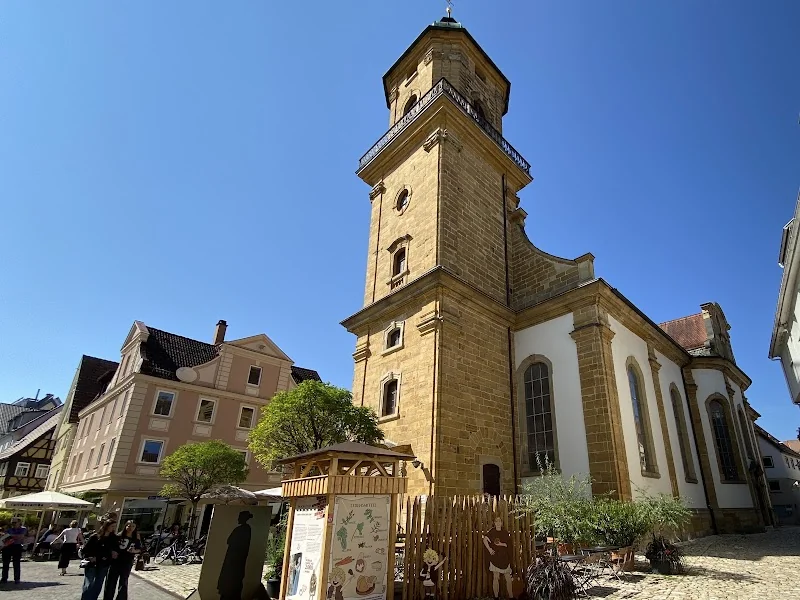
Alter Kirchpl. 1, Aalen
Alter Kirchpl. 1, 73430 Aalen, Germany
City Church St. Nicholas Aalen | History & Parking
The City Church St. Nicholas in Aalen is much more than a striking sacred building in the center of the city. It is a place where city history, faith, music, and architecture converge in a small space. Approaching the church from the Old Church Square, one stands in the historical and present heart of Aalen: in the pedestrian zone, between urban life, ecclesiastical tradition, and cultural presence. This connection makes the City Church one of the defining places in the city. As the main church of the church district and as the mother church among the places of worship in Aalen, it is not only religiously significant but also a visible sign of the long development of the city. What is special is not only its function but also its form: The baroque transverse church with its unusual spatial order, the artworks inside, and the vibrant church music give the City Church a character that clearly distinguishes it from many other church buildings. Visitors experience here not a quiet museum but a lively place where services, concerts, tours, and special occasions regularly take place. Thus, the City Church is a destination for people seeking history, for music lovers who appreciate a strong sound, and for all who want to get to know Aalen from its culturally significant side. ([ev-aa.de](https://www.ev-aa.de/wir-%C3%BCber-uns/stadtkirche/))
The History of the City Church St. Nicholas in Aalen
The history of the City Church goes back a long way. The Catholic parish church St. Nicholas is first mentioned in Aalen in 1340 and is thus one of the oldest ecclesiastical reference points in the city. At the latest with the great city fire of 1634, however, the development of the building took a dramatic turn, as the parish church fell victim to the fire and was only hastily rebuilt afterwards. This phase already shows how closely the fate of the church is linked to the history of Aalen: Every major cut in the city's history left significant traces at the church square. Particularly significant was May 28, 1765, when the tower of the predecessor building collapsed. From this loss, a completely new building emerged between 1765 and 1767, which still shapes the cityscape today. The city of Aalen and the Protestant congregation describe this new building as a baroque transverse church that emerged from the crisis as a distinctive new house of worship. This sequence of destruction, provisionality, collapse, and new beginning explains why the City Church is not just a religious building but a piece of city biography. Today, those standing in front of the building do not simply see a beautiful church but the result of a long history of loss, renewal, and urban self-confidence. This makes the City Church St. Nicholas a key place for all who want to understand how Aalen has developed over centuries. ([aalen.de](https://www.aalen.de/stadtkirche.34343.25.htm))
The emergence of the current baroque form is also remarkable. The city of Aalen points out that the baroque transverse layout represents a special architectural solution and is particularly worthwhile in the pedestrian zone. At the same time, the city describes the new building of 1767 as the design of the state master builder Johann Adam Groß. In other city representations, the transverse layout is also attributed to Johann Michael Keller, which makes the art-historical classification of the building even more interesting. Regardless of the individual attributions, it is clear: The building was created as a conscious reworking of a long-encumbered church site and received a form that is unusual for Protestant sacred architecture in Württemberg. The church is thus not merely a continuation building but a new beginning with a clear design claim. This is precisely what makes it appealing to visitors who want to think together about church building history, urban development, and religious identity. The City Church today symbolically stands for how Aalen has developed a strong center from a difficult past. This historical weight is palpable in the space and is one of the reasons why the church is still perceived so strongly today. ([aalen.de](https://www.aalen.de/stadtkirche.34343.25.htm))
Baroque Transverse Church, Art, and Spatial Effect
The City Church St. Nicholas is architecturally special because it was built as a baroque transverse church and thus possesses a spatial form that is rare in Protestant churches. The city of Aalen explicitly mentions the dimensions of 39 meters in length and 16 meters in width. However, more important than the external numbers is the internal order: altar, baptismal font, and pulpit are located in the center of the building. This creates a central church space where liturgy and architecture work together directly. This center defines the character of the space, as it directs the gaze not into a long nave but to the common center of the service. For visitors, this results in an unusually clear and almost theatrical spatial experience that clearly reveals the baroque ambition of the building. The Protestant congregation also describes the City Church as a showcase for the entire region. This fits well with this spatial effect, as the building is not only functional but also representative. Upon entering the church, one immediately perceives that simplicity in the sense of sobriety does not dominate here, but a consciously designed order in which art, light, and liturgical function come together. This focus on the center makes the City Church so exciting for architecture enthusiasts, art lovers, and those interested in church history. ([aalen.de](https://www.aalen.de/die-kulturdenkmaeler-aalens.236471.25.htm))
Several art-historical highlights add to this special spatial effect. The city of Aalen names the liturgical center, created by the Rococo artist Thomas Schaidhauf, as a central furnishing element. Additionally, there are the ceiling paintings by Anton Wintergerst, which depict the resurrection on the organ side, the ascension of Christ on the west side, and the Last Judgment in the center. This iconography deeply anchors the space in the baroque and early classical piety culture. The four sacristy windows depicting Martin Luther, Johannes Brenz, Jacob Andreae, and Johannes Preu are also among the remarkable details that make the City Church a place of high art-historical value. The Protestant congregation and the city tourism information also point to larger church music events that fill the building with sound and emphasize its acoustic effect. Thus, the space lives not only from its architectural form but from the connection of architecture, image program, and music. This is precisely what makes the City Church a building that one should not only look at but experience in peace. Those who take their time discover new details and understand why the church has become so formative for Aalen. ([aalen.de](https://www.aalen.de/die-kulturdenkmaeler-aalens.236471.25.htm))
The tower is also part of the special perception of the City Church. The city of Aalen states that it is 36 meters high and describes that from there, a choral is played in all four directions during the week at 6 PM, on Saturdays at 11:45 AM, and on holidays at 8:30 AM. This choral is played by the youth band of the Aalen music school. This is not just a detail but a strong sign of how much the City Church influences the everyday life of the city. When walking through the city center, one encounters it not only as a building but also as an acoustic landmark. The combination of tower height, centrally located transverse space, and baroque design makes the building a rarely clearly readable church space. In conjunction with the historic city center, the City Church almost acts as an architectural hub where perspectives converge. For this reason, even visitors without a church focus will find it worthwhile to take a closer look: The City Church is an example of how architecture can be more than just a shell. It gives the city a face, a sound, and a place of concentration. ([aalen.de](https://www.aalen.de/die-kulturdenkmaeler-aalens.236471.25.htm))
Church Music, Organ, and Events in the City Church
A significant part of the current impact of the City Church St. Nicholas is its role as a music venue. The Protestant congregation Aalen refers to it as the heart of the community and explicitly points to large church music events for a larger audience. Since its inauguration on Easter night 2009, the new Rieger organ has been sounding there. Thus, the City Church not only has a distinctive sacred space but also an instrument that has placed the musical use of the building on a modern foundation. In practice, this means: The City Church is not only the place for Sunday services but also a stage and resonance space for concert formats, choral music, and special church music. The current program for 2026 of the Protestant Church Music Aalen clearly shows how broad the spectrum is. Among other things, saxophone and organ are mentioned as the opening concert, violin sonatas with Bach and Biber, the hour of church music, Joseph Haydn's The Seven Last Words of Our Savior on the Cross, Rossini's Petite Messe solennelle, as well as performances of the Christmas Oratorio and other concert formats. The Aalener Bach Cycle series is also included. This diversity proves that the City Church is not only used musically at specific points but functions as a stable anchor for church cultural work throughout the year. ([ev-aa.de](https://www.ev-aa.de/wir-%C3%BCber-uns/stadtkirche/))
For the perception of the City Church, this is particularly important because here spiritual function and cultural openness reinforce each other. The Protestant congregation calls the church the main church of the church district and a showcase for the entire region. In this context, church music events gain greater significance than mere concerts: They carry the City Church far beyond the inner community context. The city tourism information also builds on this and offers special tours that focus exclusively on the Aalen City Church St. Nicholas in the heart of the old town. The fact that the building is experienced not only in worship but also in a cultural context makes a significant part of its profile. Particularly appealing is how the historic building is connected with contemporary musical life. The City Church is neither a frozen monument nor a mere concert building but a lively place where today's programs meet a centuries-old history. This mixture attracts people who want to not only consume a city but understand it. Those who want to experience music, space, and history together will find one of the most impressive places in Aalen in the City Church St. Nicholas. ([ev-aa.de](https://www.ev-aa.de/wir-%C3%BCber-uns/stadtkirche/))
Additionally, the city of Aalen and the Protestant Church Music Aalen actively make the place visible as a cultural and event space. The program for 2026 features not only large choral works but also formats that consciously address different target groups. This makes the City Church equally interesting for families, locals, regular guests, and cultural travelers. Those attending a concert experience the space from a different perspective than during a tour or a service. The interplay of acoustics, baroque architecture, and central church space ensures that the church always appears new in different uses. The historical substance provides the framework, and the music fills it with the present. For this reason, the City Church is an example of a successful connection between monument protection, community life, and cultural mediation. It shows how a historic church can remain relevant in the 21st century without losing its identity. The musical profile is thus not an addition but one of the most important reasons why the City Church St. Nicholas in Aalen is perceived so strongly. ([ev-aa.de](https://www.ev-aa.de/wir-%C3%BCber-uns/stadtkirche/))
Access, Parking, and Location in the Heart of the City Center
The location of the City Church St. Nicholas is a real advantage for visitors, as it is situated right in the middle of Aalen's city center. The city describes the church as a building in the pedestrian zone, located in close proximity to the most important city center areas. Those arriving by car benefit from Aalen's good connection to the regional road network: The federal highways 19 and 29 cross the city area, and the A7 is easily accessible via the Aalen/Westhausen and Aalen-South/Oberkochen exits. For the actual city center drive, the routes are manageable, as the city points out an intelligent parking guidance system that indicates available parking spaces nearby. This is particularly helpful when visiting not only the City Church but also other destinations in the city center. In practice, this means: The way to the church is short, orientation in the city is good, and the city center is set up for visitor traffic. This location is ideal for people who want to combine church visits, city strolls, and possibly a concert. The City Church is thus not located off the beaten path but at a point where church visits, cultural programs, and urban life can be well combined. ([aalen-tourismus.de](https://www.aalen-tourismus.de/anfahrt.179896.htm))
Parking in Aalen's city center is also well organized. The city mentions several central parking garages operated by the city utilities, including the Town Hall underground garage and the KUBUS parking lot, the Reichsstädter Markt parking garage, the Spritzenhausplatz underground garage, the Spitalstraße parking garage, and the P&R parking garage at the main train station. Public parking spaces are also displayed via the geodata portal, and modern mobile parking with PayByPhone is available for many areas. The city describes the walking distances to the destinations in the city center as short; in an older city contribution, it is even mentioned that the marketplace can be reached on foot from the parking garages in about ten minutes. This is practical for the City Church, as visitors can quickly switch between parking lot, city center, and church. Those arriving by train also benefit: Aalen is an important railway junction in Eastern Württemberg with direct or very well-connected services from Stuttgart, Ulm, Nuremberg, Karlsruhe, Donauwörth, and Augsburg. Thus, the City Church is suitable for both spontaneous visits and planned excursions. The combination of a central location, good accessibility, and a reliable parking structure is a real advantage. It makes the City Church a place that can be visited without significant logistical effort. ([aalen.de](https://www.aalen.de/anfahrt-und-parken-in-aalen.565.25.htm))
Anyone traveling in Aalen quickly realizes that the City Church is not only spatially but also functionally integrated into the city center. From here, further attractions, shopping opportunities, and gastronomic offers are easily accessible. The urban environment is thus not a side stage but part of the visitor experience. Especially because the City Church is located in a vibrant city center, it can be easily incorporated into a larger tour. This is particularly interesting for those who want to connect history and present: First a look at the baroque church, then a stroll through the old town, later perhaps a coffee or a concert visit. The city of Aalen supports this use with clear traffic and parking information, making the visit uncomplicated. This is also helpful for groups, as arrival and meeting points are easy to coordinate. The City Church is thus not only significant in content but also practically excellently embedded. This accessibility contributes to its presence for locals as well as for guests from the region and beyond. ([aalen.de](https://www.aalen.de/anfahrt-und-parken-in-aalen.565.25.htm))
Guided Tours, Group Visits, and Practical Information
For those who want to see the City Church St. Nicholas not just from the outside but understand its content better, the Aalen Tourist Information offers its own guided tours. According to the official tourism site, this tour focuses exclusively on the Aalen City Church St. Nicholas in the heart of the old town. This is an important point because it makes clear: The church is not just a stop among many but an independent destination with enough substance for a complete visit. During the tour, visitors learn, among other things, why the church is considered the third church building at this site and what the City Church has in common with the famous Neresheim Monastery Church. Additionally, the four sacristy windows with Martin Luther, Johannes Brenz, Jacob Andreae, and Johannes Preu are explained. Such details make the difference between a fleeting visit and a content-rich experience. Group tours can be booked at a desired date, subject to availability. If no other use is pending, the tour costs 70 euros. For groups, this is a good opportunity to convey history, art, and architecture in a compact form. Booking is done through the Aalen Tourist Information, which makes organization easy. ([aalen-tourismus.de](https://www.aalen-tourismus.de/die-aalener-stadtkirche.186506.htm))
The City Church is also a lively place in the everyday life of the congregation. The Protestant congregation describes it as the main church of the church district and as a place where central events take place, such as those of social significance like Labor Day, the Week for Life, Anti-War Day, Equal Rights Day, or World Children's Day. This shows that the City Church is relevant not only for ecclesiastical high festivals but is also understood as a place of public responsibility. Together with the large church music events, an open profile emerges that extends far beyond the community boundaries. Thus, when visiting the church, one may not only experience a quiet interior but a place where social, musical, and spiritual themes come together. For an SEO-oriented location description, this is important: The City Church is a sought-after place for history, worship, church music, tours, and city center visits. It is also practical that it is located in the urban environment, making it easy to combine tours, strolls, and other city center destinations. This makes the City Church attractive for travel groups, culture enthusiasts, and local visitors alike. ([ev-aa.de](https://www.ev-aa.de/wir-%C3%BCber-uns/stadtkirche/))
Therefore, those visiting the City Church St. Nicholas should take a little time. The building reveals itself best when one does not just walk through but allows the center of the space, the artworks, the windows, and the connection to the city to have an effect. Especially with a church that has such a clear history, slow seeing is worthwhile. The City Church is a building that can be understood without reading specialist literature if one knows the key stations: first mention in the 14th century, destruction in the 17th century, new beginning in the 18th century, musical renewal in the 21st century. This line makes the charm of the place. For visitors, it is therefore an ideal destination if they want to discover Aalen not just as a shopping or transit city but as a city with cultural depth. The church is easily accessible, well embedded, and rich enough in content for a longer stay. This mixture of accessibility and significance makes it one of the most important destinations in the Aalen city center. ([ev-aa.de](https://www.ev-aa.de/wir-%C3%BCber-uns/stadtkirche/))
Why the City Church Shapes the Face of Aalen
The City Church St. Nicholas is more than a beautiful monument for Aalen. It is a symbol of the city center, a place of ecclesiastical identity, and a building from which the urban self-understanding can be read. The Protestant congregation calls it the mother church, the main church of the church district, and a showcase for the region. These three terms describe very well why the church has such a strong impact on the life of the city. As a mother church, it stands for origin and tradition. As a main church, it shows ecclesiastical significance and responsibility. As a showcase, it makes visible how Aalen carries its history outward. Additionally, central events take place here repeatedly, such as services and occasions of social relevance. Thus, the City Church stands not only for the past but also for the present and participation. When one looks at the building, one sees a church that is deeply rooted in history but is still actively used today. This connection of permanence and presence gives it its special radiance. For visitors, this is a strong experience because one feels that here not only preservation occurs but life is lived. ([ev-aa.de](https://www.ev-aa.de/wir-%C3%BCber-uns/stadtkirche/))
This significance is also clearly recognizable in the cityscape. The city of Aalen emphasizes that the baroque transverse layout is worth seeing in the pedestrian zone. This makes the City Church a visible focal point in the center that cannot be overlooked. Such places often shape the perception of a city more strongly than large new buildings because they bring together historical depth, scale, and identity. The City Church fulfills exactly this function. Its tower sets a vertical accent, its interior tells of baroque order and theological center, and its use for music and community life anchors it in everyday life. For Aalen, the church is therefore not just a beautiful motif but a true guiding image in urban space. When visiting the city center, one almost inevitably encounters it, and this presence makes it so effective. It is a place where the city explains itself: through history, through architecture, through sound, and through encounter. Thus, the City Church St. Nicholas belongs to those buildings where one can read Aalen very concentratedly. ([aalen.de](https://www.aalen.de/stadtkirche.34343.25.htm))
This makes the City Church St. Nicholas relevant for the future as well. Because places like this do not only function as monuments but as platforms for culture, faith, and community. The ongoing concerts of the Protestant Church Music Aalen, the tours of the Tourist Information, and the regular community events ensure that the place cannot freeze. This is where its strength lies. A building that has stood at the center for centuries remains alive only if it is used, told, and visited. The City Church fulfills this task exemplary. It is a place that one visits for its beauty, understands for its history, and remembers for its atmosphere. So, if one is looking for a destination in Aalen that has both cultural and historical and spiritual significance, the City Church St. Nicholas offers a very strong answer. It not only shapes the face of the city but also the way Aalen presents itself. That is why it is one of the most important and interesting places in the city. ([ev-aa.de](https://www.ev-aa.de/wir-%C3%BCber-uns/stadtkirche/))
Sources:
Show moreShow less
City Church St. Nicholas Aalen | History & Parking
The City Church St. Nicholas in Aalen is much more than a striking sacred building in the center of the city. It is a place where city history, faith, music, and architecture converge in a small space. Approaching the church from the Old Church Square, one stands in the historical and present heart of Aalen: in the pedestrian zone, between urban life, ecclesiastical tradition, and cultural presence. This connection makes the City Church one of the defining places in the city. As the main church of the church district and as the mother church among the places of worship in Aalen, it is not only religiously significant but also a visible sign of the long development of the city. What is special is not only its function but also its form: The baroque transverse church with its unusual spatial order, the artworks inside, and the vibrant church music give the City Church a character that clearly distinguishes it from many other church buildings. Visitors experience here not a quiet museum but a lively place where services, concerts, tours, and special occasions regularly take place. Thus, the City Church is a destination for people seeking history, for music lovers who appreciate a strong sound, and for all who want to get to know Aalen from its culturally significant side. ([ev-aa.de](https://www.ev-aa.de/wir-%C3%BCber-uns/stadtkirche/))
The History of the City Church St. Nicholas in Aalen
The history of the City Church goes back a long way. The Catholic parish church St. Nicholas is first mentioned in Aalen in 1340 and is thus one of the oldest ecclesiastical reference points in the city. At the latest with the great city fire of 1634, however, the development of the building took a dramatic turn, as the parish church fell victim to the fire and was only hastily rebuilt afterwards. This phase already shows how closely the fate of the church is linked to the history of Aalen: Every major cut in the city's history left significant traces at the church square. Particularly significant was May 28, 1765, when the tower of the predecessor building collapsed. From this loss, a completely new building emerged between 1765 and 1767, which still shapes the cityscape today. The city of Aalen and the Protestant congregation describe this new building as a baroque transverse church that emerged from the crisis as a distinctive new house of worship. This sequence of destruction, provisionality, collapse, and new beginning explains why the City Church is not just a religious building but a piece of city biography. Today, those standing in front of the building do not simply see a beautiful church but the result of a long history of loss, renewal, and urban self-confidence. This makes the City Church St. Nicholas a key place for all who want to understand how Aalen has developed over centuries. ([aalen.de](https://www.aalen.de/stadtkirche.34343.25.htm))
The emergence of the current baroque form is also remarkable. The city of Aalen points out that the baroque transverse layout represents a special architectural solution and is particularly worthwhile in the pedestrian zone. At the same time, the city describes the new building of 1767 as the design of the state master builder Johann Adam Groß. In other city representations, the transverse layout is also attributed to Johann Michael Keller, which makes the art-historical classification of the building even more interesting. Regardless of the individual attributions, it is clear: The building was created as a conscious reworking of a long-encumbered church site and received a form that is unusual for Protestant sacred architecture in Württemberg. The church is thus not merely a continuation building but a new beginning with a clear design claim. This is precisely what makes it appealing to visitors who want to think together about church building history, urban development, and religious identity. The City Church today symbolically stands for how Aalen has developed a strong center from a difficult past. This historical weight is palpable in the space and is one of the reasons why the church is still perceived so strongly today. ([aalen.de](https://www.aalen.de/stadtkirche.34343.25.htm))
Baroque Transverse Church, Art, and Spatial Effect
The City Church St. Nicholas is architecturally special because it was built as a baroque transverse church and thus possesses a spatial form that is rare in Protestant churches. The city of Aalen explicitly mentions the dimensions of 39 meters in length and 16 meters in width. However, more important than the external numbers is the internal order: altar, baptismal font, and pulpit are located in the center of the building. This creates a central church space where liturgy and architecture work together directly. This center defines the character of the space, as it directs the gaze not into a long nave but to the common center of the service. For visitors, this results in an unusually clear and almost theatrical spatial experience that clearly reveals the baroque ambition of the building. The Protestant congregation also describes the City Church as a showcase for the entire region. This fits well with this spatial effect, as the building is not only functional but also representative. Upon entering the church, one immediately perceives that simplicity in the sense of sobriety does not dominate here, but a consciously designed order in which art, light, and liturgical function come together. This focus on the center makes the City Church so exciting for architecture enthusiasts, art lovers, and those interested in church history. ([aalen.de](https://www.aalen.de/die-kulturdenkmaeler-aalens.236471.25.htm))
Several art-historical highlights add to this special spatial effect. The city of Aalen names the liturgical center, created by the Rococo artist Thomas Schaidhauf, as a central furnishing element. Additionally, there are the ceiling paintings by Anton Wintergerst, which depict the resurrection on the organ side, the ascension of Christ on the west side, and the Last Judgment in the center. This iconography deeply anchors the space in the baroque and early classical piety culture. The four sacristy windows depicting Martin Luther, Johannes Brenz, Jacob Andreae, and Johannes Preu are also among the remarkable details that make the City Church a place of high art-historical value. The Protestant congregation and the city tourism information also point to larger church music events that fill the building with sound and emphasize its acoustic effect. Thus, the space lives not only from its architectural form but from the connection of architecture, image program, and music. This is precisely what makes the City Church a building that one should not only look at but experience in peace. Those who take their time discover new details and understand why the church has become so formative for Aalen. ([aalen.de](https://www.aalen.de/die-kulturdenkmaeler-aalens.236471.25.htm))
The tower is also part of the special perception of the City Church. The city of Aalen states that it is 36 meters high and describes that from there, a choral is played in all four directions during the week at 6 PM, on Saturdays at 11:45 AM, and on holidays at 8:30 AM. This choral is played by the youth band of the Aalen music school. This is not just a detail but a strong sign of how much the City Church influences the everyday life of the city. When walking through the city center, one encounters it not only as a building but also as an acoustic landmark. The combination of tower height, centrally located transverse space, and baroque design makes the building a rarely clearly readable church space. In conjunction with the historic city center, the City Church almost acts as an architectural hub where perspectives converge. For this reason, even visitors without a church focus will find it worthwhile to take a closer look: The City Church is an example of how architecture can be more than just a shell. It gives the city a face, a sound, and a place of concentration. ([aalen.de](https://www.aalen.de/die-kulturdenkmaeler-aalens.236471.25.htm))
Church Music, Organ, and Events in the City Church
A significant part of the current impact of the City Church St. Nicholas is its role as a music venue. The Protestant congregation Aalen refers to it as the heart of the community and explicitly points to large church music events for a larger audience. Since its inauguration on Easter night 2009, the new Rieger organ has been sounding there. Thus, the City Church not only has a distinctive sacred space but also an instrument that has placed the musical use of the building on a modern foundation. In practice, this means: The City Church is not only the place for Sunday services but also a stage and resonance space for concert formats, choral music, and special church music. The current program for 2026 of the Protestant Church Music Aalen clearly shows how broad the spectrum is. Among other things, saxophone and organ are mentioned as the opening concert, violin sonatas with Bach and Biber, the hour of church music, Joseph Haydn's The Seven Last Words of Our Savior on the Cross, Rossini's Petite Messe solennelle, as well as performances of the Christmas Oratorio and other concert formats. The Aalener Bach Cycle series is also included. This diversity proves that the City Church is not only used musically at specific points but functions as a stable anchor for church cultural work throughout the year. ([ev-aa.de](https://www.ev-aa.de/wir-%C3%BCber-uns/stadtkirche/))
For the perception of the City Church, this is particularly important because here spiritual function and cultural openness reinforce each other. The Protestant congregation calls the church the main church of the church district and a showcase for the entire region. In this context, church music events gain greater significance than mere concerts: They carry the City Church far beyond the inner community context. The city tourism information also builds on this and offers special tours that focus exclusively on the Aalen City Church St. Nicholas in the heart of the old town. The fact that the building is experienced not only in worship but also in a cultural context makes a significant part of its profile. Particularly appealing is how the historic building is connected with contemporary musical life. The City Church is neither a frozen monument nor a mere concert building but a lively place where today's programs meet a centuries-old history. This mixture attracts people who want to not only consume a city but understand it. Those who want to experience music, space, and history together will find one of the most impressive places in Aalen in the City Church St. Nicholas. ([ev-aa.de](https://www.ev-aa.de/wir-%C3%BCber-uns/stadtkirche/))
Additionally, the city of Aalen and the Protestant Church Music Aalen actively make the place visible as a cultural and event space. The program for 2026 features not only large choral works but also formats that consciously address different target groups. This makes the City Church equally interesting for families, locals, regular guests, and cultural travelers. Those attending a concert experience the space from a different perspective than during a tour or a service. The interplay of acoustics, baroque architecture, and central church space ensures that the church always appears new in different uses. The historical substance provides the framework, and the music fills it with the present. For this reason, the City Church is an example of a successful connection between monument protection, community life, and cultural mediation. It shows how a historic church can remain relevant in the 21st century without losing its identity. The musical profile is thus not an addition but one of the most important reasons why the City Church St. Nicholas in Aalen is perceived so strongly. ([ev-aa.de](https://www.ev-aa.de/wir-%C3%BCber-uns/stadtkirche/))
Access, Parking, and Location in the Heart of the City Center
The location of the City Church St. Nicholas is a real advantage for visitors, as it is situated right in the middle of Aalen's city center. The city describes the church as a building in the pedestrian zone, located in close proximity to the most important city center areas. Those arriving by car benefit from Aalen's good connection to the regional road network: The federal highways 19 and 29 cross the city area, and the A7 is easily accessible via the Aalen/Westhausen and Aalen-South/Oberkochen exits. For the actual city center drive, the routes are manageable, as the city points out an intelligent parking guidance system that indicates available parking spaces nearby. This is particularly helpful when visiting not only the City Church but also other destinations in the city center. In practice, this means: The way to the church is short, orientation in the city is good, and the city center is set up for visitor traffic. This location is ideal for people who want to combine church visits, city strolls, and possibly a concert. The City Church is thus not located off the beaten path but at a point where church visits, cultural programs, and urban life can be well combined. ([aalen-tourismus.de](https://www.aalen-tourismus.de/anfahrt.179896.htm))
Parking in Aalen's city center is also well organized. The city mentions several central parking garages operated by the city utilities, including the Town Hall underground garage and the KUBUS parking lot, the Reichsstädter Markt parking garage, the Spritzenhausplatz underground garage, the Spitalstraße parking garage, and the P&R parking garage at the main train station. Public parking spaces are also displayed via the geodata portal, and modern mobile parking with PayByPhone is available for many areas. The city describes the walking distances to the destinations in the city center as short; in an older city contribution, it is even mentioned that the marketplace can be reached on foot from the parking garages in about ten minutes. This is practical for the City Church, as visitors can quickly switch between parking lot, city center, and church. Those arriving by train also benefit: Aalen is an important railway junction in Eastern Württemberg with direct or very well-connected services from Stuttgart, Ulm, Nuremberg, Karlsruhe, Donauwörth, and Augsburg. Thus, the City Church is suitable for both spontaneous visits and planned excursions. The combination of a central location, good accessibility, and a reliable parking structure is a real advantage. It makes the City Church a place that can be visited without significant logistical effort. ([aalen.de](https://www.aalen.de/anfahrt-und-parken-in-aalen.565.25.htm))
Anyone traveling in Aalen quickly realizes that the City Church is not only spatially but also functionally integrated into the city center. From here, further attractions, shopping opportunities, and gastronomic offers are easily accessible. The urban environment is thus not a side stage but part of the visitor experience. Especially because the City Church is located in a vibrant city center, it can be easily incorporated into a larger tour. This is particularly interesting for those who want to connect history and present: First a look at the baroque church, then a stroll through the old town, later perhaps a coffee or a concert visit. The city of Aalen supports this use with clear traffic and parking information, making the visit uncomplicated. This is also helpful for groups, as arrival and meeting points are easy to coordinate. The City Church is thus not only significant in content but also practically excellently embedded. This accessibility contributes to its presence for locals as well as for guests from the region and beyond. ([aalen.de](https://www.aalen.de/anfahrt-und-parken-in-aalen.565.25.htm))
Guided Tours, Group Visits, and Practical Information
For those who want to see the City Church St. Nicholas not just from the outside but understand its content better, the Aalen Tourist Information offers its own guided tours. According to the official tourism site, this tour focuses exclusively on the Aalen City Church St. Nicholas in the heart of the old town. This is an important point because it makes clear: The church is not just a stop among many but an independent destination with enough substance for a complete visit. During the tour, visitors learn, among other things, why the church is considered the third church building at this site and what the City Church has in common with the famous Neresheim Monastery Church. Additionally, the four sacristy windows with Martin Luther, Johannes Brenz, Jacob Andreae, and Johannes Preu are explained. Such details make the difference between a fleeting visit and a content-rich experience. Group tours can be booked at a desired date, subject to availability. If no other use is pending, the tour costs 70 euros. For groups, this is a good opportunity to convey history, art, and architecture in a compact form. Booking is done through the Aalen Tourist Information, which makes organization easy. ([aalen-tourismus.de](https://www.aalen-tourismus.de/die-aalener-stadtkirche.186506.htm))
The City Church is also a lively place in the everyday life of the congregation. The Protestant congregation describes it as the main church of the church district and as a place where central events take place, such as those of social significance like Labor Day, the Week for Life, Anti-War Day, Equal Rights Day, or World Children's Day. This shows that the City Church is relevant not only for ecclesiastical high festivals but is also understood as a place of public responsibility. Together with the large church music events, an open profile emerges that extends far beyond the community boundaries. Thus, when visiting the church, one may not only experience a quiet interior but a place where social, musical, and spiritual themes come together. For an SEO-oriented location description, this is important: The City Church is a sought-after place for history, worship, church music, tours, and city center visits. It is also practical that it is located in the urban environment, making it easy to combine tours, strolls, and other city center destinations. This makes the City Church attractive for travel groups, culture enthusiasts, and local visitors alike. ([ev-aa.de](https://www.ev-aa.de/wir-%C3%BCber-uns/stadtkirche/))
Therefore, those visiting the City Church St. Nicholas should take a little time. The building reveals itself best when one does not just walk through but allows the center of the space, the artworks, the windows, and the connection to the city to have an effect. Especially with a church that has such a clear history, slow seeing is worthwhile. The City Church is a building that can be understood without reading specialist literature if one knows the key stations: first mention in the 14th century, destruction in the 17th century, new beginning in the 18th century, musical renewal in the 21st century. This line makes the charm of the place. For visitors, it is therefore an ideal destination if they want to discover Aalen not just as a shopping or transit city but as a city with cultural depth. The church is easily accessible, well embedded, and rich enough in content for a longer stay. This mixture of accessibility and significance makes it one of the most important destinations in the Aalen city center. ([ev-aa.de](https://www.ev-aa.de/wir-%C3%BCber-uns/stadtkirche/))
Why the City Church Shapes the Face of Aalen
The City Church St. Nicholas is more than a beautiful monument for Aalen. It is a symbol of the city center, a place of ecclesiastical identity, and a building from which the urban self-understanding can be read. The Protestant congregation calls it the mother church, the main church of the church district, and a showcase for the region. These three terms describe very well why the church has such a strong impact on the life of the city. As a mother church, it stands for origin and tradition. As a main church, it shows ecclesiastical significance and responsibility. As a showcase, it makes visible how Aalen carries its history outward. Additionally, central events take place here repeatedly, such as services and occasions of social relevance. Thus, the City Church stands not only for the past but also for the present and participation. When one looks at the building, one sees a church that is deeply rooted in history but is still actively used today. This connection of permanence and presence gives it its special radiance. For visitors, this is a strong experience because one feels that here not only preservation occurs but life is lived. ([ev-aa.de](https://www.ev-aa.de/wir-%C3%BCber-uns/stadtkirche/))
This significance is also clearly recognizable in the cityscape. The city of Aalen emphasizes that the baroque transverse layout is worth seeing in the pedestrian zone. This makes the City Church a visible focal point in the center that cannot be overlooked. Such places often shape the perception of a city more strongly than large new buildings because they bring together historical depth, scale, and identity. The City Church fulfills exactly this function. Its tower sets a vertical accent, its interior tells of baroque order and theological center, and its use for music and community life anchors it in everyday life. For Aalen, the church is therefore not just a beautiful motif but a true guiding image in urban space. When visiting the city center, one almost inevitably encounters it, and this presence makes it so effective. It is a place where the city explains itself: through history, through architecture, through sound, and through encounter. Thus, the City Church St. Nicholas belongs to those buildings where one can read Aalen very concentratedly. ([aalen.de](https://www.aalen.de/stadtkirche.34343.25.htm))
This makes the City Church St. Nicholas relevant for the future as well. Because places like this do not only function as monuments but as platforms for culture, faith, and community. The ongoing concerts of the Protestant Church Music Aalen, the tours of the Tourist Information, and the regular community events ensure that the place cannot freeze. This is where its strength lies. A building that has stood at the center for centuries remains alive only if it is used, told, and visited. The City Church fulfills this task exemplary. It is a place that one visits for its beauty, understands for its history, and remembers for its atmosphere. So, if one is looking for a destination in Aalen that has both cultural and historical and spiritual significance, the City Church St. Nicholas offers a very strong answer. It not only shapes the face of the city but also the way Aalen presents itself. That is why it is one of the most important and interesting places in the city. ([ev-aa.de](https://www.ev-aa.de/wir-%C3%BCber-uns/stadtkirche/))
Sources:
City Church St. Nicholas Aalen | History & Parking
The City Church St. Nicholas in Aalen is much more than a striking sacred building in the center of the city. It is a place where city history, faith, music, and architecture converge in a small space. Approaching the church from the Old Church Square, one stands in the historical and present heart of Aalen: in the pedestrian zone, between urban life, ecclesiastical tradition, and cultural presence. This connection makes the City Church one of the defining places in the city. As the main church of the church district and as the mother church among the places of worship in Aalen, it is not only religiously significant but also a visible sign of the long development of the city. What is special is not only its function but also its form: The baroque transverse church with its unusual spatial order, the artworks inside, and the vibrant church music give the City Church a character that clearly distinguishes it from many other church buildings. Visitors experience here not a quiet museum but a lively place where services, concerts, tours, and special occasions regularly take place. Thus, the City Church is a destination for people seeking history, for music lovers who appreciate a strong sound, and for all who want to get to know Aalen from its culturally significant side. ([ev-aa.de](https://www.ev-aa.de/wir-%C3%BCber-uns/stadtkirche/))
The History of the City Church St. Nicholas in Aalen
The history of the City Church goes back a long way. The Catholic parish church St. Nicholas is first mentioned in Aalen in 1340 and is thus one of the oldest ecclesiastical reference points in the city. At the latest with the great city fire of 1634, however, the development of the building took a dramatic turn, as the parish church fell victim to the fire and was only hastily rebuilt afterwards. This phase already shows how closely the fate of the church is linked to the history of Aalen: Every major cut in the city's history left significant traces at the church square. Particularly significant was May 28, 1765, when the tower of the predecessor building collapsed. From this loss, a completely new building emerged between 1765 and 1767, which still shapes the cityscape today. The city of Aalen and the Protestant congregation describe this new building as a baroque transverse church that emerged from the crisis as a distinctive new house of worship. This sequence of destruction, provisionality, collapse, and new beginning explains why the City Church is not just a religious building but a piece of city biography. Today, those standing in front of the building do not simply see a beautiful church but the result of a long history of loss, renewal, and urban self-confidence. This makes the City Church St. Nicholas a key place for all who want to understand how Aalen has developed over centuries. ([aalen.de](https://www.aalen.de/stadtkirche.34343.25.htm))
The emergence of the current baroque form is also remarkable. The city of Aalen points out that the baroque transverse layout represents a special architectural solution and is particularly worthwhile in the pedestrian zone. At the same time, the city describes the new building of 1767 as the design of the state master builder Johann Adam Groß. In other city representations, the transverse layout is also attributed to Johann Michael Keller, which makes the art-historical classification of the building even more interesting. Regardless of the individual attributions, it is clear: The building was created as a conscious reworking of a long-encumbered church site and received a form that is unusual for Protestant sacred architecture in Württemberg. The church is thus not merely a continuation building but a new beginning with a clear design claim. This is precisely what makes it appealing to visitors who want to think together about church building history, urban development, and religious identity. The City Church today symbolically stands for how Aalen has developed a strong center from a difficult past. This historical weight is palpable in the space and is one of the reasons why the church is still perceived so strongly today. ([aalen.de](https://www.aalen.de/stadtkirche.34343.25.htm))
Baroque Transverse Church, Art, and Spatial Effect
The City Church St. Nicholas is architecturally special because it was built as a baroque transverse church and thus possesses a spatial form that is rare in Protestant churches. The city of Aalen explicitly mentions the dimensions of 39 meters in length and 16 meters in width. However, more important than the external numbers is the internal order: altar, baptismal font, and pulpit are located in the center of the building. This creates a central church space where liturgy and architecture work together directly. This center defines the character of the space, as it directs the gaze not into a long nave but to the common center of the service. For visitors, this results in an unusually clear and almost theatrical spatial experience that clearly reveals the baroque ambition of the building. The Protestant congregation also describes the City Church as a showcase for the entire region. This fits well with this spatial effect, as the building is not only functional but also representative. Upon entering the church, one immediately perceives that simplicity in the sense of sobriety does not dominate here, but a consciously designed order in which art, light, and liturgical function come together. This focus on the center makes the City Church so exciting for architecture enthusiasts, art lovers, and those interested in church history. ([aalen.de](https://www.aalen.de/die-kulturdenkmaeler-aalens.236471.25.htm))
Several art-historical highlights add to this special spatial effect. The city of Aalen names the liturgical center, created by the Rococo artist Thomas Schaidhauf, as a central furnishing element. Additionally, there are the ceiling paintings by Anton Wintergerst, which depict the resurrection on the organ side, the ascension of Christ on the west side, and the Last Judgment in the center. This iconography deeply anchors the space in the baroque and early classical piety culture. The four sacristy windows depicting Martin Luther, Johannes Brenz, Jacob Andreae, and Johannes Preu are also among the remarkable details that make the City Church a place of high art-historical value. The Protestant congregation and the city tourism information also point to larger church music events that fill the building with sound and emphasize its acoustic effect. Thus, the space lives not only from its architectural form but from the connection of architecture, image program, and music. This is precisely what makes the City Church a building that one should not only look at but experience in peace. Those who take their time discover new details and understand why the church has become so formative for Aalen. ([aalen.de](https://www.aalen.de/die-kulturdenkmaeler-aalens.236471.25.htm))
The tower is also part of the special perception of the City Church. The city of Aalen states that it is 36 meters high and describes that from there, a choral is played in all four directions during the week at 6 PM, on Saturdays at 11:45 AM, and on holidays at 8:30 AM. This choral is played by the youth band of the Aalen music school. This is not just a detail but a strong sign of how much the City Church influences the everyday life of the city. When walking through the city center, one encounters it not only as a building but also as an acoustic landmark. The combination of tower height, centrally located transverse space, and baroque design makes the building a rarely clearly readable church space. In conjunction with the historic city center, the City Church almost acts as an architectural hub where perspectives converge. For this reason, even visitors without a church focus will find it worthwhile to take a closer look: The City Church is an example of how architecture can be more than just a shell. It gives the city a face, a sound, and a place of concentration. ([aalen.de](https://www.aalen.de/die-kulturdenkmaeler-aalens.236471.25.htm))
Church Music, Organ, and Events in the City Church
A significant part of the current impact of the City Church St. Nicholas is its role as a music venue. The Protestant congregation Aalen refers to it as the heart of the community and explicitly points to large church music events for a larger audience. Since its inauguration on Easter night 2009, the new Rieger organ has been sounding there. Thus, the City Church not only has a distinctive sacred space but also an instrument that has placed the musical use of the building on a modern foundation. In practice, this means: The City Church is not only the place for Sunday services but also a stage and resonance space for concert formats, choral music, and special church music. The current program for 2026 of the Protestant Church Music Aalen clearly shows how broad the spectrum is. Among other things, saxophone and organ are mentioned as the opening concert, violin sonatas with Bach and Biber, the hour of church music, Joseph Haydn's The Seven Last Words of Our Savior on the Cross, Rossini's Petite Messe solennelle, as well as performances of the Christmas Oratorio and other concert formats. The Aalener Bach Cycle series is also included. This diversity proves that the City Church is not only used musically at specific points but functions as a stable anchor for church cultural work throughout the year. ([ev-aa.de](https://www.ev-aa.de/wir-%C3%BCber-uns/stadtkirche/))
For the perception of the City Church, this is particularly important because here spiritual function and cultural openness reinforce each other. The Protestant congregation calls the church the main church of the church district and a showcase for the entire region. In this context, church music events gain greater significance than mere concerts: They carry the City Church far beyond the inner community context. The city tourism information also builds on this and offers special tours that focus exclusively on the Aalen City Church St. Nicholas in the heart of the old town. The fact that the building is experienced not only in worship but also in a cultural context makes a significant part of its profile. Particularly appealing is how the historic building is connected with contemporary musical life. The City Church is neither a frozen monument nor a mere concert building but a lively place where today's programs meet a centuries-old history. This mixture attracts people who want to not only consume a city but understand it. Those who want to experience music, space, and history together will find one of the most impressive places in Aalen in the City Church St. Nicholas. ([ev-aa.de](https://www.ev-aa.de/wir-%C3%BCber-uns/stadtkirche/))
Additionally, the city of Aalen and the Protestant Church Music Aalen actively make the place visible as a cultural and event space. The program for 2026 features not only large choral works but also formats that consciously address different target groups. This makes the City Church equally interesting for families, locals, regular guests, and cultural travelers. Those attending a concert experience the space from a different perspective than during a tour or a service. The interplay of acoustics, baroque architecture, and central church space ensures that the church always appears new in different uses. The historical substance provides the framework, and the music fills it with the present. For this reason, the City Church is an example of a successful connection between monument protection, community life, and cultural mediation. It shows how a historic church can remain relevant in the 21st century without losing its identity. The musical profile is thus not an addition but one of the most important reasons why the City Church St. Nicholas in Aalen is perceived so strongly. ([ev-aa.de](https://www.ev-aa.de/wir-%C3%BCber-uns/stadtkirche/))
Access, Parking, and Location in the Heart of the City Center
The location of the City Church St. Nicholas is a real advantage for visitors, as it is situated right in the middle of Aalen's city center. The city describes the church as a building in the pedestrian zone, located in close proximity to the most important city center areas. Those arriving by car benefit from Aalen's good connection to the regional road network: The federal highways 19 and 29 cross the city area, and the A7 is easily accessible via the Aalen/Westhausen and Aalen-South/Oberkochen exits. For the actual city center drive, the routes are manageable, as the city points out an intelligent parking guidance system that indicates available parking spaces nearby. This is particularly helpful when visiting not only the City Church but also other destinations in the city center. In practice, this means: The way to the church is short, orientation in the city is good, and the city center is set up for visitor traffic. This location is ideal for people who want to combine church visits, city strolls, and possibly a concert. The City Church is thus not located off the beaten path but at a point where church visits, cultural programs, and urban life can be well combined. ([aalen-tourismus.de](https://www.aalen-tourismus.de/anfahrt.179896.htm))
Parking in Aalen's city center is also well organized. The city mentions several central parking garages operated by the city utilities, including the Town Hall underground garage and the KUBUS parking lot, the Reichsstädter Markt parking garage, the Spritzenhausplatz underground garage, the Spitalstraße parking garage, and the P&R parking garage at the main train station. Public parking spaces are also displayed via the geodata portal, and modern mobile parking with PayByPhone is available for many areas. The city describes the walking distances to the destinations in the city center as short; in an older city contribution, it is even mentioned that the marketplace can be reached on foot from the parking garages in about ten minutes. This is practical for the City Church, as visitors can quickly switch between parking lot, city center, and church. Those arriving by train also benefit: Aalen is an important railway junction in Eastern Württemberg with direct or very well-connected services from Stuttgart, Ulm, Nuremberg, Karlsruhe, Donauwörth, and Augsburg. Thus, the City Church is suitable for both spontaneous visits and planned excursions. The combination of a central location, good accessibility, and a reliable parking structure is a real advantage. It makes the City Church a place that can be visited without significant logistical effort. ([aalen.de](https://www.aalen.de/anfahrt-und-parken-in-aalen.565.25.htm))
Anyone traveling in Aalen quickly realizes that the City Church is not only spatially but also functionally integrated into the city center. From here, further attractions, shopping opportunities, and gastronomic offers are easily accessible. The urban environment is thus not a side stage but part of the visitor experience. Especially because the City Church is located in a vibrant city center, it can be easily incorporated into a larger tour. This is particularly interesting for those who want to connect history and present: First a look at the baroque church, then a stroll through the old town, later perhaps a coffee or a concert visit. The city of Aalen supports this use with clear traffic and parking information, making the visit uncomplicated. This is also helpful for groups, as arrival and meeting points are easy to coordinate. The City Church is thus not only significant in content but also practically excellently embedded. This accessibility contributes to its presence for locals as well as for guests from the region and beyond. ([aalen.de](https://www.aalen.de/anfahrt-und-parken-in-aalen.565.25.htm))
Guided Tours, Group Visits, and Practical Information
For those who want to see the City Church St. Nicholas not just from the outside but understand its content better, the Aalen Tourist Information offers its own guided tours. According to the official tourism site, this tour focuses exclusively on the Aalen City Church St. Nicholas in the heart of the old town. This is an important point because it makes clear: The church is not just a stop among many but an independent destination with enough substance for a complete visit. During the tour, visitors learn, among other things, why the church is considered the third church building at this site and what the City Church has in common with the famous Neresheim Monastery Church. Additionally, the four sacristy windows with Martin Luther, Johannes Brenz, Jacob Andreae, and Johannes Preu are explained. Such details make the difference between a fleeting visit and a content-rich experience. Group tours can be booked at a desired date, subject to availability. If no other use is pending, the tour costs 70 euros. For groups, this is a good opportunity to convey history, art, and architecture in a compact form. Booking is done through the Aalen Tourist Information, which makes organization easy. ([aalen-tourismus.de](https://www.aalen-tourismus.de/die-aalener-stadtkirche.186506.htm))
The City Church is also a lively place in the everyday life of the congregation. The Protestant congregation describes it as the main church of the church district and as a place where central events take place, such as those of social significance like Labor Day, the Week for Life, Anti-War Day, Equal Rights Day, or World Children's Day. This shows that the City Church is relevant not only for ecclesiastical high festivals but is also understood as a place of public responsibility. Together with the large church music events, an open profile emerges that extends far beyond the community boundaries. Thus, when visiting the church, one may not only experience a quiet interior but a place where social, musical, and spiritual themes come together. For an SEO-oriented location description, this is important: The City Church is a sought-after place for history, worship, church music, tours, and city center visits. It is also practical that it is located in the urban environment, making it easy to combine tours, strolls, and other city center destinations. This makes the City Church attractive for travel groups, culture enthusiasts, and local visitors alike. ([ev-aa.de](https://www.ev-aa.de/wir-%C3%BCber-uns/stadtkirche/))
Therefore, those visiting the City Church St. Nicholas should take a little time. The building reveals itself best when one does not just walk through but allows the center of the space, the artworks, the windows, and the connection to the city to have an effect. Especially with a church that has such a clear history, slow seeing is worthwhile. The City Church is a building that can be understood without reading specialist literature if one knows the key stations: first mention in the 14th century, destruction in the 17th century, new beginning in the 18th century, musical renewal in the 21st century. This line makes the charm of the place. For visitors, it is therefore an ideal destination if they want to discover Aalen not just as a shopping or transit city but as a city with cultural depth. The church is easily accessible, well embedded, and rich enough in content for a longer stay. This mixture of accessibility and significance makes it one of the most important destinations in the Aalen city center. ([ev-aa.de](https://www.ev-aa.de/wir-%C3%BCber-uns/stadtkirche/))
Why the City Church Shapes the Face of Aalen
The City Church St. Nicholas is more than a beautiful monument for Aalen. It is a symbol of the city center, a place of ecclesiastical identity, and a building from which the urban self-understanding can be read. The Protestant congregation calls it the mother church, the main church of the church district, and a showcase for the region. These three terms describe very well why the church has such a strong impact on the life of the city. As a mother church, it stands for origin and tradition. As a main church, it shows ecclesiastical significance and responsibility. As a showcase, it makes visible how Aalen carries its history outward. Additionally, central events take place here repeatedly, such as services and occasions of social relevance. Thus, the City Church stands not only for the past but also for the present and participation. When one looks at the building, one sees a church that is deeply rooted in history but is still actively used today. This connection of permanence and presence gives it its special radiance. For visitors, this is a strong experience because one feels that here not only preservation occurs but life is lived. ([ev-aa.de](https://www.ev-aa.de/wir-%C3%BCber-uns/stadtkirche/))
This significance is also clearly recognizable in the cityscape. The city of Aalen emphasizes that the baroque transverse layout is worth seeing in the pedestrian zone. This makes the City Church a visible focal point in the center that cannot be overlooked. Such places often shape the perception of a city more strongly than large new buildings because they bring together historical depth, scale, and identity. The City Church fulfills exactly this function. Its tower sets a vertical accent, its interior tells of baroque order and theological center, and its use for music and community life anchors it in everyday life. For Aalen, the church is therefore not just a beautiful motif but a true guiding image in urban space. When visiting the city center, one almost inevitably encounters it, and this presence makes it so effective. It is a place where the city explains itself: through history, through architecture, through sound, and through encounter. Thus, the City Church St. Nicholas belongs to those buildings where one can read Aalen very concentratedly. ([aalen.de](https://www.aalen.de/stadtkirche.34343.25.htm))
This makes the City Church St. Nicholas relevant for the future as well. Because places like this do not only function as monuments but as platforms for culture, faith, and community. The ongoing concerts of the Protestant Church Music Aalen, the tours of the Tourist Information, and the regular community events ensure that the place cannot freeze. This is where its strength lies. A building that has stood at the center for centuries remains alive only if it is used, told, and visited. The City Church fulfills this task exemplary. It is a place that one visits for its beauty, understands for its history, and remembers for its atmosphere. So, if one is looking for a destination in Aalen that has both cultural and historical and spiritual significance, the City Church St. Nicholas offers a very strong answer. It not only shapes the face of the city but also the way Aalen presents itself. That is why it is one of the most important and interesting places in the city. ([ev-aa.de](https://www.ev-aa.de/wir-%C3%BCber-uns/stadtkirche/))
Sources:
Frequently Asked Questions
Reviews
Johnny F.
1. August 2024
The current church building dates from 1767, after the tower of the original building collapsed on May 28, 1765. The current building incorporates Baroque elements. Despite its simple furnishings, the church offers a number of works of art. Total stay in Aalen: 5.34 hours.
Thomas Eirich
19. March 2021
Aalen City was in full bloom, even in front of St. Nicholas Church. A wonderfully relaxed atmosphere. And this year? Hopefully again.
Andreas Sloma
28. January 2021
A beautiful church where, interestingly, the altar is positioned to the side in the middle.
Kalliha Calypso
21. August 2022
A beautiful old church in the old town of Aalen, right in the heart of the city's lively quarter.
Sascha76 Weschenfelder
14. May 2024
During my stroll through Aalen, where I was asking around, I came across an interesting Protestant church. St. Nicholas Church. It seems unassuming, perhaps from the outside... But inside, it's truly beautiful. What's special is that the congregation sits on either side of the altar. The ceiling is decorated with frescoes and looks really lovely.