
Aalen
Marienstraße 5, 73431 Aalen, Deutschland
St. Maria Aalen | Worship & Parking
St. Maria in Aalen is much more than just a Catholic church at a central address. The Marienkirche, together with the community center, rectory, and parish office, forms a complex that is intentionally designed for encounters, worship, education, and community. Those heading to the address Marienstraße 5 in Aalen will find a place that tells the history of the Aalen Catholics as well as their current community life. The modern church was consecrated in 1972 after the old Marienkirche was demolished in 1969. Today, the ensemble represents a clear, open, and liturgically focused church space that accompanies the community in everyday life as well as on Sundays and holidays. The combination of architecture, art, and practical usability makes St. Maria a striking destination for people who want to attend services, learn about the interior, or simply understand one of the most important Catholic churches in the city. ([katholische-kirche-aalen.de](https://katholische-kirche-aalen.de/startseite/st-maria/))
History of the Marienkirche and the New Building from 1969 to 1972
The history of St. Maria begins long before the current building. The Catholic parish of St. Maria was established on November 1, 1963, but at that time, the community essentially only had the neo-Gothic parish church consecrated in 1868 with 400 seats, an old rectory, and the St. Michael community center. After World War II, the Catholic community in Aalen grew significantly, partly because many displaced persons came to the city. At the same time, the urban situation changed dramatically: The planned elevated road bridge over the railway line was to come so close to the old church that the decision was made not to give the Marienkirche a future at that location. In March 1969, the neo-Gothic church was demolished. For the community, this was a turning point, but also the beginning of a new start. During the construction period, services were held in a barrack as an emergency church, and Sunday services were also moved to other churches in the city. ([katholische-kirche-aalen.de](https://katholische-kirche-aalen.de/wp-content/uploads/2024/09/Kirchenfuehrer_StMaria.pdf))
Five designs were submitted for the new building. The planning task was demanding: a sacred center was required with a church for 600 people, a weekday chapel, a community hall for 300 people, youth rooms, and apartments for the pastor and sacristan. The contract was awarded to the Stuttgart architect Wilfried Beck-Erlang. His design focused on a large space oriented towards the altar area and a clear connection between liturgy and community life. The construction work was taken over from July 1969 by the company Klee KG from Ellwangen. The construction period was, as the chronicle emphasizes, long and arduous, as the artistic interior design also required many discussions. Ultimately, Beck-Erlang himself designed the altar, tabernacle stele, and ambo. On the 2nd Sunday of Advent in 1972, the church was consecrated; the actual celebration was led by Auxiliary Bishop Georg Moser, and even television was present. Even before the consecration, from June 11, 1972, the new building was used for services. ([katholische-kirche-aalen.de](https://katholische-kirche-aalen.de/wp-content/uploads/2024/09/Kirchenfuehrer_StMaria.pdf))
This construction history explains much of the character of the place. St. Maria was not created as a representative large church, but as a deliberately planned space for a growing urban community. The goal was not only to replace the loss of the old church but to provide a contemporary response to new pastoral and urban conditions. Therefore, the ensemble includes not only the actual church space but also the community center, rectory, and office. The result is a functionally and spiritually conceived center of Catholic life in the city center of Aalen, which continues to see itself as a meeting point for worship, education, exchange, and communal celebration. ([katholische-kirche-aalen.de](https://katholische-kirche-aalen.de/startseite/st-maria/))
Architecture, Interior, and the Special Brutalism of St. Maria
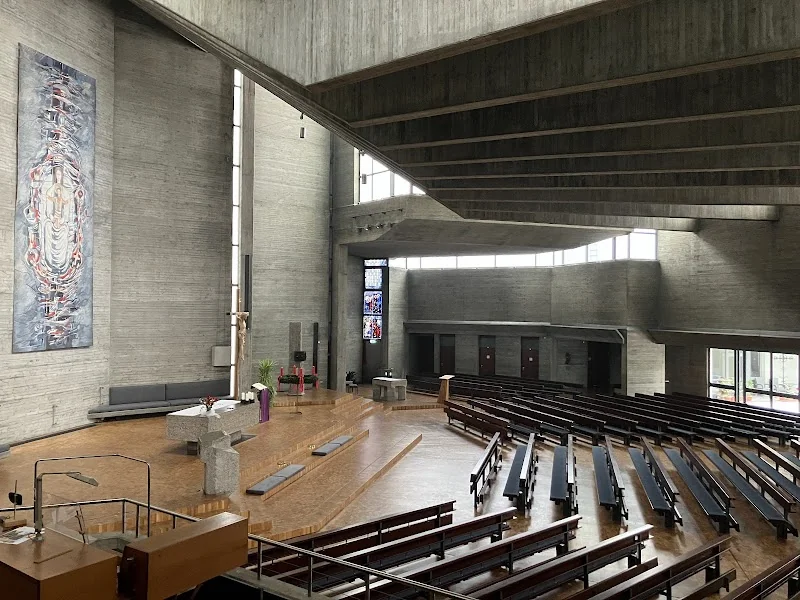
Architecturally, St. Maria belongs to the striking church buildings of post-war modernism in Aalen. The community describes the building as modern architecture with a defining concrete architecture by Stuttgart architect Beck-Erlang. The space is not designed for monumentality in the traditional sense, but for clarity, movement, and concentration. Upon entering the church space, visitors experience, according to the community, a wide area that opens up in breadth. The large choir flows seamlessly into the side altar area on the right and the organ loft on the left. This is not a rigid church nave, but a deliberately composed interior that leads the worshippers towards the center. The architecture works with exposed concrete, open spaces, and a strong orientation towards the altar area. This is precisely where the reference to Brutalism lies, that is, to a modernity of raw, unplastered concrete with visible structure. ([katholische-kirche-aalen.de](https://katholische-kirche-aalen.de/startseite/st-maria/))
Inside, this attitude becomes very concrete. The church is designed as a unified space that is organized around the altar area. The lighting is also focused on this area so that nothing distracts from the liturgical center. As a result, the interior does not feel cold, but concentrated and community-building. An architecture museum curator describes the building as a particularly striking example of its era; a parish priest, on the other hand, explains that the community does not sit in a static hall, but is taken into a movement. The concrete beams rise from the semicircle of the nave towards the front, bend, and lead the gaze upward. The benches are arranged in a segmental arch shape, almost like in a parliament, which gives the space both closeness and equality. This form language is exciting for visitors because it is not only aesthetically pleasing but also theologically readable: the center is not the building itself, but the gathered community before God. ([katholische-kirche-aalen.de](https://katholische-kirche-aalen.de/wp-content/uploads/2024/09/Kirchenfuehrer_StMaria.pdf))
The architecture also includes clearly readable functional zones. On the left, the organ and space for the choir and musical accompaniment of the services are located in the loft. On the opposite side is the weekday chapel, whose lower ceiling still appears monumental. The weekday chapel and the main space together form a liturgical and spatial connection that is particularly important during the week. This makes St. Maria not just a Sunday house, but a church building that can accommodate various forms of prayer and community. This mixture of liturgical concentration and everyday usability is one of the reasons why St. Maria functions so well in the Aalen context. ([katholische-kirche-aalen.de](https://katholische-kirche-aalen.de/wp-content/uploads/2024/09/Kirchenfuehrer_StMaria.pdf))
Mary Carpet, Organ, and Artworks from the Old Church
A significant part of the appeal of St. Maria lies in the furnishings, which consciously connect to the old Marienkirche. The view in the church space falls on the Mary carpet, which is described as the focal point of the church. It was completely handmade in the studio for textile weaving Gertrud Bernhardt in Reutlingen. The design comes from Helmut Schuster from Wasseralfingen, five weavers worked for eight months on the carpet, and its dimensions are 8.50 meters in length and 3.10 meters in width. The consecration took place on December 13, 1981. Thematically, the work is not just decoration but a theological image statement: Mary is depicted as the Mother of God, Mother of Christ, and Mother of Humanity, and the carpet focuses the gaze on this center. Its colors and shapes give the space a strong visual calm without appearing sterile. For visitors looking for photos or impressions of the interior of St. Maria Aalen, the Mary carpet is one of the most striking motifs overall. ([katholische-kirche-aalen.de](https://katholische-kirche-aalen.de/wp-content/uploads/2024/09/Kirchenfuehrer_StMaria.pdf))
The organ is also one of the defining elements of the church. The loft houses the organ, choir area, and space for the musical accompaniment of the services; the organ itself was installed in 1980 and has 37 registers. Before the pipe organ was installed, an electronic Ahlborn organ served as a temporary solution. The choir of the Marienkirche played an important role in financing the new organ and contributed with initiatives and donations to the initial funding. This shows that the musical identity of the place is not just a technical question but has grown from the community itself. For the current perception of the church, this is important: St. Maria is not just a building but a sound space that closely connects liturgy and music. ([katholische-kirche-aalen.de](https://katholische-kirche-aalen.de/wp-content/uploads/2024/09/Kirchenfuehrer_StMaria.pdf))
The furnishings also include numerous adopted or re-carved artworks. The Twelve Apostles from the old Marienkirche adorn the left side wall; they date from the 19th century. St. Joseph and John the Baptist also come from the old stock and highlight the baptismal area. The Madonna in the side altar area is a re-carving by Josef Wolfsteiner from Hüttlingen, as well as the Pieta and the expressive cross in the choir area. Windows and figures from the old church were deliberately integrated into the new building to create a visible bridge between the old and new Marienkirche. Even the glazing from the old church was preserved and now appears at the side altar like a column of light in the space. These artworks make St. Maria a place where local piety, craftsmanship, and memory are closely intertwined. ([katholische-kirche-aalen.de](https://katholische-kirche-aalen.de/startseite/st-maria/))
Especially impressive is the way the community describes the connection between art and faith. The old and new elements do not stand next to each other like museum pieces, but work liturgically. The apostles, the Madonna, the Pieta, the cross, and the carpet create an image world that makes the church space readable as a narrative space. When entering the church, one encounters not only concrete and architecture but a deliberately constructed Marian iconography that continues the path from the tradition of the old parish church into the present. Therefore, St. Maria is also a worthwhile destination for culturally and historically interested visitors, even if they do not come primarily for a service. ([katholische-kirche-aalen.de](https://katholische-kirche-aalen.de/wp-content/uploads/2024/09/Kirchenfuehrer_StMaria.pdf))
Service Schedule, Children's Church, and Vibrant Community Work
St. Maria is primarily an active community location. The community itself describes its center as a place where worship, educational offerings, and social gatherings take place under one roof. This is also evident in current community life: The city of Aalen continuously publishes service times for the Catholic Marienkirche, including Saturdays at 8 a.m. and Sundays at 10:30 a.m., as well as special celebrations and liturgical offerings during the major church seasons. For visitors looking for services or programs at St. Maria Aalen, this overview is particularly useful as it shows that the church is not only a historical building but a regularly used place of worship. Additionally, there are current notices about the parish, which are maintained on the official website of St. Maria and in the church announcements. ([aalen.de](https://www.aalen.de/sixcms.php/detail.php?_bereich=&id=2957&utm_source=openai))
A particularly vibrant part of community work is the Children's Church St. Maria. It has existed since 1995, was conceived and founded by a group of mothers, and takes place approximately twice a month for children aged about three to eight years. The Children's Church is prepared and conducted by volunteer women. The children actively participate in the service, for example, preparing the altar, cross, and candle at the beginning, and experiencing biblical stories in a child-friendly way. Additionally, there are Egli figures, cloths, lay figures, and Kamishibai. The Children's Church usually runs parallel to the 11 a.m. service in the St. Maria community center. This is a strong signal for family-friendliness and shows that St. Maria not only relies on traditional forms of worship but also on early religious education and participation. ([katholische-kirche-aalen.de](https://katholische-kirche-aalen.de/kinderkirche/kinderkirche-st-maria/))
However, community life extends far beyond the Children's Church. The website lists various musical and communal forms, such as the choir of the Marienkirche, other choirs, and social groups. The liturgy is also diverse: in addition to the Sunday mass, there are weekday offerings, special celebrations, and community events. The community explicitly emphasizes that it exchanges ideas about faith and what moves people and works together on the church of tomorrow. For visitors, this means: St. Maria is not a silent monument but a place with ongoing use, with voices, music, and participation. This lively character explains why the church frequently appears in search queries like St. Maria Aalen photos, St. Maria Aalen interior, or St. Maria Aalen church guide. Those who visit the place discover not only architecture but an active community that brings together tradition and the present. ([katholische-kirche-aalen.de](https://katholische-kirche-aalen.de/startseite/st-maria/))
Directions, Parking, and Practical Tips for Your Visit
St. Maria is located in the heart of Aalen and is therefore easily accessible for visitors. The official address is Marienstraße 5, 73431 Aalen. This address is currently listed on the city page for the Catholic Marienkirche, and the community refers directly to its parish office in the same building complex. The location is particularly convenient because the city of Aalen maintains a dense parking system with several parking garages and underground garages for the city center. Among others, the Rathaus underground garage and the KUBUS parking lot, the Reichsstädter Markt parking garage, the Spritzenhausplatz underground garage, the Spitalstraße parking garage, and the P&R parking garage at the main train station are mentioned. The city also points to a dynamic parking guidance system that leads traffic participants to free spaces. So, for those looking to park at St. Maria Aalen, there are several options available in the city center. ([aalen.de](https://www.aalen.de/sixcms.php/detail.php?_bereich=&id=2957&utm_source=openai))
For the immediate vicinity of the church, it is particularly interesting that the city of Aalen also mentions parking spaces under the elevated bridge behind the Marienkirche in a city center overview. This is practical because the church itself was built directly next to the elevated bridge and thus lies in an urban, traffic-friendly environment. Therefore, those arriving by car should not only keep an eye on the immediate church surroundings but also the nearby parking garages and public parking spaces in the city center. For persons with mobility impairments, the city also refers to various disabled parking spaces in the geodata portal. Overall, the location is more urban than peripheral: the paths are short, and the church integrates into the center of Aalen. ([katholische-kirche-aalen.de](https://katholische-kirche-aalen.de/startseite/st-maria/))
Visiting on-site is also well planned. The St. Maria parish office at Marienstraße 5 is listed on the official website with fixed opening hours, currently on Wednesdays from 8:30 a.m. to 11:00 a.m. and Fridays from 1:30 p.m. to 3:00 p.m. Those with current questions about services, groups, room rentals, or events can find additional contacts and information on the website of the Catholic Church Aalen. This is useful for practical visits because liturgical times, holiday regulations, or special services may change. Especially during major feasts, Children's Church, or special celebrations, it is always worth checking the current announcements. This way, a visit to St. Maria remains not only easily accessible but also well prepared. ([katholische-kirche-aalen.de](https://katholische-kirche-aalen.de/))
Opening Hours, Contact, and Why St. Maria is So Special Today
The official presentation of St. Maria shows that this location is intentionally organized as a center. The church, community center, and associated services form a place where worship, educational offerings, and encounters come together. This is precisely where the strength of the location lies: it is historically significant, architecturally independent, and simultaneously strongly anchored in the everyday life of the community. For visitors coming for a service, a concert, a family offering, or simply out of interest in modern sacred architecture, St. Maria offers a dense experience. The mixture of concrete architecture, liturgical clarity, Mary carpet, old figure world, and active community work makes the church a place that fulfills both emotional and factual search queries very well. ([katholische-kirche-aalen.de](https://katholische-kirche-aalen.de/startseite/st-maria/))
Particularly interesting is how consistently the community keeps the place alive. The Children's Church is aimed at the youngest, music is firmly anchored in the life of the location with choir and organ, and the service times are publicly accessible. Thus, St. Maria fulfills several roles: it is a parish church, community center, memory space, and a place for the continuation of a centuries-old local tradition. Those who visit the place quickly sense that here not only history is preserved but also the present is shaped. Precisely for this reason, St. Maria in Aalen remains relevant for search queries such as St. Maria Aalen photos, program, interior, directions, parking, or church guide: the place connects all these themes in a single, characterful ensemble. ([aalen.de](https://www.aalen.de/sixcms.php/detail.php?_bereich=&id=2957&utm_source=openai))
Sources:
Show moreShow less
St. Maria Aalen | Worship & Parking
St. Maria in Aalen is much more than just a Catholic church at a central address. The Marienkirche, together with the community center, rectory, and parish office, forms a complex that is intentionally designed for encounters, worship, education, and community. Those heading to the address Marienstraße 5 in Aalen will find a place that tells the history of the Aalen Catholics as well as their current community life. The modern church was consecrated in 1972 after the old Marienkirche was demolished in 1969. Today, the ensemble represents a clear, open, and liturgically focused church space that accompanies the community in everyday life as well as on Sundays and holidays. The combination of architecture, art, and practical usability makes St. Maria a striking destination for people who want to attend services, learn about the interior, or simply understand one of the most important Catholic churches in the city. ([katholische-kirche-aalen.de](https://katholische-kirche-aalen.de/startseite/st-maria/))
History of the Marienkirche and the New Building from 1969 to 1972
The history of St. Maria begins long before the current building. The Catholic parish of St. Maria was established on November 1, 1963, but at that time, the community essentially only had the neo-Gothic parish church consecrated in 1868 with 400 seats, an old rectory, and the St. Michael community center. After World War II, the Catholic community in Aalen grew significantly, partly because many displaced persons came to the city. At the same time, the urban situation changed dramatically: The planned elevated road bridge over the railway line was to come so close to the old church that the decision was made not to give the Marienkirche a future at that location. In March 1969, the neo-Gothic church was demolished. For the community, this was a turning point, but also the beginning of a new start. During the construction period, services were held in a barrack as an emergency church, and Sunday services were also moved to other churches in the city. ([katholische-kirche-aalen.de](https://katholische-kirche-aalen.de/wp-content/uploads/2024/09/Kirchenfuehrer_StMaria.pdf))
Five designs were submitted for the new building. The planning task was demanding: a sacred center was required with a church for 600 people, a weekday chapel, a community hall for 300 people, youth rooms, and apartments for the pastor and sacristan. The contract was awarded to the Stuttgart architect Wilfried Beck-Erlang. His design focused on a large space oriented towards the altar area and a clear connection between liturgy and community life. The construction work was taken over from July 1969 by the company Klee KG from Ellwangen. The construction period was, as the chronicle emphasizes, long and arduous, as the artistic interior design also required many discussions. Ultimately, Beck-Erlang himself designed the altar, tabernacle stele, and ambo. On the 2nd Sunday of Advent in 1972, the church was consecrated; the actual celebration was led by Auxiliary Bishop Georg Moser, and even television was present. Even before the consecration, from June 11, 1972, the new building was used for services. ([katholische-kirche-aalen.de](https://katholische-kirche-aalen.de/wp-content/uploads/2024/09/Kirchenfuehrer_StMaria.pdf))
This construction history explains much of the character of the place. St. Maria was not created as a representative large church, but as a deliberately planned space for a growing urban community. The goal was not only to replace the loss of the old church but to provide a contemporary response to new pastoral and urban conditions. Therefore, the ensemble includes not only the actual church space but also the community center, rectory, and office. The result is a functionally and spiritually conceived center of Catholic life in the city center of Aalen, which continues to see itself as a meeting point for worship, education, exchange, and communal celebration. ([katholische-kirche-aalen.de](https://katholische-kirche-aalen.de/startseite/st-maria/))
Architecture, Interior, and the Special Brutalism of St. Maria
Architecturally, St. Maria belongs to the striking church buildings of post-war modernism in Aalen. The community describes the building as modern architecture with a defining concrete architecture by Stuttgart architect Beck-Erlang. The space is not designed for monumentality in the traditional sense, but for clarity, movement, and concentration. Upon entering the church space, visitors experience, according to the community, a wide area that opens up in breadth. The large choir flows seamlessly into the side altar area on the right and the organ loft on the left. This is not a rigid church nave, but a deliberately composed interior that leads the worshippers towards the center. The architecture works with exposed concrete, open spaces, and a strong orientation towards the altar area. This is precisely where the reference to Brutalism lies, that is, to a modernity of raw, unplastered concrete with visible structure. ([katholische-kirche-aalen.de](https://katholische-kirche-aalen.de/startseite/st-maria/))
Inside, this attitude becomes very concrete. The church is designed as a unified space that is organized around the altar area. The lighting is also focused on this area so that nothing distracts from the liturgical center. As a result, the interior does not feel cold, but concentrated and community-building. An architecture museum curator describes the building as a particularly striking example of its era; a parish priest, on the other hand, explains that the community does not sit in a static hall, but is taken into a movement. The concrete beams rise from the semicircle of the nave towards the front, bend, and lead the gaze upward. The benches are arranged in a segmental arch shape, almost like in a parliament, which gives the space both closeness and equality. This form language is exciting for visitors because it is not only aesthetically pleasing but also theologically readable: the center is not the building itself, but the gathered community before God. ([katholische-kirche-aalen.de](https://katholische-kirche-aalen.de/wp-content/uploads/2024/09/Kirchenfuehrer_StMaria.pdf))
The architecture also includes clearly readable functional zones. On the left, the organ and space for the choir and musical accompaniment of the services are located in the loft. On the opposite side is the weekday chapel, whose lower ceiling still appears monumental. The weekday chapel and the main space together form a liturgical and spatial connection that is particularly important during the week. This makes St. Maria not just a Sunday house, but a church building that can accommodate various forms of prayer and community. This mixture of liturgical concentration and everyday usability is one of the reasons why St. Maria functions so well in the Aalen context. ([katholische-kirche-aalen.de](https://katholische-kirche-aalen.de/wp-content/uploads/2024/09/Kirchenfuehrer_StMaria.pdf))
Mary Carpet, Organ, and Artworks from the Old Church
A significant part of the appeal of St. Maria lies in the furnishings, which consciously connect to the old Marienkirche. The view in the church space falls on the Mary carpet, which is described as the focal point of the church. It was completely handmade in the studio for textile weaving Gertrud Bernhardt in Reutlingen. The design comes from Helmut Schuster from Wasseralfingen, five weavers worked for eight months on the carpet, and its dimensions are 8.50 meters in length and 3.10 meters in width. The consecration took place on December 13, 1981. Thematically, the work is not just decoration but a theological image statement: Mary is depicted as the Mother of God, Mother of Christ, and Mother of Humanity, and the carpet focuses the gaze on this center. Its colors and shapes give the space a strong visual calm without appearing sterile. For visitors looking for photos or impressions of the interior of St. Maria Aalen, the Mary carpet is one of the most striking motifs overall. ([katholische-kirche-aalen.de](https://katholische-kirche-aalen.de/wp-content/uploads/2024/09/Kirchenfuehrer_StMaria.pdf))
The organ is also one of the defining elements of the church. The loft houses the organ, choir area, and space for the musical accompaniment of the services; the organ itself was installed in 1980 and has 37 registers. Before the pipe organ was installed, an electronic Ahlborn organ served as a temporary solution. The choir of the Marienkirche played an important role in financing the new organ and contributed with initiatives and donations to the initial funding. This shows that the musical identity of the place is not just a technical question but has grown from the community itself. For the current perception of the church, this is important: St. Maria is not just a building but a sound space that closely connects liturgy and music. ([katholische-kirche-aalen.de](https://katholische-kirche-aalen.de/wp-content/uploads/2024/09/Kirchenfuehrer_StMaria.pdf))
The furnishings also include numerous adopted or re-carved artworks. The Twelve Apostles from the old Marienkirche adorn the left side wall; they date from the 19th century. St. Joseph and John the Baptist also come from the old stock and highlight the baptismal area. The Madonna in the side altar area is a re-carving by Josef Wolfsteiner from Hüttlingen, as well as the Pieta and the expressive cross in the choir area. Windows and figures from the old church were deliberately integrated into the new building to create a visible bridge between the old and new Marienkirche. Even the glazing from the old church was preserved and now appears at the side altar like a column of light in the space. These artworks make St. Maria a place where local piety, craftsmanship, and memory are closely intertwined. ([katholische-kirche-aalen.de](https://katholische-kirche-aalen.de/startseite/st-maria/))
Especially impressive is the way the community describes the connection between art and faith. The old and new elements do not stand next to each other like museum pieces, but work liturgically. The apostles, the Madonna, the Pieta, the cross, and the carpet create an image world that makes the church space readable as a narrative space. When entering the church, one encounters not only concrete and architecture but a deliberately constructed Marian iconography that continues the path from the tradition of the old parish church into the present. Therefore, St. Maria is also a worthwhile destination for culturally and historically interested visitors, even if they do not come primarily for a service. ([katholische-kirche-aalen.de](https://katholische-kirche-aalen.de/wp-content/uploads/2024/09/Kirchenfuehrer_StMaria.pdf))
Service Schedule, Children's Church, and Vibrant Community Work
St. Maria is primarily an active community location. The community itself describes its center as a place where worship, educational offerings, and social gatherings take place under one roof. This is also evident in current community life: The city of Aalen continuously publishes service times for the Catholic Marienkirche, including Saturdays at 8 a.m. and Sundays at 10:30 a.m., as well as special celebrations and liturgical offerings during the major church seasons. For visitors looking for services or programs at St. Maria Aalen, this overview is particularly useful as it shows that the church is not only a historical building but a regularly used place of worship. Additionally, there are current notices about the parish, which are maintained on the official website of St. Maria and in the church announcements. ([aalen.de](https://www.aalen.de/sixcms.php/detail.php?_bereich=&id=2957&utm_source=openai))
A particularly vibrant part of community work is the Children's Church St. Maria. It has existed since 1995, was conceived and founded by a group of mothers, and takes place approximately twice a month for children aged about three to eight years. The Children's Church is prepared and conducted by volunteer women. The children actively participate in the service, for example, preparing the altar, cross, and candle at the beginning, and experiencing biblical stories in a child-friendly way. Additionally, there are Egli figures, cloths, lay figures, and Kamishibai. The Children's Church usually runs parallel to the 11 a.m. service in the St. Maria community center. This is a strong signal for family-friendliness and shows that St. Maria not only relies on traditional forms of worship but also on early religious education and participation. ([katholische-kirche-aalen.de](https://katholische-kirche-aalen.de/kinderkirche/kinderkirche-st-maria/))
However, community life extends far beyond the Children's Church. The website lists various musical and communal forms, such as the choir of the Marienkirche, other choirs, and social groups. The liturgy is also diverse: in addition to the Sunday mass, there are weekday offerings, special celebrations, and community events. The community explicitly emphasizes that it exchanges ideas about faith and what moves people and works together on the church of tomorrow. For visitors, this means: St. Maria is not a silent monument but a place with ongoing use, with voices, music, and participation. This lively character explains why the church frequently appears in search queries like St. Maria Aalen photos, St. Maria Aalen interior, or St. Maria Aalen church guide. Those who visit the place discover not only architecture but an active community that brings together tradition and the present. ([katholische-kirche-aalen.de](https://katholische-kirche-aalen.de/startseite/st-maria/))
Directions, Parking, and Practical Tips for Your Visit
St. Maria is located in the heart of Aalen and is therefore easily accessible for visitors. The official address is Marienstraße 5, 73431 Aalen. This address is currently listed on the city page for the Catholic Marienkirche, and the community refers directly to its parish office in the same building complex. The location is particularly convenient because the city of Aalen maintains a dense parking system with several parking garages and underground garages for the city center. Among others, the Rathaus underground garage and the KUBUS parking lot, the Reichsstädter Markt parking garage, the Spritzenhausplatz underground garage, the Spitalstraße parking garage, and the P&R parking garage at the main train station are mentioned. The city also points to a dynamic parking guidance system that leads traffic participants to free spaces. So, for those looking to park at St. Maria Aalen, there are several options available in the city center. ([aalen.de](https://www.aalen.de/sixcms.php/detail.php?_bereich=&id=2957&utm_source=openai))
For the immediate vicinity of the church, it is particularly interesting that the city of Aalen also mentions parking spaces under the elevated bridge behind the Marienkirche in a city center overview. This is practical because the church itself was built directly next to the elevated bridge and thus lies in an urban, traffic-friendly environment. Therefore, those arriving by car should not only keep an eye on the immediate church surroundings but also the nearby parking garages and public parking spaces in the city center. For persons with mobility impairments, the city also refers to various disabled parking spaces in the geodata portal. Overall, the location is more urban than peripheral: the paths are short, and the church integrates into the center of Aalen. ([katholische-kirche-aalen.de](https://katholische-kirche-aalen.de/startseite/st-maria/))
Visiting on-site is also well planned. The St. Maria parish office at Marienstraße 5 is listed on the official website with fixed opening hours, currently on Wednesdays from 8:30 a.m. to 11:00 a.m. and Fridays from 1:30 p.m. to 3:00 p.m. Those with current questions about services, groups, room rentals, or events can find additional contacts and information on the website of the Catholic Church Aalen. This is useful for practical visits because liturgical times, holiday regulations, or special services may change. Especially during major feasts, Children's Church, or special celebrations, it is always worth checking the current announcements. This way, a visit to St. Maria remains not only easily accessible but also well prepared. ([katholische-kirche-aalen.de](https://katholische-kirche-aalen.de/))
Opening Hours, Contact, and Why St. Maria is So Special Today
The official presentation of St. Maria shows that this location is intentionally organized as a center. The church, community center, and associated services form a place where worship, educational offerings, and encounters come together. This is precisely where the strength of the location lies: it is historically significant, architecturally independent, and simultaneously strongly anchored in the everyday life of the community. For visitors coming for a service, a concert, a family offering, or simply out of interest in modern sacred architecture, St. Maria offers a dense experience. The mixture of concrete architecture, liturgical clarity, Mary carpet, old figure world, and active community work makes the church a place that fulfills both emotional and factual search queries very well. ([katholische-kirche-aalen.de](https://katholische-kirche-aalen.de/startseite/st-maria/))
Particularly interesting is how consistently the community keeps the place alive. The Children's Church is aimed at the youngest, music is firmly anchored in the life of the location with choir and organ, and the service times are publicly accessible. Thus, St. Maria fulfills several roles: it is a parish church, community center, memory space, and a place for the continuation of a centuries-old local tradition. Those who visit the place quickly sense that here not only history is preserved but also the present is shaped. Precisely for this reason, St. Maria in Aalen remains relevant for search queries such as St. Maria Aalen photos, program, interior, directions, parking, or church guide: the place connects all these themes in a single, characterful ensemble. ([aalen.de](https://www.aalen.de/sixcms.php/detail.php?_bereich=&id=2957&utm_source=openai))
Sources:
St. Maria Aalen | Worship & Parking
St. Maria in Aalen is much more than just a Catholic church at a central address. The Marienkirche, together with the community center, rectory, and parish office, forms a complex that is intentionally designed for encounters, worship, education, and community. Those heading to the address Marienstraße 5 in Aalen will find a place that tells the history of the Aalen Catholics as well as their current community life. The modern church was consecrated in 1972 after the old Marienkirche was demolished in 1969. Today, the ensemble represents a clear, open, and liturgically focused church space that accompanies the community in everyday life as well as on Sundays and holidays. The combination of architecture, art, and practical usability makes St. Maria a striking destination for people who want to attend services, learn about the interior, or simply understand one of the most important Catholic churches in the city. ([katholische-kirche-aalen.de](https://katholische-kirche-aalen.de/startseite/st-maria/))
History of the Marienkirche and the New Building from 1969 to 1972
The history of St. Maria begins long before the current building. The Catholic parish of St. Maria was established on November 1, 1963, but at that time, the community essentially only had the neo-Gothic parish church consecrated in 1868 with 400 seats, an old rectory, and the St. Michael community center. After World War II, the Catholic community in Aalen grew significantly, partly because many displaced persons came to the city. At the same time, the urban situation changed dramatically: The planned elevated road bridge over the railway line was to come so close to the old church that the decision was made not to give the Marienkirche a future at that location. In March 1969, the neo-Gothic church was demolished. For the community, this was a turning point, but also the beginning of a new start. During the construction period, services were held in a barrack as an emergency church, and Sunday services were also moved to other churches in the city. ([katholische-kirche-aalen.de](https://katholische-kirche-aalen.de/wp-content/uploads/2024/09/Kirchenfuehrer_StMaria.pdf))
Five designs were submitted for the new building. The planning task was demanding: a sacred center was required with a church for 600 people, a weekday chapel, a community hall for 300 people, youth rooms, and apartments for the pastor and sacristan. The contract was awarded to the Stuttgart architect Wilfried Beck-Erlang. His design focused on a large space oriented towards the altar area and a clear connection between liturgy and community life. The construction work was taken over from July 1969 by the company Klee KG from Ellwangen. The construction period was, as the chronicle emphasizes, long and arduous, as the artistic interior design also required many discussions. Ultimately, Beck-Erlang himself designed the altar, tabernacle stele, and ambo. On the 2nd Sunday of Advent in 1972, the church was consecrated; the actual celebration was led by Auxiliary Bishop Georg Moser, and even television was present. Even before the consecration, from June 11, 1972, the new building was used for services. ([katholische-kirche-aalen.de](https://katholische-kirche-aalen.de/wp-content/uploads/2024/09/Kirchenfuehrer_StMaria.pdf))
This construction history explains much of the character of the place. St. Maria was not created as a representative large church, but as a deliberately planned space for a growing urban community. The goal was not only to replace the loss of the old church but to provide a contemporary response to new pastoral and urban conditions. Therefore, the ensemble includes not only the actual church space but also the community center, rectory, and office. The result is a functionally and spiritually conceived center of Catholic life in the city center of Aalen, which continues to see itself as a meeting point for worship, education, exchange, and communal celebration. ([katholische-kirche-aalen.de](https://katholische-kirche-aalen.de/startseite/st-maria/))
Architecture, Interior, and the Special Brutalism of St. Maria
Architecturally, St. Maria belongs to the striking church buildings of post-war modernism in Aalen. The community describes the building as modern architecture with a defining concrete architecture by Stuttgart architect Beck-Erlang. The space is not designed for monumentality in the traditional sense, but for clarity, movement, and concentration. Upon entering the church space, visitors experience, according to the community, a wide area that opens up in breadth. The large choir flows seamlessly into the side altar area on the right and the organ loft on the left. This is not a rigid church nave, but a deliberately composed interior that leads the worshippers towards the center. The architecture works with exposed concrete, open spaces, and a strong orientation towards the altar area. This is precisely where the reference to Brutalism lies, that is, to a modernity of raw, unplastered concrete with visible structure. ([katholische-kirche-aalen.de](https://katholische-kirche-aalen.de/startseite/st-maria/))
Inside, this attitude becomes very concrete. The church is designed as a unified space that is organized around the altar area. The lighting is also focused on this area so that nothing distracts from the liturgical center. As a result, the interior does not feel cold, but concentrated and community-building. An architecture museum curator describes the building as a particularly striking example of its era; a parish priest, on the other hand, explains that the community does not sit in a static hall, but is taken into a movement. The concrete beams rise from the semicircle of the nave towards the front, bend, and lead the gaze upward. The benches are arranged in a segmental arch shape, almost like in a parliament, which gives the space both closeness and equality. This form language is exciting for visitors because it is not only aesthetically pleasing but also theologically readable: the center is not the building itself, but the gathered community before God. ([katholische-kirche-aalen.de](https://katholische-kirche-aalen.de/wp-content/uploads/2024/09/Kirchenfuehrer_StMaria.pdf))
The architecture also includes clearly readable functional zones. On the left, the organ and space for the choir and musical accompaniment of the services are located in the loft. On the opposite side is the weekday chapel, whose lower ceiling still appears monumental. The weekday chapel and the main space together form a liturgical and spatial connection that is particularly important during the week. This makes St. Maria not just a Sunday house, but a church building that can accommodate various forms of prayer and community. This mixture of liturgical concentration and everyday usability is one of the reasons why St. Maria functions so well in the Aalen context. ([katholische-kirche-aalen.de](https://katholische-kirche-aalen.de/wp-content/uploads/2024/09/Kirchenfuehrer_StMaria.pdf))
Mary Carpet, Organ, and Artworks from the Old Church
A significant part of the appeal of St. Maria lies in the furnishings, which consciously connect to the old Marienkirche. The view in the church space falls on the Mary carpet, which is described as the focal point of the church. It was completely handmade in the studio for textile weaving Gertrud Bernhardt in Reutlingen. The design comes from Helmut Schuster from Wasseralfingen, five weavers worked for eight months on the carpet, and its dimensions are 8.50 meters in length and 3.10 meters in width. The consecration took place on December 13, 1981. Thematically, the work is not just decoration but a theological image statement: Mary is depicted as the Mother of God, Mother of Christ, and Mother of Humanity, and the carpet focuses the gaze on this center. Its colors and shapes give the space a strong visual calm without appearing sterile. For visitors looking for photos or impressions of the interior of St. Maria Aalen, the Mary carpet is one of the most striking motifs overall. ([katholische-kirche-aalen.de](https://katholische-kirche-aalen.de/wp-content/uploads/2024/09/Kirchenfuehrer_StMaria.pdf))
The organ is also one of the defining elements of the church. The loft houses the organ, choir area, and space for the musical accompaniment of the services; the organ itself was installed in 1980 and has 37 registers. Before the pipe organ was installed, an electronic Ahlborn organ served as a temporary solution. The choir of the Marienkirche played an important role in financing the new organ and contributed with initiatives and donations to the initial funding. This shows that the musical identity of the place is not just a technical question but has grown from the community itself. For the current perception of the church, this is important: St. Maria is not just a building but a sound space that closely connects liturgy and music. ([katholische-kirche-aalen.de](https://katholische-kirche-aalen.de/wp-content/uploads/2024/09/Kirchenfuehrer_StMaria.pdf))
The furnishings also include numerous adopted or re-carved artworks. The Twelve Apostles from the old Marienkirche adorn the left side wall; they date from the 19th century. St. Joseph and John the Baptist also come from the old stock and highlight the baptismal area. The Madonna in the side altar area is a re-carving by Josef Wolfsteiner from Hüttlingen, as well as the Pieta and the expressive cross in the choir area. Windows and figures from the old church were deliberately integrated into the new building to create a visible bridge between the old and new Marienkirche. Even the glazing from the old church was preserved and now appears at the side altar like a column of light in the space. These artworks make St. Maria a place where local piety, craftsmanship, and memory are closely intertwined. ([katholische-kirche-aalen.de](https://katholische-kirche-aalen.de/startseite/st-maria/))
Especially impressive is the way the community describes the connection between art and faith. The old and new elements do not stand next to each other like museum pieces, but work liturgically. The apostles, the Madonna, the Pieta, the cross, and the carpet create an image world that makes the church space readable as a narrative space. When entering the church, one encounters not only concrete and architecture but a deliberately constructed Marian iconography that continues the path from the tradition of the old parish church into the present. Therefore, St. Maria is also a worthwhile destination for culturally and historically interested visitors, even if they do not come primarily for a service. ([katholische-kirche-aalen.de](https://katholische-kirche-aalen.de/wp-content/uploads/2024/09/Kirchenfuehrer_StMaria.pdf))
Service Schedule, Children's Church, and Vibrant Community Work
St. Maria is primarily an active community location. The community itself describes its center as a place where worship, educational offerings, and social gatherings take place under one roof. This is also evident in current community life: The city of Aalen continuously publishes service times for the Catholic Marienkirche, including Saturdays at 8 a.m. and Sundays at 10:30 a.m., as well as special celebrations and liturgical offerings during the major church seasons. For visitors looking for services or programs at St. Maria Aalen, this overview is particularly useful as it shows that the church is not only a historical building but a regularly used place of worship. Additionally, there are current notices about the parish, which are maintained on the official website of St. Maria and in the church announcements. ([aalen.de](https://www.aalen.de/sixcms.php/detail.php?_bereich=&id=2957&utm_source=openai))
A particularly vibrant part of community work is the Children's Church St. Maria. It has existed since 1995, was conceived and founded by a group of mothers, and takes place approximately twice a month for children aged about three to eight years. The Children's Church is prepared and conducted by volunteer women. The children actively participate in the service, for example, preparing the altar, cross, and candle at the beginning, and experiencing biblical stories in a child-friendly way. Additionally, there are Egli figures, cloths, lay figures, and Kamishibai. The Children's Church usually runs parallel to the 11 a.m. service in the St. Maria community center. This is a strong signal for family-friendliness and shows that St. Maria not only relies on traditional forms of worship but also on early religious education and participation. ([katholische-kirche-aalen.de](https://katholische-kirche-aalen.de/kinderkirche/kinderkirche-st-maria/))
However, community life extends far beyond the Children's Church. The website lists various musical and communal forms, such as the choir of the Marienkirche, other choirs, and social groups. The liturgy is also diverse: in addition to the Sunday mass, there are weekday offerings, special celebrations, and community events. The community explicitly emphasizes that it exchanges ideas about faith and what moves people and works together on the church of tomorrow. For visitors, this means: St. Maria is not a silent monument but a place with ongoing use, with voices, music, and participation. This lively character explains why the church frequently appears in search queries like St. Maria Aalen photos, St. Maria Aalen interior, or St. Maria Aalen church guide. Those who visit the place discover not only architecture but an active community that brings together tradition and the present. ([katholische-kirche-aalen.de](https://katholische-kirche-aalen.de/startseite/st-maria/))
Directions, Parking, and Practical Tips for Your Visit
St. Maria is located in the heart of Aalen and is therefore easily accessible for visitors. The official address is Marienstraße 5, 73431 Aalen. This address is currently listed on the city page for the Catholic Marienkirche, and the community refers directly to its parish office in the same building complex. The location is particularly convenient because the city of Aalen maintains a dense parking system with several parking garages and underground garages for the city center. Among others, the Rathaus underground garage and the KUBUS parking lot, the Reichsstädter Markt parking garage, the Spritzenhausplatz underground garage, the Spitalstraße parking garage, and the P&R parking garage at the main train station are mentioned. The city also points to a dynamic parking guidance system that leads traffic participants to free spaces. So, for those looking to park at St. Maria Aalen, there are several options available in the city center. ([aalen.de](https://www.aalen.de/sixcms.php/detail.php?_bereich=&id=2957&utm_source=openai))
For the immediate vicinity of the church, it is particularly interesting that the city of Aalen also mentions parking spaces under the elevated bridge behind the Marienkirche in a city center overview. This is practical because the church itself was built directly next to the elevated bridge and thus lies in an urban, traffic-friendly environment. Therefore, those arriving by car should not only keep an eye on the immediate church surroundings but also the nearby parking garages and public parking spaces in the city center. For persons with mobility impairments, the city also refers to various disabled parking spaces in the geodata portal. Overall, the location is more urban than peripheral: the paths are short, and the church integrates into the center of Aalen. ([katholische-kirche-aalen.de](https://katholische-kirche-aalen.de/startseite/st-maria/))
Visiting on-site is also well planned. The St. Maria parish office at Marienstraße 5 is listed on the official website with fixed opening hours, currently on Wednesdays from 8:30 a.m. to 11:00 a.m. and Fridays from 1:30 p.m. to 3:00 p.m. Those with current questions about services, groups, room rentals, or events can find additional contacts and information on the website of the Catholic Church Aalen. This is useful for practical visits because liturgical times, holiday regulations, or special services may change. Especially during major feasts, Children's Church, or special celebrations, it is always worth checking the current announcements. This way, a visit to St. Maria remains not only easily accessible but also well prepared. ([katholische-kirche-aalen.de](https://katholische-kirche-aalen.de/))
Opening Hours, Contact, and Why St. Maria is So Special Today
The official presentation of St. Maria shows that this location is intentionally organized as a center. The church, community center, and associated services form a place where worship, educational offerings, and encounters come together. This is precisely where the strength of the location lies: it is historically significant, architecturally independent, and simultaneously strongly anchored in the everyday life of the community. For visitors coming for a service, a concert, a family offering, or simply out of interest in modern sacred architecture, St. Maria offers a dense experience. The mixture of concrete architecture, liturgical clarity, Mary carpet, old figure world, and active community work makes the church a place that fulfills both emotional and factual search queries very well. ([katholische-kirche-aalen.de](https://katholische-kirche-aalen.de/startseite/st-maria/))
Particularly interesting is how consistently the community keeps the place alive. The Children's Church is aimed at the youngest, music is firmly anchored in the life of the location with choir and organ, and the service times are publicly accessible. Thus, St. Maria fulfills several roles: it is a parish church, community center, memory space, and a place for the continuation of a centuries-old local tradition. Those who visit the place quickly sense that here not only history is preserved but also the present is shaped. Precisely for this reason, St. Maria in Aalen remains relevant for search queries such as St. Maria Aalen photos, program, interior, directions, parking, or church guide: the place connects all these themes in a single, characterful ensemble. ([aalen.de](https://www.aalen.de/sixcms.php/detail.php?_bereich=&id=2957&utm_source=openai))
Sources:
Upcoming Events
No events found
Frequently Asked Questions
Reviews
CraytoN
27. November 2019
I'm atheist so I have nothing to say.
Ralf Thomisch
23. December 2025
Christmas concert with Marc Maschall It was very successful. Thank you.
Heike Wiesinger
9. October 2024
Refusing to baptize a child and then charging 750 euros at the father's funeral... what does one think about that? And then giving a disgusting eulogy... what happens to children in the Catholic Church is left out here. But influencing the police psychologist about who to keep in contact with....
Michael Weber
23. May 2018
What Mr. Sedlmeier did on Pentecost 2018 is unacceptable. Used a Catholic house as a political stage. And nicely deleted the comments on fb. This is our church! Not my religion anymore, I'd gladly leave. Thanks for opening my eyes. Oh, why doesn't Mr. Sedlmeier wear a headscarf privately? What does Rome say about that?
Camel Ekwalla
8. October 2022
In life, when you decide to help, you either really help or you don't help, there are no half measures!!! It's useless to pretend...