
Aalen
Vorderer Kirchberg 32, 73432 Aalen-Unterkochen, Deutschland
St. Mary Unterkochen | Pilgrimage Church & History
St. Mary in Aalen-Unterkochen is much more than just a church on a hill. As one approaches the site, the dominant position of the church hill, which has shaped the townscape of Unterkochen to this day, is immediately visible. The church stands above the village, near the confluence of the Black and White Kochers, and it connects religious tradition, art history, and local identity in a way that is unique to Aalen. The Catholic parish of Unterkochen has around 2,800 parishioners, and the pilgrimage church is not only a house of God for many people but also a historical center of the district. This explains why religious, cultural, and practical everyday themes continue to converge around St. Mary today: services, patronage, children's and youth work, choirs, pilgrimage routes, and excursion destinations interlink. The surrounding area also plays a significant role, as Unterkochen lies at the foot of the Swabian Jura and its ridges, valleys, and hiking trails create a natural frame for the church hill. Therefore, those searching for St. Mary will not only find a single attraction but a developed ensemble of church, village, landscape, and lived community. ([se-haertsfeld-kochertal.de](https://se-haertsfeld-kochertal.de/unterkochen))
Pilgrimage Church St. Mary Unterkochen: History and Pilgrimage
The history of St. Mary dates back deep into the Middle Ages. According to official information, the church was first mentioned in a document in 1248; at the same time, it is believed that Unterkochen may have existed as a mother parish even before the founding of the Benedictine Abbey of Ellwangen in 764. Such early traces are particularly exciting for visitors today because they show that St. Mary did not only emerge with the baroque reconstruction of the 18th century but rests on a much older religious tradition. Early on, Marian devotion was alive here, as evidenced by a Marian bell cast in 1307. The heart of the pilgrimage history is the life-sized statue of Mary from 1496, attributed to the Ulm school, which still stands in the ensemble of the high altar today. This figure is not just a work of art but an expression of a piety that has grown over centuries, making Unterkochen known beyond the region. The fact that St. Mary could hardly accommodate the influx of pilgrims in the 18th century shows how strongly the place was perceived as a pilgrimage destination. Even today, this historical character is palpable: the church is not merely a monument but a living memorial site where village history, religious practice, and regional art history meet. The story of St. Mary is therefore always also the story of Unterkochen itself, from early Christianization to the present community structure. ([unterkochen.aalen.de](https://unterkochen.aalen.de/katholische-kirchengemeinde-st-maria-unterkochen.3882.264.htm))
Rococo, High Altar, and Grace Mother in St. Mary Unterkochen
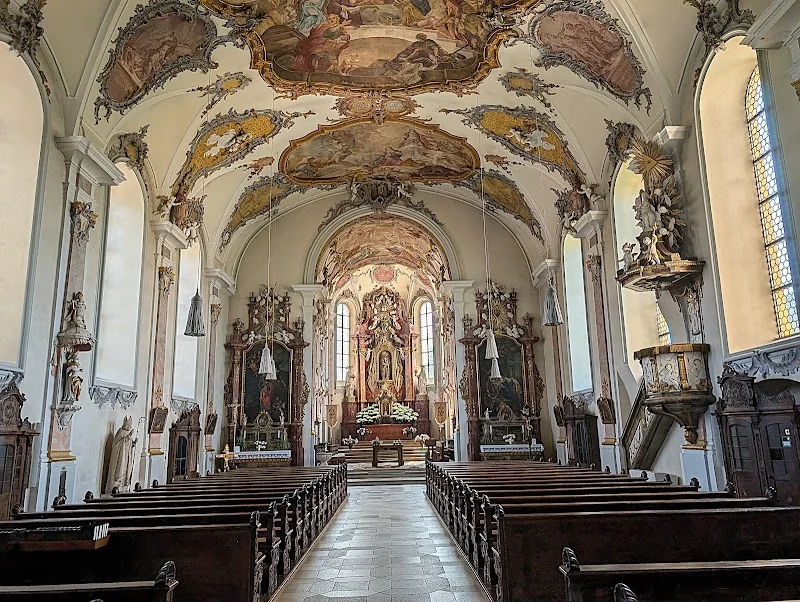
Architecturally, St. Mary is one of the most remarkable sacred buildings in the region because several epochs come together visibly here. The tower dates from the Romanesque period, the choir from the Gothic period, and the nave from the Baroque era. The expansion of the nave began in 1764 under the Swabian Gmünd master builder Johann Michael Keller and was completed in 1768; stucco work is attributed to the Wessobrunner school, and the paintings are by Johann Anwander from Lauingen. Inside, a consistently Marian iconographic program unfolds: Rococo stucco, ceiling frescoes, and numerous motifs of Marian devotion shape the space. Particularly impressive is the high altar from 1786 to 1788, which places the Unterkochen Grace Mother from 1496 at its center. It is precisely this interplay of late medieval sculpture, baroque framing, and Rococo furnishings that gives the church its charm. Later interventions are also part of the building's history: because the side walls of the nave could not permanently bear the load, lateral extensions for support were created in 1782/83; in 1802, the vault sagged, and in 1889, a lightning strike hit the west gable, necessitating repairs. A recent complete renovation took place from 1985 to 1987. Therefore, when one enters the church today, one experiences not only a beautiful space but an architectural testimony that has grown over centuries, connecting pious images, art historical quality, and technical adaptations. This is precisely what creates the special atmosphere of St. Mary Unterkochen. ([kirchenmusik-festival.de](https://www.kirchenmusik-festival.de/wallfahrtskirche-unterkochen.html))
Access and Parking at St. Mary Unterkochen
The location of St. Mary is as important for visitors as its history. The pilgrimage church is located on the Vorderer Kirchberg in Aalen-Unterkochen and visibly towers over the place. Those arriving by car will find a specific parking recommendation on the event page of the European Church Music: Elisabethenstraße. This information is particularly helpful as it significantly eases orientation for concert visitors, pilgrims, and guests. At the same time, it shows that St. Mary is not isolated but embedded in a developed town center. The church is also easily accessible for pedestrians and hikers, as Unterkochen is closely linked to the train station, the village center, and the surrounding paths. On the panoramic path and on circular routes through Unterkochen, the church is perceived as a prominent point, and hiking trails lead past it or close by. The old Härtsfeld railway line, known as the Schättere-Wegle, additionally connects the place with a historical cultural landscape. Therefore, those visiting St. Mary can combine the journey to the church with a walk through Unterkochen, a stroll to the Kocher spring, or a hike over the church hill. It is precisely this combination of good accessibility, scenic embedding, and historical context that makes the visit so attractive. For practical planning, it is important to note: the church itself is located on the church hill, the church is regularly used for services and events, and for access, Elisabethenstraße is the nearby parking solution. ([kirchenmusik-festival.de](https://www.kirchenmusik-festival.de/wallfahrtskirche-unterkochen.html))
Organ, Bells, and Musical Tradition in St. Mary Unterkochen
Part of the special appeal of St. Mary also includes its music. The current organ was built in 1964 by Gebrüder Link from Giengen an der Brenz, has 27 registers on two manuals and pedal, and was completely overhauled and sonically redesigned in 1987. Thus, the church possesses an instrument that represents both modern organ building history and fits excellently with the baroque spatial effect. The organ is not the first in this church: in the historical development, predecessor instruments from 1711, 1770, and 1891 can be found, allowing for a long musical tradition to be traced here. Equally impressive is the bell inventory: the church tower houses six bells, including a particularly old bell from 1307, dedicated to the Mother of God, and the heavy Paul bell from 1960, weighing around two tons. The tower reaches a height of 45 meters with the cross. These figures are not just technical details but refer to the acoustic and visible presence of the church in the village. This musical life is complemented by choirs and parish work, such as the Cappella Nova, the youth choir of the Catholic parish of St. Mary Unterkochen, which was founded in 1977 and regularly contributes to services. This explains why St. Mary is not simply perceived as a silent monument but as a vibrant sound space where music, liturgy, and community interact. Especially the organ and bells make the house audible beyond the local borders. ([organindex.de](https://organindex.de/index.php?title=Aalen%2FUnterkochen%2C_Wallfahrtskirche_St._Maria))
Seating Plan, Services, and Patronage in Unterkochen
St. Mary is also well-structured for events and services. On the European Church Music page, a hall and seating plan is provided as a PDF for the pilgrimage church, which is particularly significant for concerts and special events. This shows that the church is used not only liturgically but also as a venue and event location. At the same time, the pastoral unit points out that the community regularly meets in the pilgrimage church for services; an up-to-date overview of upcoming services is offered online. Particularly important for the church year is the patronage: it is celebrated in August around the Feast of the Assumption of Mary. This connects the community directly to the Marian devotion that has shaped St. Mary for centuries. Practical visitor information completes the picture: the Catholic parish office of St. Mary is located at Vorderer Kirchberg 30, the church itself at Vorderer Kirchberg 32, and the office hours in Unterkochen are Tuesdays from 3:00 PM to 5:30 PM and Fridays from 9:00 AM to 11:00 AM. Additionally, the parish is the sponsor of the two local Catholic kindergartens St. Joseph and Maria Fatima, thus having a significant impact on the everyday life of the district. Therefore, St. Mary is not only historically significant but also organizationally and socially a focal point of community life. Those looking for services, seating plans, patronage, or community contacts will find here a church that concretely brings together tradition and present. ([kirchenmusik-festival.de](https://www.kirchenmusik-festival.de/wallfahrtskirche-unterkochen.html))
Unterkochen, Kocher Spring, and the Visit On-Site
A visit to St. Mary is also worthwhile because the church is part of an exceptionally attractive environment. Unterkochen lies at the foot of the Swabian Jura, where the Black and White Kochers converge. The official tourism description highlights the scenic quality of the place: steep Jura escarpments, forests, juniper heaths, spring zones, and green valley areas shape the surroundings. Therefore, those visiting the pilgrimage church also experience a historic village with a strong connection to the landscape. In close proximity are the Kocher spring, the old Schättere route with the viaduct, and various hiking trails that connect Unterkochen with the surrounding area. This is precisely what creates the special appeal of St. Mary: one can experience the church as a destination of a pilgrimage, as a stop on a hike, or as a cultural center of a walk. The local community also thrives on this connection between place, church, and landscape. The parish openly speaks of many groups and offerings that one can join, thus pointing to an active community life that is not only historically but also socially supported. For visitors, this means: St. Mary is not a closed museum but a place where history, liturgy, club life, family work, and regional identity meet. Those who take their time can easily combine a church visit with a walk through Unterkochen, a detour to the Kocher spring, or a tour along the historical railway line. It is precisely this combination of quiet devotion and vibrant surroundings that makes St. Mary Unterkochen so special and explains why the church remains one of the most important addresses for culture, faith, and orientation in Aalen to this day. ([se-haertsfeld-kochertal.de](https://se-haertsfeld-kochertal.de/unterkochen?utm_source=openai))
Sources:
- City of Aalen - Catholic Parish of St. Mary Unterkochen ([unterkochen.aalen.de](https://unterkochen.aalen.de/katholische-kirchengemeinde-st-maria-unterkochen.3882.264.htm))
- SE Härtsfeld-Kochertal - Unterkochen ([se-haertsfeld-kochertal.de](https://se-haertsfeld-kochertal.de/unterkochen?utm_source=openai))
- SE Härtsfeld-Kochertal - Unterkochen Parish Church ([se-haertsfeld-kochertal.de](https://se-haertsfeld-kochertal.de/unterkochen-pfarrkirche?utm_source=openai))
- City of Aalen - Pilgrimage Church St. Mary Unterkochen ([aalen.de](https://www.aalen.de/wallfahrtskirche-st-maria-unterkochen.3109.htm?utm_source=openai))
- Festival European Church Music - Pilgrimage Church Unterkochen ([kirchenmusik-festival.de](https://www.kirchenmusik-festival.de/wallfahrtskirche-unterkochen.html))
- Organ index - Aalen/Unterkochen, Pilgrimage Church St. Mary ([organindex.de](https://organindex.de/index.php?title=Aalen%2FUnterkochen%2C_Wallfahrtskirche_St._Maria))
- Aalen Tourism - Junker-Hans-Weg: The Unterkochen ... ([aalen-tourismus.de](https://www.aalen-tourismus.de/download.197611.htm))
Show moreShow less
St. Mary Unterkochen | Pilgrimage Church & History
St. Mary in Aalen-Unterkochen is much more than just a church on a hill. As one approaches the site, the dominant position of the church hill, which has shaped the townscape of Unterkochen to this day, is immediately visible. The church stands above the village, near the confluence of the Black and White Kochers, and it connects religious tradition, art history, and local identity in a way that is unique to Aalen. The Catholic parish of Unterkochen has around 2,800 parishioners, and the pilgrimage church is not only a house of God for many people but also a historical center of the district. This explains why religious, cultural, and practical everyday themes continue to converge around St. Mary today: services, patronage, children's and youth work, choirs, pilgrimage routes, and excursion destinations interlink. The surrounding area also plays a significant role, as Unterkochen lies at the foot of the Swabian Jura and its ridges, valleys, and hiking trails create a natural frame for the church hill. Therefore, those searching for St. Mary will not only find a single attraction but a developed ensemble of church, village, landscape, and lived community. ([se-haertsfeld-kochertal.de](https://se-haertsfeld-kochertal.de/unterkochen))
Pilgrimage Church St. Mary Unterkochen: History and Pilgrimage
The history of St. Mary dates back deep into the Middle Ages. According to official information, the church was first mentioned in a document in 1248; at the same time, it is believed that Unterkochen may have existed as a mother parish even before the founding of the Benedictine Abbey of Ellwangen in 764. Such early traces are particularly exciting for visitors today because they show that St. Mary did not only emerge with the baroque reconstruction of the 18th century but rests on a much older religious tradition. Early on, Marian devotion was alive here, as evidenced by a Marian bell cast in 1307. The heart of the pilgrimage history is the life-sized statue of Mary from 1496, attributed to the Ulm school, which still stands in the ensemble of the high altar today. This figure is not just a work of art but an expression of a piety that has grown over centuries, making Unterkochen known beyond the region. The fact that St. Mary could hardly accommodate the influx of pilgrims in the 18th century shows how strongly the place was perceived as a pilgrimage destination. Even today, this historical character is palpable: the church is not merely a monument but a living memorial site where village history, religious practice, and regional art history meet. The story of St. Mary is therefore always also the story of Unterkochen itself, from early Christianization to the present community structure. ([unterkochen.aalen.de](https://unterkochen.aalen.de/katholische-kirchengemeinde-st-maria-unterkochen.3882.264.htm))
Rococo, High Altar, and Grace Mother in St. Mary Unterkochen
Architecturally, St. Mary is one of the most remarkable sacred buildings in the region because several epochs come together visibly here. The tower dates from the Romanesque period, the choir from the Gothic period, and the nave from the Baroque era. The expansion of the nave began in 1764 under the Swabian Gmünd master builder Johann Michael Keller and was completed in 1768; stucco work is attributed to the Wessobrunner school, and the paintings are by Johann Anwander from Lauingen. Inside, a consistently Marian iconographic program unfolds: Rococo stucco, ceiling frescoes, and numerous motifs of Marian devotion shape the space. Particularly impressive is the high altar from 1786 to 1788, which places the Unterkochen Grace Mother from 1496 at its center. It is precisely this interplay of late medieval sculpture, baroque framing, and Rococo furnishings that gives the church its charm. Later interventions are also part of the building's history: because the side walls of the nave could not permanently bear the load, lateral extensions for support were created in 1782/83; in 1802, the vault sagged, and in 1889, a lightning strike hit the west gable, necessitating repairs. A recent complete renovation took place from 1985 to 1987. Therefore, when one enters the church today, one experiences not only a beautiful space but an architectural testimony that has grown over centuries, connecting pious images, art historical quality, and technical adaptations. This is precisely what creates the special atmosphere of St. Mary Unterkochen. ([kirchenmusik-festival.de](https://www.kirchenmusik-festival.de/wallfahrtskirche-unterkochen.html))
Access and Parking at St. Mary Unterkochen
The location of St. Mary is as important for visitors as its history. The pilgrimage church is located on the Vorderer Kirchberg in Aalen-Unterkochen and visibly towers over the place. Those arriving by car will find a specific parking recommendation on the event page of the European Church Music: Elisabethenstraße. This information is particularly helpful as it significantly eases orientation for concert visitors, pilgrims, and guests. At the same time, it shows that St. Mary is not isolated but embedded in a developed town center. The church is also easily accessible for pedestrians and hikers, as Unterkochen is closely linked to the train station, the village center, and the surrounding paths. On the panoramic path and on circular routes through Unterkochen, the church is perceived as a prominent point, and hiking trails lead past it or close by. The old Härtsfeld railway line, known as the Schättere-Wegle, additionally connects the place with a historical cultural landscape. Therefore, those visiting St. Mary can combine the journey to the church with a walk through Unterkochen, a stroll to the Kocher spring, or a hike over the church hill. It is precisely this combination of good accessibility, scenic embedding, and historical context that makes the visit so attractive. For practical planning, it is important to note: the church itself is located on the church hill, the church is regularly used for services and events, and for access, Elisabethenstraße is the nearby parking solution. ([kirchenmusik-festival.de](https://www.kirchenmusik-festival.de/wallfahrtskirche-unterkochen.html))
Organ, Bells, and Musical Tradition in St. Mary Unterkochen
Part of the special appeal of St. Mary also includes its music. The current organ was built in 1964 by Gebrüder Link from Giengen an der Brenz, has 27 registers on two manuals and pedal, and was completely overhauled and sonically redesigned in 1987. Thus, the church possesses an instrument that represents both modern organ building history and fits excellently with the baroque spatial effect. The organ is not the first in this church: in the historical development, predecessor instruments from 1711, 1770, and 1891 can be found, allowing for a long musical tradition to be traced here. Equally impressive is the bell inventory: the church tower houses six bells, including a particularly old bell from 1307, dedicated to the Mother of God, and the heavy Paul bell from 1960, weighing around two tons. The tower reaches a height of 45 meters with the cross. These figures are not just technical details but refer to the acoustic and visible presence of the church in the village. This musical life is complemented by choirs and parish work, such as the Cappella Nova, the youth choir of the Catholic parish of St. Mary Unterkochen, which was founded in 1977 and regularly contributes to services. This explains why St. Mary is not simply perceived as a silent monument but as a vibrant sound space where music, liturgy, and community interact. Especially the organ and bells make the house audible beyond the local borders. ([organindex.de](https://organindex.de/index.php?title=Aalen%2FUnterkochen%2C_Wallfahrtskirche_St._Maria))
Seating Plan, Services, and Patronage in Unterkochen
St. Mary is also well-structured for events and services. On the European Church Music page, a hall and seating plan is provided as a PDF for the pilgrimage church, which is particularly significant for concerts and special events. This shows that the church is used not only liturgically but also as a venue and event location. At the same time, the pastoral unit points out that the community regularly meets in the pilgrimage church for services; an up-to-date overview of upcoming services is offered online. Particularly important for the church year is the patronage: it is celebrated in August around the Feast of the Assumption of Mary. This connects the community directly to the Marian devotion that has shaped St. Mary for centuries. Practical visitor information completes the picture: the Catholic parish office of St. Mary is located at Vorderer Kirchberg 30, the church itself at Vorderer Kirchberg 32, and the office hours in Unterkochen are Tuesdays from 3:00 PM to 5:30 PM and Fridays from 9:00 AM to 11:00 AM. Additionally, the parish is the sponsor of the two local Catholic kindergartens St. Joseph and Maria Fatima, thus having a significant impact on the everyday life of the district. Therefore, St. Mary is not only historically significant but also organizationally and socially a focal point of community life. Those looking for services, seating plans, patronage, or community contacts will find here a church that concretely brings together tradition and present. ([kirchenmusik-festival.de](https://www.kirchenmusik-festival.de/wallfahrtskirche-unterkochen.html))
Unterkochen, Kocher Spring, and the Visit On-Site
A visit to St. Mary is also worthwhile because the church is part of an exceptionally attractive environment. Unterkochen lies at the foot of the Swabian Jura, where the Black and White Kochers converge. The official tourism description highlights the scenic quality of the place: steep Jura escarpments, forests, juniper heaths, spring zones, and green valley areas shape the surroundings. Therefore, those visiting the pilgrimage church also experience a historic village with a strong connection to the landscape. In close proximity are the Kocher spring, the old Schättere route with the viaduct, and various hiking trails that connect Unterkochen with the surrounding area. This is precisely what creates the special appeal of St. Mary: one can experience the church as a destination of a pilgrimage, as a stop on a hike, or as a cultural center of a walk. The local community also thrives on this connection between place, church, and landscape. The parish openly speaks of many groups and offerings that one can join, thus pointing to an active community life that is not only historically but also socially supported. For visitors, this means: St. Mary is not a closed museum but a place where history, liturgy, club life, family work, and regional identity meet. Those who take their time can easily combine a church visit with a walk through Unterkochen, a detour to the Kocher spring, or a tour along the historical railway line. It is precisely this combination of quiet devotion and vibrant surroundings that makes St. Mary Unterkochen so special and explains why the church remains one of the most important addresses for culture, faith, and orientation in Aalen to this day. ([se-haertsfeld-kochertal.de](https://se-haertsfeld-kochertal.de/unterkochen?utm_source=openai))
Sources:
- City of Aalen - Catholic Parish of St. Mary Unterkochen ([unterkochen.aalen.de](https://unterkochen.aalen.de/katholische-kirchengemeinde-st-maria-unterkochen.3882.264.htm))
- SE Härtsfeld-Kochertal - Unterkochen ([se-haertsfeld-kochertal.de](https://se-haertsfeld-kochertal.de/unterkochen?utm_source=openai))
- SE Härtsfeld-Kochertal - Unterkochen Parish Church ([se-haertsfeld-kochertal.de](https://se-haertsfeld-kochertal.de/unterkochen-pfarrkirche?utm_source=openai))
- City of Aalen - Pilgrimage Church St. Mary Unterkochen ([aalen.de](https://www.aalen.de/wallfahrtskirche-st-maria-unterkochen.3109.htm?utm_source=openai))
- Festival European Church Music - Pilgrimage Church Unterkochen ([kirchenmusik-festival.de](https://www.kirchenmusik-festival.de/wallfahrtskirche-unterkochen.html))
- Organ index - Aalen/Unterkochen, Pilgrimage Church St. Mary ([organindex.de](https://organindex.de/index.php?title=Aalen%2FUnterkochen%2C_Wallfahrtskirche_St._Maria))
- Aalen Tourism - Junker-Hans-Weg: The Unterkochen ... ([aalen-tourismus.de](https://www.aalen-tourismus.de/download.197611.htm))
St. Mary Unterkochen | Pilgrimage Church & History
St. Mary in Aalen-Unterkochen is much more than just a church on a hill. As one approaches the site, the dominant position of the church hill, which has shaped the townscape of Unterkochen to this day, is immediately visible. The church stands above the village, near the confluence of the Black and White Kochers, and it connects religious tradition, art history, and local identity in a way that is unique to Aalen. The Catholic parish of Unterkochen has around 2,800 parishioners, and the pilgrimage church is not only a house of God for many people but also a historical center of the district. This explains why religious, cultural, and practical everyday themes continue to converge around St. Mary today: services, patronage, children's and youth work, choirs, pilgrimage routes, and excursion destinations interlink. The surrounding area also plays a significant role, as Unterkochen lies at the foot of the Swabian Jura and its ridges, valleys, and hiking trails create a natural frame for the church hill. Therefore, those searching for St. Mary will not only find a single attraction but a developed ensemble of church, village, landscape, and lived community. ([se-haertsfeld-kochertal.de](https://se-haertsfeld-kochertal.de/unterkochen))
Pilgrimage Church St. Mary Unterkochen: History and Pilgrimage
The history of St. Mary dates back deep into the Middle Ages. According to official information, the church was first mentioned in a document in 1248; at the same time, it is believed that Unterkochen may have existed as a mother parish even before the founding of the Benedictine Abbey of Ellwangen in 764. Such early traces are particularly exciting for visitors today because they show that St. Mary did not only emerge with the baroque reconstruction of the 18th century but rests on a much older religious tradition. Early on, Marian devotion was alive here, as evidenced by a Marian bell cast in 1307. The heart of the pilgrimage history is the life-sized statue of Mary from 1496, attributed to the Ulm school, which still stands in the ensemble of the high altar today. This figure is not just a work of art but an expression of a piety that has grown over centuries, making Unterkochen known beyond the region. The fact that St. Mary could hardly accommodate the influx of pilgrims in the 18th century shows how strongly the place was perceived as a pilgrimage destination. Even today, this historical character is palpable: the church is not merely a monument but a living memorial site where village history, religious practice, and regional art history meet. The story of St. Mary is therefore always also the story of Unterkochen itself, from early Christianization to the present community structure. ([unterkochen.aalen.de](https://unterkochen.aalen.de/katholische-kirchengemeinde-st-maria-unterkochen.3882.264.htm))
Rococo, High Altar, and Grace Mother in St. Mary Unterkochen
Architecturally, St. Mary is one of the most remarkable sacred buildings in the region because several epochs come together visibly here. The tower dates from the Romanesque period, the choir from the Gothic period, and the nave from the Baroque era. The expansion of the nave began in 1764 under the Swabian Gmünd master builder Johann Michael Keller and was completed in 1768; stucco work is attributed to the Wessobrunner school, and the paintings are by Johann Anwander from Lauingen. Inside, a consistently Marian iconographic program unfolds: Rococo stucco, ceiling frescoes, and numerous motifs of Marian devotion shape the space. Particularly impressive is the high altar from 1786 to 1788, which places the Unterkochen Grace Mother from 1496 at its center. It is precisely this interplay of late medieval sculpture, baroque framing, and Rococo furnishings that gives the church its charm. Later interventions are also part of the building's history: because the side walls of the nave could not permanently bear the load, lateral extensions for support were created in 1782/83; in 1802, the vault sagged, and in 1889, a lightning strike hit the west gable, necessitating repairs. A recent complete renovation took place from 1985 to 1987. Therefore, when one enters the church today, one experiences not only a beautiful space but an architectural testimony that has grown over centuries, connecting pious images, art historical quality, and technical adaptations. This is precisely what creates the special atmosphere of St. Mary Unterkochen. ([kirchenmusik-festival.de](https://www.kirchenmusik-festival.de/wallfahrtskirche-unterkochen.html))
Access and Parking at St. Mary Unterkochen
The location of St. Mary is as important for visitors as its history. The pilgrimage church is located on the Vorderer Kirchberg in Aalen-Unterkochen and visibly towers over the place. Those arriving by car will find a specific parking recommendation on the event page of the European Church Music: Elisabethenstraße. This information is particularly helpful as it significantly eases orientation for concert visitors, pilgrims, and guests. At the same time, it shows that St. Mary is not isolated but embedded in a developed town center. The church is also easily accessible for pedestrians and hikers, as Unterkochen is closely linked to the train station, the village center, and the surrounding paths. On the panoramic path and on circular routes through Unterkochen, the church is perceived as a prominent point, and hiking trails lead past it or close by. The old Härtsfeld railway line, known as the Schättere-Wegle, additionally connects the place with a historical cultural landscape. Therefore, those visiting St. Mary can combine the journey to the church with a walk through Unterkochen, a stroll to the Kocher spring, or a hike over the church hill. It is precisely this combination of good accessibility, scenic embedding, and historical context that makes the visit so attractive. For practical planning, it is important to note: the church itself is located on the church hill, the church is regularly used for services and events, and for access, Elisabethenstraße is the nearby parking solution. ([kirchenmusik-festival.de](https://www.kirchenmusik-festival.de/wallfahrtskirche-unterkochen.html))
Organ, Bells, and Musical Tradition in St. Mary Unterkochen
Part of the special appeal of St. Mary also includes its music. The current organ was built in 1964 by Gebrüder Link from Giengen an der Brenz, has 27 registers on two manuals and pedal, and was completely overhauled and sonically redesigned in 1987. Thus, the church possesses an instrument that represents both modern organ building history and fits excellently with the baroque spatial effect. The organ is not the first in this church: in the historical development, predecessor instruments from 1711, 1770, and 1891 can be found, allowing for a long musical tradition to be traced here. Equally impressive is the bell inventory: the church tower houses six bells, including a particularly old bell from 1307, dedicated to the Mother of God, and the heavy Paul bell from 1960, weighing around two tons. The tower reaches a height of 45 meters with the cross. These figures are not just technical details but refer to the acoustic and visible presence of the church in the village. This musical life is complemented by choirs and parish work, such as the Cappella Nova, the youth choir of the Catholic parish of St. Mary Unterkochen, which was founded in 1977 and regularly contributes to services. This explains why St. Mary is not simply perceived as a silent monument but as a vibrant sound space where music, liturgy, and community interact. Especially the organ and bells make the house audible beyond the local borders. ([organindex.de](https://organindex.de/index.php?title=Aalen%2FUnterkochen%2C_Wallfahrtskirche_St._Maria))
Seating Plan, Services, and Patronage in Unterkochen
St. Mary is also well-structured for events and services. On the European Church Music page, a hall and seating plan is provided as a PDF for the pilgrimage church, which is particularly significant for concerts and special events. This shows that the church is used not only liturgically but also as a venue and event location. At the same time, the pastoral unit points out that the community regularly meets in the pilgrimage church for services; an up-to-date overview of upcoming services is offered online. Particularly important for the church year is the patronage: it is celebrated in August around the Feast of the Assumption of Mary. This connects the community directly to the Marian devotion that has shaped St. Mary for centuries. Practical visitor information completes the picture: the Catholic parish office of St. Mary is located at Vorderer Kirchberg 30, the church itself at Vorderer Kirchberg 32, and the office hours in Unterkochen are Tuesdays from 3:00 PM to 5:30 PM and Fridays from 9:00 AM to 11:00 AM. Additionally, the parish is the sponsor of the two local Catholic kindergartens St. Joseph and Maria Fatima, thus having a significant impact on the everyday life of the district. Therefore, St. Mary is not only historically significant but also organizationally and socially a focal point of community life. Those looking for services, seating plans, patronage, or community contacts will find here a church that concretely brings together tradition and present. ([kirchenmusik-festival.de](https://www.kirchenmusik-festival.de/wallfahrtskirche-unterkochen.html))
Unterkochen, Kocher Spring, and the Visit On-Site
A visit to St. Mary is also worthwhile because the church is part of an exceptionally attractive environment. Unterkochen lies at the foot of the Swabian Jura, where the Black and White Kochers converge. The official tourism description highlights the scenic quality of the place: steep Jura escarpments, forests, juniper heaths, spring zones, and green valley areas shape the surroundings. Therefore, those visiting the pilgrimage church also experience a historic village with a strong connection to the landscape. In close proximity are the Kocher spring, the old Schättere route with the viaduct, and various hiking trails that connect Unterkochen with the surrounding area. This is precisely what creates the special appeal of St. Mary: one can experience the church as a destination of a pilgrimage, as a stop on a hike, or as a cultural center of a walk. The local community also thrives on this connection between place, church, and landscape. The parish openly speaks of many groups and offerings that one can join, thus pointing to an active community life that is not only historically but also socially supported. For visitors, this means: St. Mary is not a closed museum but a place where history, liturgy, club life, family work, and regional identity meet. Those who take their time can easily combine a church visit with a walk through Unterkochen, a detour to the Kocher spring, or a tour along the historical railway line. It is precisely this combination of quiet devotion and vibrant surroundings that makes St. Mary Unterkochen so special and explains why the church remains one of the most important addresses for culture, faith, and orientation in Aalen to this day. ([se-haertsfeld-kochertal.de](https://se-haertsfeld-kochertal.de/unterkochen?utm_source=openai))
Sources:
- City of Aalen - Catholic Parish of St. Mary Unterkochen ([unterkochen.aalen.de](https://unterkochen.aalen.de/katholische-kirchengemeinde-st-maria-unterkochen.3882.264.htm))
- SE Härtsfeld-Kochertal - Unterkochen ([se-haertsfeld-kochertal.de](https://se-haertsfeld-kochertal.de/unterkochen?utm_source=openai))
- SE Härtsfeld-Kochertal - Unterkochen Parish Church ([se-haertsfeld-kochertal.de](https://se-haertsfeld-kochertal.de/unterkochen-pfarrkirche?utm_source=openai))
- City of Aalen - Pilgrimage Church St. Mary Unterkochen ([aalen.de](https://www.aalen.de/wallfahrtskirche-st-maria-unterkochen.3109.htm?utm_source=openai))
- Festival European Church Music - Pilgrimage Church Unterkochen ([kirchenmusik-festival.de](https://www.kirchenmusik-festival.de/wallfahrtskirche-unterkochen.html))
- Organ index - Aalen/Unterkochen, Pilgrimage Church St. Mary ([organindex.de](https://organindex.de/index.php?title=Aalen%2FUnterkochen%2C_Wallfahrtskirche_St._Maria))
- Aalen Tourism - Junker-Hans-Weg: The Unterkochen ... ([aalen-tourismus.de](https://www.aalen-tourismus.de/download.197611.htm))
Upcoming Events
Frequently Asked Questions
Reviews
Patrick Gläser (Orgel rockt)
13. January 2024
A "typical" pilgrimage church with a fitting design. High space with very pleasant, good acoustics. It features a quite interesting two-manual Link organ on the second gallery. 😊
Tani
26. September 2019
Very beautiful church. I was there for a church wedding. The pastor was great. Despite his Indian background, he was easily understood. It was lovely.
Wolfgang Brenner
18. November 2019
One of the most beautiful churches in the Aalen area, beautiful paintings and a very challenging acoustics, just Google it and visit. It's worth it.
Gerhard Benesch
23. May 2019
Access or elevator to the altar area at the archway, behind the church, is reachable for wheelchair users ... beautiful.
Herwig Mehlo
8. August 2017
Picturesque place, great view, very appealing pilgrimage church at an easily accessible pilgrimage site.