
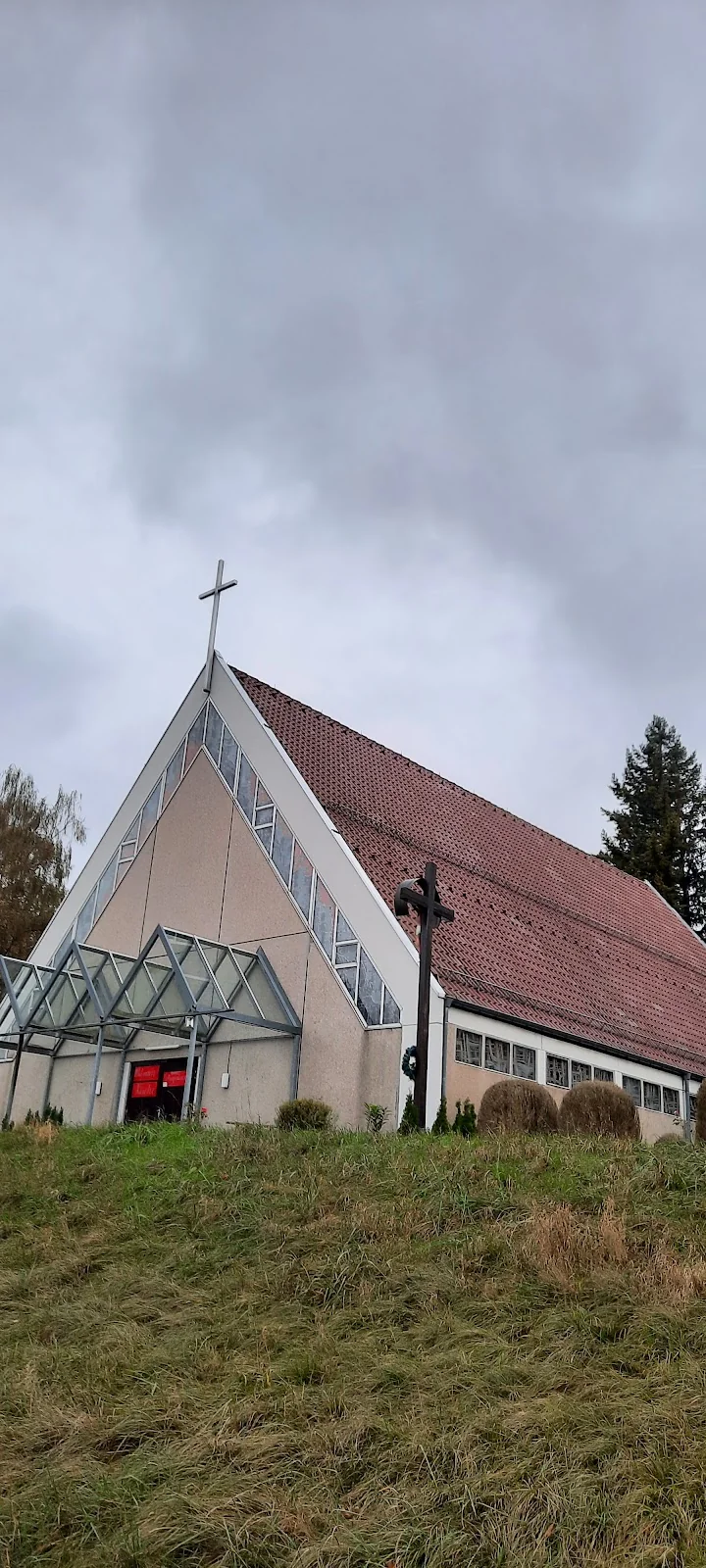
Langertstraße 116, Aalen
Langertstraße 116, 73431 Aalen, Germany
St. Augustinus Aalen | History & Architecture
St. Augustinus in Aalen is a church that appears calm and clear at first glance, but upon closer inspection tells an astonishingly dense history. The house of worship is located at Langertstraße 116 in the southern part of Aalen on a hill between Triumphstadt and Zochental. Visitors to the site do not experience an anonymous large church, but rather a space with a deliberately simple presence, understood as a house of God, a meeting place for the community, and a place for quiet reflection. The church guide explicitly invites people to enter the church, to let it affect them, to find peace, to pray, and to come before God with their own questions and doubts. This is exactly what makes St. Augustinus so special: Here, architecture, faith, neighborhood, and memory come together to create a place that does not need to be loud to leave an impression. ([katholische-kirche-aalen.de](https://katholische-kirche-aalen.de/wp-content/uploads/2024/09/Kirchenfuehrer_StAugustinus.pdf))
Planning and Construction of St. Augustinus Church in Aalen
The history of St. Augustinus does not begin with the visible building, but in the years after World War II, when many displaced persons from Silesia, the Sudetenland, Egerland, North and South Bohemia, and other eastern regions came to Aalen. In the 1950s, there was already consideration for building a church for the Triumphstadt settlement, as a new Catholic community was forming there and a sacred center was needed. City pastor Rudolf Renz early on sought a suitable building site. After difficult negotiations, the property was purchased in May 1968 with the support of the city. The purchase contract was concluded on May 20, 1968. Shortly thereafter, the decision was made to construct the church using prefabricated construction for cost reasons. Thus, St. Augustinus was not only a construction project but also a response to the concrete social and spiritual situation of the time. ([katholische-kirche-aalen.de](https://katholische-kirche-aalen.de/wp-content/uploads/2024/09/Kirchenfuehrer_StAugustinus.pdf))
The design comes from architect Frank from Herrenberg, who received several commissions for this type of church in the diocese. The church guide describes that the shell construction could already be erected in September 1969 using prefabricated parts, and the local press at the time reported on a church that stood in shell construction in just a few hours. The consecration took place on September 13, 1970, by Abbot Johannes Kraus from the Neresheim Monastery and was accompanied by a large turnout from the population. Thus, St. Augustinus quickly became a firmly anchored place in the church life of the city. Later, the church became a symbol of permanence again: In September 2020, it was able to celebrate its fiftieth anniversary. At the same time, the restored field cross at the entrance of the church was consecrated in this context. This chronology shows that the site was not only built but has been continuously supported, protected, and enlivened over decades. ([katholische-kirche-aalen.de](https://katholische-kirche-aalen.de/wp-content/uploads/2024/09/Kirchenfuehrer_StAugustinus.pdf))
The name of the church also has a double meaning. On the one hand, Augustine is the patron saint of the church, whose feast is celebrated on August 28. On the other hand, the name was also chosen in memory of Cardinal Augustin Bea, who particularly worked for the unity of Christian churches in the 20th century. This is important for the history of the place because evangelical services were also held in St. Augustinus until the early 1990s. The church was thus not only a space for one denomination but also a sign of lived closeness between Christian communities for a long time. Today, a line can be seen: From the construction as a reaction to a new housing estate through early ecumenical openness to the current participatory church, St. Augustinus has always remained a place where the church responds to a concrete urban reality. ([katholische-kirche-aalen.de](https://katholische-kirche-aalen.de/wp-content/uploads/2024/09/Kirchenfuehrer_StAugustinus.pdf))
Architecture, Windows, and Interior with Augustine Symbolism
Architecturally, St. Augustinus appears deliberately restrained. The church guide describes the architecture as not extraordinary but of simple beauty. It is precisely this simplicity that makes the space convincing. The towering steep roof with a low eaves gives the building warmth and presence. Between the concrete beams of the ceiling lies a wooden cladding, complemented by brown benches and a carpet in a similar color scheme. This creates a calm, cozy interior that is focused on concentration and contemplation. The furnishings remained initially sparse because at the same time the old St. Mary’s Church was to be demolished due to the construction of the new high bridge, and a new main church along with a community center was planned in Aalen. Many elements were therefore financed through donations and gifts. This interplay of simplicity, community spirit, and donated details continues to shape the character of the church to this day. ([katholische-kirche-aalen.de](https://katholische-kirche-aalen.de/wp-content/uploads/2024/09/Kirchenfuehrer_StAugustinus.pdf))
Particularly defining are the windows. The surrounding band of colored glass was designed by Georg Sternbacher and executed in his workshop in Unterkochen. In the nave, the windows are glazed in concrete, while in the gable of the gallery they are made of lead glass. The blue, yellow, and red glass surfaces with ornamental order not only aim to adorn but also to contribute to reflection and contemplation. Sternbacher himself explained that the main theme refers to symbols of Saint Augustine. In the two large windows on the east side, a flaming heart pierced by an arrow appears as a sign of the love of God of the church's patron. On the west side, the Eucharist with chalice and host is at the center; four crosses in the corners of the window refer to the four Latin Church Fathers, of whom Augustine is one. This imagery is complemented by the north window and the side window bands, which take up the flowing sea and the famous Augustine legend of the boy on the beach. Thus, the theological depth of the patron is made visible in colors, forms, and light. ([katholische-kirche-aalen.de](https://katholische-kirche-aalen.de/wp-content/uploads/2024/09/Kirchenfuehrer_StAugustinus.pdf))
The remaining furnishings also tell of the connection between sacred space and community. The altar is made of Kirchheimer shell limestone and is raised by two steps. The statue of Mary was solemnly consecrated in 1971 as a re-carving, and the figure of Augustine was added in 1980 and created by Erwin Massopust. Additionally, there is the organ, which was handed over from the former hospital chapel on August 30, 1992. It had to be disassembled, dusted, rebuilt, and re-tuned. The church guide also emphasizes that the figure of the church patron stands on a console to the left of the altar wall and is carved from lime wood. This clear arrangement of altar, figure, glass, and wood makes St. Augustinus a space where the liturgical order becomes immediately visible. The architecture is thus not monumental but very consciously shaped. It relies on calm proportions, light, and an understandable symbolic language that even visitors without church background can intuitively read. ([katholische-kirche-aalen.de](https://katholische-kirche-aalen.de/wp-content/uploads/2024/09/Kirchenfuehrer_StAugustinus.pdf))
Participatory Church, Services, and Spiritual Life
A special phase began in 2017 when the then pastor Wolfgang Sedlmeier vetoed plans to deconsecrate and demolish St. Augustinus. From this objection, the participatory church emerged. This is more than a nice term: The church guide describes very concretely that essential preservation measures have since been carried out by volunteers. Closing duties, order, cleanliness, decoration, and minor repairs are taken care of by people from the community. There is neither a caretaker nor a sacristan. Thus, St. Augustinus is an example of how a church location can be preserved and continued through the involvement of community members. The church is not only built; it is supported. This form of responsibility makes the site interesting for visitors because here, not only stone history but also lived present becomes visible. ([katholische-kirche-aalen.de](https://katholische-kirche-aalen.de/wp-content/uploads/2024/09/Kirchenfuehrer_StAugustinus.pdf))
The spiritual life is diverse. Catholic services take place in the church, and the church guide also mentions that a Russian Orthodox service is celebrated once a month. This points to an openness that fits the character of the place. Additionally, St. Augustinus was historically also used by evangelicals and thus was a space of confessional closeness for a long time. Today, this openness is evident not only in the liturgical life but also in the handling of the building itself: The church guide explicitly understands the church as a place where one can pray, gather, and reflect. The atmosphere is deliberately quiet but not sterile. It is precisely the mix of liturgical function, personal devotion, and communal care that distinguishes it from a pure event location. Those who come here are not looking for tickets or a show plan but a space for faith, peace, and encounter. Nevertheless, the church is not an isolated special place but part of the vibrant Catholic network in Aalen. ([katholische-kirche-aalen.de](https://katholische-kirche-aalen.de/wp-content/uploads/2024/09/Kirchenfuehrer_StAugustinus.pdf))
The inner attitude of the community is also remarkable. The website of the Catholic Church Aalen describes St. Augustinus not in isolation but as part of a pastoral unit, in which Salvator, St. Mary, and St. Boniface work together, and additionally, Italian and Croatian communities are included. For St. Augustinus, this means: The place does not stand alone but is embedded in a larger church community. That the church is still open today and explicitly invites visitors to explore shows the balance between sacred dignity and accessible invitation. Those who enter the space should not only see it but also arrive internally. This is exactly why the name participatory church fits so well: It means not only help in everyday life but also an attitude in which community, building, and service belong together. ([katholische-kirche-aalen.de](https://katholische-kirche-aalen.de/))
Festivals, Family, and Community Culture around St. Augustinus
St. Augustinus is not only a place of quiet devotion but also a vibrant meeting point for celebrations and community experiences. A beautiful example is the St. Nicholas celebration with a Christmas market in and around St. Augustinus, announced for Friday, December 5, 2025. The celebration in the church is organized by the St. Augustinus kindergarten, along with St. Nicholas, a cozy Christmas market, and hearty and sweet offerings. The St. Augustinus support association, the Triumphstadt-Zochental shared living community, and several kindergartens in the area work together on this. This shows how strongly the site is integrated into the social environment. St. Augustinus is thus a place where families, children, and adults can celebrate together without losing the church's character. The church becomes a neighborhood center in such moments, where faith, community, and everyday life come together quite naturally. ([katholische-kirche-aalen.de](https://katholische-kirche-aalen.de/class/grosse-nikolausfeier-mit-weihnachtsmarkt-in-und-um-st-augustinus/))
This neighborhood function is also evident in other contexts. As early as 2023, the Catholic Church Aalen reported on field crosses at Langert, specifically in the area between St. Augustinus and the Limesthermen. Four field crosses were donated by families after World War II as signs of gratitude or mourning. One of them was taken over by the parish, and after renovation by the participatory church, it stands in front of St. Augustinus Church. These field crosses are a special local memorial milieu that connects the church with the history of the city and its inhabitants. The Ösch procession on Ascension Day passes one of these crosses and makes it clear that St. Augustinus does not only function within its walls. The place radiates into the residential environment, into paths, intersections, and established neighborhoods. This is where an important part of its appeal lies: The church is a religious center and at the same time a place of memory for the surroundings. ([katholische-kirche-aalen.de](https://katholische-kirche-aalen.de/2023/05/09/oeschprozession-und-neues-feldkreuz/))
The fiftieth anniversary in 2020 also fits into this interpretation. It was not only a festive retrospective on the construction of 1970 but also a sign that the community has reasserted itself. The restored Stations of the Cross, the consecrated figure of Christ, the renewed field cross at the entrance, and the many small volunteer efforts show that St. Augustinus lives from people who take responsibility. This creates a culture that is neither museum-like nor arbitrary. Family celebrations, St. Nicholas, ecumenical connections, the support from volunteers, and the visible care of the outdoor space interlink. For visitors, this mix makes the place particularly interesting: St. Augustinus is not a pure sightseeing object but a place where one still experiences how community takes shape in everyday life. ([katholische-kirche-aalen.de](https://katholische-kirche-aalen.de/wp-content/uploads/2024/09/Kirchenfuehrer_StAugustinus.pdf))
Location in Triumphstadt, Orientation, and Visit On-Site
For orientation on-site, the address is clear: Langertstraße 116, 73431 Aalen. The city of Aalen lists the Catholic St. Augustinus Church in its own directory and additionally refers to the geodata portal. The church guide complements the location with a descriptive account: St. Augustinus stands in the southern part of Aalen on a hill that connects Triumphstadt and Zochental. This is a beautiful, almost picturesque location because the church thus visibly mediates between residential area, street, and neighborhood. Those heading to the site will not find a hidden edge building but a clearly located point in the urban fabric. The proximity to the field crosses at Langert and to the Limesthermen also shows that religious, historical, and urban spaces overlap here. For visitors, this means: The way to St. Augustinus is not just a short drive but almost a small walk through a piece of Aalen's city history. ([aalen.de](https://www.aalen.de/katholische-st-augustinus-kirche.2655.25.htm))
Those visiting St. Augustinus should adjust their expectations of a classic event venue. There is no ticket logic here like in a concert hall, nor is there an elaborately published seating plan like in a multipurpose hall. The church is intended as a place of worship, reflection, and communal life. The benches, the light, the symbolism, and the open invitation to enter determine the experience more than an event infrastructure. This is not a disadvantage but the essence of the place. Especially in a time when many buildings are only read by function, St. Augustinus remains a counter-model: a house with a clear spiritual purpose and a sense of space that focuses on peace and concentration. That the church is open and visitors are explicitly welcome makes it additionally attractive for all who want to discover architecture, faith history, or local identity. ([katholische-kirche-aalen.de](https://katholische-kirche-aalen.de/wp-content/uploads/2024/09/Kirchenfuehrer_StAugustinus.pdf))
The practical peculiarity lies less in capacity numbers than in the atmosphere. St. Augustinus is a church that shapes the character of Triumphstadt because it emerged from a specific historical situation and is today supported by volunteers, families, pastoral care, and special celebrations. The visible simplicity, the strong window images, the Augustine symbolism, and the location on the hill make the site a distinctive point in Aalen. Those looking for a place where architecture and community life complement each other meaningfully will find it here. And those simply wanting to visit a quiet, open church space in Aalen will find in St. Augustinus a place that fulfills this wish very directly. ([katholische-kirche-aalen.de](https://katholische-kirche-aalen.de/wp-content/uploads/2024/09/Kirchenfuehrer_StAugustinus.pdf))
Sources:
- Catholic Church Aalen - Church Guide St. Augustinus ([katholische-kirche-aalen.de](https://katholische-kirche-aalen.de/wp-content/uploads/2024/09/Kirchenfuehrer_StAugustinus.pdf))
- City of Aalen - Catholic St. Augustinus Church ([aalen.de](https://www.aalen.de/katholische-st-augustinus-kirche.2655.25.htm))
- Catholic Church Aalen - St. Mary and Community Page ([katholische-kirche-aalen.de](https://katholische-kirche-aalen.de/startseite/st-maria/))
- Catholic Church Aalen - Ösch Procession and New Field Cross ([katholische-kirche-aalen.de](https://katholische-kirche-aalen.de/2023/05/09/oeschprozession-und-neues-feldkreuz/))
- Catholic Church Aalen - Large St. Nicholas Celebration with Christmas Market in and around St. Augustinus ([katholische-kirche-aalen.de](https://katholische-kirche-aalen.de/class/grosse-nikolausfeier-mit-weihnachtsmarkt-in-und-um-st-augustinus/))
Show moreShow less
St. Augustinus Aalen | History & Architecture
St. Augustinus in Aalen is a church that appears calm and clear at first glance, but upon closer inspection tells an astonishingly dense history. The house of worship is located at Langertstraße 116 in the southern part of Aalen on a hill between Triumphstadt and Zochental. Visitors to the site do not experience an anonymous large church, but rather a space with a deliberately simple presence, understood as a house of God, a meeting place for the community, and a place for quiet reflection. The church guide explicitly invites people to enter the church, to let it affect them, to find peace, to pray, and to come before God with their own questions and doubts. This is exactly what makes St. Augustinus so special: Here, architecture, faith, neighborhood, and memory come together to create a place that does not need to be loud to leave an impression. ([katholische-kirche-aalen.de](https://katholische-kirche-aalen.de/wp-content/uploads/2024/09/Kirchenfuehrer_StAugustinus.pdf))
Planning and Construction of St. Augustinus Church in Aalen
The history of St. Augustinus does not begin with the visible building, but in the years after World War II, when many displaced persons from Silesia, the Sudetenland, Egerland, North and South Bohemia, and other eastern regions came to Aalen. In the 1950s, there was already consideration for building a church for the Triumphstadt settlement, as a new Catholic community was forming there and a sacred center was needed. City pastor Rudolf Renz early on sought a suitable building site. After difficult negotiations, the property was purchased in May 1968 with the support of the city. The purchase contract was concluded on May 20, 1968. Shortly thereafter, the decision was made to construct the church using prefabricated construction for cost reasons. Thus, St. Augustinus was not only a construction project but also a response to the concrete social and spiritual situation of the time. ([katholische-kirche-aalen.de](https://katholische-kirche-aalen.de/wp-content/uploads/2024/09/Kirchenfuehrer_StAugustinus.pdf))
The design comes from architect Frank from Herrenberg, who received several commissions for this type of church in the diocese. The church guide describes that the shell construction could already be erected in September 1969 using prefabricated parts, and the local press at the time reported on a church that stood in shell construction in just a few hours. The consecration took place on September 13, 1970, by Abbot Johannes Kraus from the Neresheim Monastery and was accompanied by a large turnout from the population. Thus, St. Augustinus quickly became a firmly anchored place in the church life of the city. Later, the church became a symbol of permanence again: In September 2020, it was able to celebrate its fiftieth anniversary. At the same time, the restored field cross at the entrance of the church was consecrated in this context. This chronology shows that the site was not only built but has been continuously supported, protected, and enlivened over decades. ([katholische-kirche-aalen.de](https://katholische-kirche-aalen.de/wp-content/uploads/2024/09/Kirchenfuehrer_StAugustinus.pdf))
The name of the church also has a double meaning. On the one hand, Augustine is the patron saint of the church, whose feast is celebrated on August 28. On the other hand, the name was also chosen in memory of Cardinal Augustin Bea, who particularly worked for the unity of Christian churches in the 20th century. This is important for the history of the place because evangelical services were also held in St. Augustinus until the early 1990s. The church was thus not only a space for one denomination but also a sign of lived closeness between Christian communities for a long time. Today, a line can be seen: From the construction as a reaction to a new housing estate through early ecumenical openness to the current participatory church, St. Augustinus has always remained a place where the church responds to a concrete urban reality. ([katholische-kirche-aalen.de](https://katholische-kirche-aalen.de/wp-content/uploads/2024/09/Kirchenfuehrer_StAugustinus.pdf))
Architecture, Windows, and Interior with Augustine Symbolism
Architecturally, St. Augustinus appears deliberately restrained. The church guide describes the architecture as not extraordinary but of simple beauty. It is precisely this simplicity that makes the space convincing. The towering steep roof with a low eaves gives the building warmth and presence. Between the concrete beams of the ceiling lies a wooden cladding, complemented by brown benches and a carpet in a similar color scheme. This creates a calm, cozy interior that is focused on concentration and contemplation. The furnishings remained initially sparse because at the same time the old St. Mary’s Church was to be demolished due to the construction of the new high bridge, and a new main church along with a community center was planned in Aalen. Many elements were therefore financed through donations and gifts. This interplay of simplicity, community spirit, and donated details continues to shape the character of the church to this day. ([katholische-kirche-aalen.de](https://katholische-kirche-aalen.de/wp-content/uploads/2024/09/Kirchenfuehrer_StAugustinus.pdf))
Particularly defining are the windows. The surrounding band of colored glass was designed by Georg Sternbacher and executed in his workshop in Unterkochen. In the nave, the windows are glazed in concrete, while in the gable of the gallery they are made of lead glass. The blue, yellow, and red glass surfaces with ornamental order not only aim to adorn but also to contribute to reflection and contemplation. Sternbacher himself explained that the main theme refers to symbols of Saint Augustine. In the two large windows on the east side, a flaming heart pierced by an arrow appears as a sign of the love of God of the church's patron. On the west side, the Eucharist with chalice and host is at the center; four crosses in the corners of the window refer to the four Latin Church Fathers, of whom Augustine is one. This imagery is complemented by the north window and the side window bands, which take up the flowing sea and the famous Augustine legend of the boy on the beach. Thus, the theological depth of the patron is made visible in colors, forms, and light. ([katholische-kirche-aalen.de](https://katholische-kirche-aalen.de/wp-content/uploads/2024/09/Kirchenfuehrer_StAugustinus.pdf))
The remaining furnishings also tell of the connection between sacred space and community. The altar is made of Kirchheimer shell limestone and is raised by two steps. The statue of Mary was solemnly consecrated in 1971 as a re-carving, and the figure of Augustine was added in 1980 and created by Erwin Massopust. Additionally, there is the organ, which was handed over from the former hospital chapel on August 30, 1992. It had to be disassembled, dusted, rebuilt, and re-tuned. The church guide also emphasizes that the figure of the church patron stands on a console to the left of the altar wall and is carved from lime wood. This clear arrangement of altar, figure, glass, and wood makes St. Augustinus a space where the liturgical order becomes immediately visible. The architecture is thus not monumental but very consciously shaped. It relies on calm proportions, light, and an understandable symbolic language that even visitors without church background can intuitively read. ([katholische-kirche-aalen.de](https://katholische-kirche-aalen.de/wp-content/uploads/2024/09/Kirchenfuehrer_StAugustinus.pdf))
Participatory Church, Services, and Spiritual Life
A special phase began in 2017 when the then pastor Wolfgang Sedlmeier vetoed plans to deconsecrate and demolish St. Augustinus. From this objection, the participatory church emerged. This is more than a nice term: The church guide describes very concretely that essential preservation measures have since been carried out by volunteers. Closing duties, order, cleanliness, decoration, and minor repairs are taken care of by people from the community. There is neither a caretaker nor a sacristan. Thus, St. Augustinus is an example of how a church location can be preserved and continued through the involvement of community members. The church is not only built; it is supported. This form of responsibility makes the site interesting for visitors because here, not only stone history but also lived present becomes visible. ([katholische-kirche-aalen.de](https://katholische-kirche-aalen.de/wp-content/uploads/2024/09/Kirchenfuehrer_StAugustinus.pdf))
The spiritual life is diverse. Catholic services take place in the church, and the church guide also mentions that a Russian Orthodox service is celebrated once a month. This points to an openness that fits the character of the place. Additionally, St. Augustinus was historically also used by evangelicals and thus was a space of confessional closeness for a long time. Today, this openness is evident not only in the liturgical life but also in the handling of the building itself: The church guide explicitly understands the church as a place where one can pray, gather, and reflect. The atmosphere is deliberately quiet but not sterile. It is precisely the mix of liturgical function, personal devotion, and communal care that distinguishes it from a pure event location. Those who come here are not looking for tickets or a show plan but a space for faith, peace, and encounter. Nevertheless, the church is not an isolated special place but part of the vibrant Catholic network in Aalen. ([katholische-kirche-aalen.de](https://katholische-kirche-aalen.de/wp-content/uploads/2024/09/Kirchenfuehrer_StAugustinus.pdf))
The inner attitude of the community is also remarkable. The website of the Catholic Church Aalen describes St. Augustinus not in isolation but as part of a pastoral unit, in which Salvator, St. Mary, and St. Boniface work together, and additionally, Italian and Croatian communities are included. For St. Augustinus, this means: The place does not stand alone but is embedded in a larger church community. That the church is still open today and explicitly invites visitors to explore shows the balance between sacred dignity and accessible invitation. Those who enter the space should not only see it but also arrive internally. This is exactly why the name participatory church fits so well: It means not only help in everyday life but also an attitude in which community, building, and service belong together. ([katholische-kirche-aalen.de](https://katholische-kirche-aalen.de/))
Festivals, Family, and Community Culture around St. Augustinus
St. Augustinus is not only a place of quiet devotion but also a vibrant meeting point for celebrations and community experiences. A beautiful example is the St. Nicholas celebration with a Christmas market in and around St. Augustinus, announced for Friday, December 5, 2025. The celebration in the church is organized by the St. Augustinus kindergarten, along with St. Nicholas, a cozy Christmas market, and hearty and sweet offerings. The St. Augustinus support association, the Triumphstadt-Zochental shared living community, and several kindergartens in the area work together on this. This shows how strongly the site is integrated into the social environment. St. Augustinus is thus a place where families, children, and adults can celebrate together without losing the church's character. The church becomes a neighborhood center in such moments, where faith, community, and everyday life come together quite naturally. ([katholische-kirche-aalen.de](https://katholische-kirche-aalen.de/class/grosse-nikolausfeier-mit-weihnachtsmarkt-in-und-um-st-augustinus/))
This neighborhood function is also evident in other contexts. As early as 2023, the Catholic Church Aalen reported on field crosses at Langert, specifically in the area between St. Augustinus and the Limesthermen. Four field crosses were donated by families after World War II as signs of gratitude or mourning. One of them was taken over by the parish, and after renovation by the participatory church, it stands in front of St. Augustinus Church. These field crosses are a special local memorial milieu that connects the church with the history of the city and its inhabitants. The Ösch procession on Ascension Day passes one of these crosses and makes it clear that St. Augustinus does not only function within its walls. The place radiates into the residential environment, into paths, intersections, and established neighborhoods. This is where an important part of its appeal lies: The church is a religious center and at the same time a place of memory for the surroundings. ([katholische-kirche-aalen.de](https://katholische-kirche-aalen.de/2023/05/09/oeschprozession-und-neues-feldkreuz/))
The fiftieth anniversary in 2020 also fits into this interpretation. It was not only a festive retrospective on the construction of 1970 but also a sign that the community has reasserted itself. The restored Stations of the Cross, the consecrated figure of Christ, the renewed field cross at the entrance, and the many small volunteer efforts show that St. Augustinus lives from people who take responsibility. This creates a culture that is neither museum-like nor arbitrary. Family celebrations, St. Nicholas, ecumenical connections, the support from volunteers, and the visible care of the outdoor space interlink. For visitors, this mix makes the place particularly interesting: St. Augustinus is not a pure sightseeing object but a place where one still experiences how community takes shape in everyday life. ([katholische-kirche-aalen.de](https://katholische-kirche-aalen.de/wp-content/uploads/2024/09/Kirchenfuehrer_StAugustinus.pdf))
Location in Triumphstadt, Orientation, and Visit On-Site
For orientation on-site, the address is clear: Langertstraße 116, 73431 Aalen. The city of Aalen lists the Catholic St. Augustinus Church in its own directory and additionally refers to the geodata portal. The church guide complements the location with a descriptive account: St. Augustinus stands in the southern part of Aalen on a hill that connects Triumphstadt and Zochental. This is a beautiful, almost picturesque location because the church thus visibly mediates between residential area, street, and neighborhood. Those heading to the site will not find a hidden edge building but a clearly located point in the urban fabric. The proximity to the field crosses at Langert and to the Limesthermen also shows that religious, historical, and urban spaces overlap here. For visitors, this means: The way to St. Augustinus is not just a short drive but almost a small walk through a piece of Aalen's city history. ([aalen.de](https://www.aalen.de/katholische-st-augustinus-kirche.2655.25.htm))
Those visiting St. Augustinus should adjust their expectations of a classic event venue. There is no ticket logic here like in a concert hall, nor is there an elaborately published seating plan like in a multipurpose hall. The church is intended as a place of worship, reflection, and communal life. The benches, the light, the symbolism, and the open invitation to enter determine the experience more than an event infrastructure. This is not a disadvantage but the essence of the place. Especially in a time when many buildings are only read by function, St. Augustinus remains a counter-model: a house with a clear spiritual purpose and a sense of space that focuses on peace and concentration. That the church is open and visitors are explicitly welcome makes it additionally attractive for all who want to discover architecture, faith history, or local identity. ([katholische-kirche-aalen.de](https://katholische-kirche-aalen.de/wp-content/uploads/2024/09/Kirchenfuehrer_StAugustinus.pdf))
The practical peculiarity lies less in capacity numbers than in the atmosphere. St. Augustinus is a church that shapes the character of Triumphstadt because it emerged from a specific historical situation and is today supported by volunteers, families, pastoral care, and special celebrations. The visible simplicity, the strong window images, the Augustine symbolism, and the location on the hill make the site a distinctive point in Aalen. Those looking for a place where architecture and community life complement each other meaningfully will find it here. And those simply wanting to visit a quiet, open church space in Aalen will find in St. Augustinus a place that fulfills this wish very directly. ([katholische-kirche-aalen.de](https://katholische-kirche-aalen.de/wp-content/uploads/2024/09/Kirchenfuehrer_StAugustinus.pdf))
Sources:
- Catholic Church Aalen - Church Guide St. Augustinus ([katholische-kirche-aalen.de](https://katholische-kirche-aalen.de/wp-content/uploads/2024/09/Kirchenfuehrer_StAugustinus.pdf))
- City of Aalen - Catholic St. Augustinus Church ([aalen.de](https://www.aalen.de/katholische-st-augustinus-kirche.2655.25.htm))
- Catholic Church Aalen - St. Mary and Community Page ([katholische-kirche-aalen.de](https://katholische-kirche-aalen.de/startseite/st-maria/))
- Catholic Church Aalen - Ösch Procession and New Field Cross ([katholische-kirche-aalen.de](https://katholische-kirche-aalen.de/2023/05/09/oeschprozession-und-neues-feldkreuz/))
- Catholic Church Aalen - Large St. Nicholas Celebration with Christmas Market in and around St. Augustinus ([katholische-kirche-aalen.de](https://katholische-kirche-aalen.de/class/grosse-nikolausfeier-mit-weihnachtsmarkt-in-und-um-st-augustinus/))
St. Augustinus Aalen | History & Architecture
St. Augustinus in Aalen is a church that appears calm and clear at first glance, but upon closer inspection tells an astonishingly dense history. The house of worship is located at Langertstraße 116 in the southern part of Aalen on a hill between Triumphstadt and Zochental. Visitors to the site do not experience an anonymous large church, but rather a space with a deliberately simple presence, understood as a house of God, a meeting place for the community, and a place for quiet reflection. The church guide explicitly invites people to enter the church, to let it affect them, to find peace, to pray, and to come before God with their own questions and doubts. This is exactly what makes St. Augustinus so special: Here, architecture, faith, neighborhood, and memory come together to create a place that does not need to be loud to leave an impression. ([katholische-kirche-aalen.de](https://katholische-kirche-aalen.de/wp-content/uploads/2024/09/Kirchenfuehrer_StAugustinus.pdf))
Planning and Construction of St. Augustinus Church in Aalen
The history of St. Augustinus does not begin with the visible building, but in the years after World War II, when many displaced persons from Silesia, the Sudetenland, Egerland, North and South Bohemia, and other eastern regions came to Aalen. In the 1950s, there was already consideration for building a church for the Triumphstadt settlement, as a new Catholic community was forming there and a sacred center was needed. City pastor Rudolf Renz early on sought a suitable building site. After difficult negotiations, the property was purchased in May 1968 with the support of the city. The purchase contract was concluded on May 20, 1968. Shortly thereafter, the decision was made to construct the church using prefabricated construction for cost reasons. Thus, St. Augustinus was not only a construction project but also a response to the concrete social and spiritual situation of the time. ([katholische-kirche-aalen.de](https://katholische-kirche-aalen.de/wp-content/uploads/2024/09/Kirchenfuehrer_StAugustinus.pdf))
The design comes from architect Frank from Herrenberg, who received several commissions for this type of church in the diocese. The church guide describes that the shell construction could already be erected in September 1969 using prefabricated parts, and the local press at the time reported on a church that stood in shell construction in just a few hours. The consecration took place on September 13, 1970, by Abbot Johannes Kraus from the Neresheim Monastery and was accompanied by a large turnout from the population. Thus, St. Augustinus quickly became a firmly anchored place in the church life of the city. Later, the church became a symbol of permanence again: In September 2020, it was able to celebrate its fiftieth anniversary. At the same time, the restored field cross at the entrance of the church was consecrated in this context. This chronology shows that the site was not only built but has been continuously supported, protected, and enlivened over decades. ([katholische-kirche-aalen.de](https://katholische-kirche-aalen.de/wp-content/uploads/2024/09/Kirchenfuehrer_StAugustinus.pdf))
The name of the church also has a double meaning. On the one hand, Augustine is the patron saint of the church, whose feast is celebrated on August 28. On the other hand, the name was also chosen in memory of Cardinal Augustin Bea, who particularly worked for the unity of Christian churches in the 20th century. This is important for the history of the place because evangelical services were also held in St. Augustinus until the early 1990s. The church was thus not only a space for one denomination but also a sign of lived closeness between Christian communities for a long time. Today, a line can be seen: From the construction as a reaction to a new housing estate through early ecumenical openness to the current participatory church, St. Augustinus has always remained a place where the church responds to a concrete urban reality. ([katholische-kirche-aalen.de](https://katholische-kirche-aalen.de/wp-content/uploads/2024/09/Kirchenfuehrer_StAugustinus.pdf))
Architecture, Windows, and Interior with Augustine Symbolism
Architecturally, St. Augustinus appears deliberately restrained. The church guide describes the architecture as not extraordinary but of simple beauty. It is precisely this simplicity that makes the space convincing. The towering steep roof with a low eaves gives the building warmth and presence. Between the concrete beams of the ceiling lies a wooden cladding, complemented by brown benches and a carpet in a similar color scheme. This creates a calm, cozy interior that is focused on concentration and contemplation. The furnishings remained initially sparse because at the same time the old St. Mary’s Church was to be demolished due to the construction of the new high bridge, and a new main church along with a community center was planned in Aalen. Many elements were therefore financed through donations and gifts. This interplay of simplicity, community spirit, and donated details continues to shape the character of the church to this day. ([katholische-kirche-aalen.de](https://katholische-kirche-aalen.de/wp-content/uploads/2024/09/Kirchenfuehrer_StAugustinus.pdf))
Particularly defining are the windows. The surrounding band of colored glass was designed by Georg Sternbacher and executed in his workshop in Unterkochen. In the nave, the windows are glazed in concrete, while in the gable of the gallery they are made of lead glass. The blue, yellow, and red glass surfaces with ornamental order not only aim to adorn but also to contribute to reflection and contemplation. Sternbacher himself explained that the main theme refers to symbols of Saint Augustine. In the two large windows on the east side, a flaming heart pierced by an arrow appears as a sign of the love of God of the church's patron. On the west side, the Eucharist with chalice and host is at the center; four crosses in the corners of the window refer to the four Latin Church Fathers, of whom Augustine is one. This imagery is complemented by the north window and the side window bands, which take up the flowing sea and the famous Augustine legend of the boy on the beach. Thus, the theological depth of the patron is made visible in colors, forms, and light. ([katholische-kirche-aalen.de](https://katholische-kirche-aalen.de/wp-content/uploads/2024/09/Kirchenfuehrer_StAugustinus.pdf))
The remaining furnishings also tell of the connection between sacred space and community. The altar is made of Kirchheimer shell limestone and is raised by two steps. The statue of Mary was solemnly consecrated in 1971 as a re-carving, and the figure of Augustine was added in 1980 and created by Erwin Massopust. Additionally, there is the organ, which was handed over from the former hospital chapel on August 30, 1992. It had to be disassembled, dusted, rebuilt, and re-tuned. The church guide also emphasizes that the figure of the church patron stands on a console to the left of the altar wall and is carved from lime wood. This clear arrangement of altar, figure, glass, and wood makes St. Augustinus a space where the liturgical order becomes immediately visible. The architecture is thus not monumental but very consciously shaped. It relies on calm proportions, light, and an understandable symbolic language that even visitors without church background can intuitively read. ([katholische-kirche-aalen.de](https://katholische-kirche-aalen.de/wp-content/uploads/2024/09/Kirchenfuehrer_StAugustinus.pdf))
Participatory Church, Services, and Spiritual Life
A special phase began in 2017 when the then pastor Wolfgang Sedlmeier vetoed plans to deconsecrate and demolish St. Augustinus. From this objection, the participatory church emerged. This is more than a nice term: The church guide describes very concretely that essential preservation measures have since been carried out by volunteers. Closing duties, order, cleanliness, decoration, and minor repairs are taken care of by people from the community. There is neither a caretaker nor a sacristan. Thus, St. Augustinus is an example of how a church location can be preserved and continued through the involvement of community members. The church is not only built; it is supported. This form of responsibility makes the site interesting for visitors because here, not only stone history but also lived present becomes visible. ([katholische-kirche-aalen.de](https://katholische-kirche-aalen.de/wp-content/uploads/2024/09/Kirchenfuehrer_StAugustinus.pdf))
The spiritual life is diverse. Catholic services take place in the church, and the church guide also mentions that a Russian Orthodox service is celebrated once a month. This points to an openness that fits the character of the place. Additionally, St. Augustinus was historically also used by evangelicals and thus was a space of confessional closeness for a long time. Today, this openness is evident not only in the liturgical life but also in the handling of the building itself: The church guide explicitly understands the church as a place where one can pray, gather, and reflect. The atmosphere is deliberately quiet but not sterile. It is precisely the mix of liturgical function, personal devotion, and communal care that distinguishes it from a pure event location. Those who come here are not looking for tickets or a show plan but a space for faith, peace, and encounter. Nevertheless, the church is not an isolated special place but part of the vibrant Catholic network in Aalen. ([katholische-kirche-aalen.de](https://katholische-kirche-aalen.de/wp-content/uploads/2024/09/Kirchenfuehrer_StAugustinus.pdf))
The inner attitude of the community is also remarkable. The website of the Catholic Church Aalen describes St. Augustinus not in isolation but as part of a pastoral unit, in which Salvator, St. Mary, and St. Boniface work together, and additionally, Italian and Croatian communities are included. For St. Augustinus, this means: The place does not stand alone but is embedded in a larger church community. That the church is still open today and explicitly invites visitors to explore shows the balance between sacred dignity and accessible invitation. Those who enter the space should not only see it but also arrive internally. This is exactly why the name participatory church fits so well: It means not only help in everyday life but also an attitude in which community, building, and service belong together. ([katholische-kirche-aalen.de](https://katholische-kirche-aalen.de/))
Festivals, Family, and Community Culture around St. Augustinus
St. Augustinus is not only a place of quiet devotion but also a vibrant meeting point for celebrations and community experiences. A beautiful example is the St. Nicholas celebration with a Christmas market in and around St. Augustinus, announced for Friday, December 5, 2025. The celebration in the church is organized by the St. Augustinus kindergarten, along with St. Nicholas, a cozy Christmas market, and hearty and sweet offerings. The St. Augustinus support association, the Triumphstadt-Zochental shared living community, and several kindergartens in the area work together on this. This shows how strongly the site is integrated into the social environment. St. Augustinus is thus a place where families, children, and adults can celebrate together without losing the church's character. The church becomes a neighborhood center in such moments, where faith, community, and everyday life come together quite naturally. ([katholische-kirche-aalen.de](https://katholische-kirche-aalen.de/class/grosse-nikolausfeier-mit-weihnachtsmarkt-in-und-um-st-augustinus/))
This neighborhood function is also evident in other contexts. As early as 2023, the Catholic Church Aalen reported on field crosses at Langert, specifically in the area between St. Augustinus and the Limesthermen. Four field crosses were donated by families after World War II as signs of gratitude or mourning. One of them was taken over by the parish, and after renovation by the participatory church, it stands in front of St. Augustinus Church. These field crosses are a special local memorial milieu that connects the church with the history of the city and its inhabitants. The Ösch procession on Ascension Day passes one of these crosses and makes it clear that St. Augustinus does not only function within its walls. The place radiates into the residential environment, into paths, intersections, and established neighborhoods. This is where an important part of its appeal lies: The church is a religious center and at the same time a place of memory for the surroundings. ([katholische-kirche-aalen.de](https://katholische-kirche-aalen.de/2023/05/09/oeschprozession-und-neues-feldkreuz/))
The fiftieth anniversary in 2020 also fits into this interpretation. It was not only a festive retrospective on the construction of 1970 but also a sign that the community has reasserted itself. The restored Stations of the Cross, the consecrated figure of Christ, the renewed field cross at the entrance, and the many small volunteer efforts show that St. Augustinus lives from people who take responsibility. This creates a culture that is neither museum-like nor arbitrary. Family celebrations, St. Nicholas, ecumenical connections, the support from volunteers, and the visible care of the outdoor space interlink. For visitors, this mix makes the place particularly interesting: St. Augustinus is not a pure sightseeing object but a place where one still experiences how community takes shape in everyday life. ([katholische-kirche-aalen.de](https://katholische-kirche-aalen.de/wp-content/uploads/2024/09/Kirchenfuehrer_StAugustinus.pdf))
Location in Triumphstadt, Orientation, and Visit On-Site
For orientation on-site, the address is clear: Langertstraße 116, 73431 Aalen. The city of Aalen lists the Catholic St. Augustinus Church in its own directory and additionally refers to the geodata portal. The church guide complements the location with a descriptive account: St. Augustinus stands in the southern part of Aalen on a hill that connects Triumphstadt and Zochental. This is a beautiful, almost picturesque location because the church thus visibly mediates between residential area, street, and neighborhood. Those heading to the site will not find a hidden edge building but a clearly located point in the urban fabric. The proximity to the field crosses at Langert and to the Limesthermen also shows that religious, historical, and urban spaces overlap here. For visitors, this means: The way to St. Augustinus is not just a short drive but almost a small walk through a piece of Aalen's city history. ([aalen.de](https://www.aalen.de/katholische-st-augustinus-kirche.2655.25.htm))
Those visiting St. Augustinus should adjust their expectations of a classic event venue. There is no ticket logic here like in a concert hall, nor is there an elaborately published seating plan like in a multipurpose hall. The church is intended as a place of worship, reflection, and communal life. The benches, the light, the symbolism, and the open invitation to enter determine the experience more than an event infrastructure. This is not a disadvantage but the essence of the place. Especially in a time when many buildings are only read by function, St. Augustinus remains a counter-model: a house with a clear spiritual purpose and a sense of space that focuses on peace and concentration. That the church is open and visitors are explicitly welcome makes it additionally attractive for all who want to discover architecture, faith history, or local identity. ([katholische-kirche-aalen.de](https://katholische-kirche-aalen.de/wp-content/uploads/2024/09/Kirchenfuehrer_StAugustinus.pdf))
The practical peculiarity lies less in capacity numbers than in the atmosphere. St. Augustinus is a church that shapes the character of Triumphstadt because it emerged from a specific historical situation and is today supported by volunteers, families, pastoral care, and special celebrations. The visible simplicity, the strong window images, the Augustine symbolism, and the location on the hill make the site a distinctive point in Aalen. Those looking for a place where architecture and community life complement each other meaningfully will find it here. And those simply wanting to visit a quiet, open church space in Aalen will find in St. Augustinus a place that fulfills this wish very directly. ([katholische-kirche-aalen.de](https://katholische-kirche-aalen.de/wp-content/uploads/2024/09/Kirchenfuehrer_StAugustinus.pdf))
Sources:
- Catholic Church Aalen - Church Guide St. Augustinus ([katholische-kirche-aalen.de](https://katholische-kirche-aalen.de/wp-content/uploads/2024/09/Kirchenfuehrer_StAugustinus.pdf))
- City of Aalen - Catholic St. Augustinus Church ([aalen.de](https://www.aalen.de/katholische-st-augustinus-kirche.2655.25.htm))
- Catholic Church Aalen - St. Mary and Community Page ([katholische-kirche-aalen.de](https://katholische-kirche-aalen.de/startseite/st-maria/))
- Catholic Church Aalen - Ösch Procession and New Field Cross ([katholische-kirche-aalen.de](https://katholische-kirche-aalen.de/2023/05/09/oeschprozession-und-neues-feldkreuz/))
- Catholic Church Aalen - Large St. Nicholas Celebration with Christmas Market in and around St. Augustinus ([katholische-kirche-aalen.de](https://katholische-kirche-aalen.de/class/grosse-nikolausfeier-mit-weihnachtsmarkt-in-und-um-st-augustinus/))
Frequently Asked Questions
Reviews
Myke V.
19. October 2024
Peace and quiet!!!
T U
17. March 2026
A wonderful building for services and community gatherings. Thanks to the owners for their care of this church!
Ella Schmidt
4. November 2025
Adrian Incert
5. October 2025
Rainer Neumann
21. May 2025