
Aalen
Stefanspl., 73433 Aalen, Deutschland
Sieger-Köder-Weg Wasseralfingen | Photos & Tour
The Sieger-Köder-Weg in Wasseralfingen is not just an ordinary walk, but an art-historical tour that connects the place, its people, and the visual language of Sieger Köder. The path commemorates the painter, pastor, and religious artist born in Wasseralfingen in 1925, whose life remained deeply connected to the district. After his death in 2015, the path was created in his honor and designed as a journey of insights. Those who walk it encounter not only works by Sieger Köder himself but also works by fellow artists, art-historical treasures, and text panels with quotes that deepen the experience. Over approximately 3 kilometers, a dense cultural space emerges between Stefansplatz, the church, the town hall, the Kocher, the castle, and the cemetery. Depending on the duration of the visit, it takes about 40 to 90 minutes, but those who look closely will quickly discover that this path is much more than a route from station to station. It is an invitation to read Wasseralfingen anew as a place of memory, connection to home, and religiously influenced art. ([aalen-tourismus.de](https://www.aalen-tourismus.de/sieger-koeder-weg-wasseralfingen.182524.htm))
What makes the Sieger-Köder-Weg in Wasseralfingen special
The special charm of the Sieger-Köder-Weg lies in the fact that it cannot be reduced to a single building or a single artwork. Rather, it links the biography of an artist born in Wasseralfingen with the historical core of the district and with places that were formative for Köder himself. The official description speaks of artworks from his hometown, works by fellow artist colleagues, art-historical treasures in churches and a castle complex, as well as text panels that explain the works with thought-provoking quotes. This makes the path not only an aesthetic experience but also a substantive one. Visitors see how art, home, and faith belong together, and this connection was central for Sieger Köder himself. His attitude, the love for his homeland, for art, for God, and for fellow human beings, is palpable along the stations. Especially because the tour is small-scale, it unfolds a strong density: one walks a few steps and yet constantly shifts between interior art, sculpture, architecture, river landscape, and culture of remembrance. This makes the path one of the most impressive cultural walks in Aalen-Wasseralfingen. ([aalen-tourismus.de](https://www.aalen-tourismus.de/sieger-koeder-weg-wasseralfingen.182524.htm))
The history of its creation also gives depth to the path. The city of Aalen points out that Wasseralfingen was historically shaped by industry, iron ore processing, and a strong population increase, which led to its elevation to city status in 1951. At the same time, the local history reminds us that Wasseralfingen lost its independence with the administrative reform in 1975, but its cultural identity is to be consciously preserved. This is exactly where the Sieger-Köder-Weg comes in: it makes visible a place whose history is shaped by work, faith, art, and communal development. Those interested in local history quickly recognize that the tour is not decorative embellishment but a deliberately set identity project. It shows how a district preserves its own narrative through art and passes it on to future generations. This is an important reason why the path is also interesting for people who did not know Sieger Köder beforehand. It serves as an entry point into his work and at the same time as access to the history of Wasseralfingen. ([wasseralfingen.aalen.de](https://wasseralfingen.aalen.de/sieger-koeder-weg.144650.267.htm))
St. Stephanus at Stefansplatz: the artistic focal point of the route
The most important starting and reference point of the Sieger-Köder-Weg is the Catholic parish church of St. Stephanus at Stefansplatz. The church was built between 1881 and 1883 as a classic three-nave basilica and forms the center of the tour with its historic neighboring buildings. The artistic journey of discovery begins at the west facade and the large entrance portal, as Sieger Köder designed figure reliefs and two sculptural bronze handles on the copper surface. Inside the church, this impression continues: along the walls of both side aisles, 14 Stations of the Cross painted by Köder lead to the choir, where the so-called Wasseralfinger altar stands. This corresponds to a Gothic, convertible wing altar and includes a total of nine images with central themes of the Christian faith. Köder repeatedly connects biblical scenes with personal experiences and current references. This is precisely what makes the impact of the church so strong: it is not merely an exhibition space but a spiritual space where art and liturgy intertwine. ([wasseralfingen.aalen.de](https://wasseralfingen.aalen.de/sieger-koeder-weg-flyer.144647.267.htm))
The furnishings of St. Stephanus include additional works that make the visit particularly exciting. Sieger Köder created the bronze tabernacle, and above the altar, five tall stained glass windows by the friend artist Rudolf Haegele complement the ensemble. Helmut Schuster, a painter from Wasseralfingen and later a fellow artist, is also represented with a rose window at the organ gallery. Before leaving, the first stained glass rose window created by Köder, featuring a dove as a symbol of the Holy Spirit, catches the eye. The church space thus becomes a dense overall work, where various artists and several generations come together. The official path description also emphasizes that even the view inside awakens the desire in many visitors to linger longer. Therefore, those visiting the Sieger-Köder-Weg should not only tick off St. Stephanus as a station but understand it as the actual focal point of the path. Here, Köder's handwriting condenses in an impressive way: figurative, biblical, human, and deeply connected to Wasseralfingen. ([wasseralfingen.aalen.de](https://wasseralfingen.aalen.de/sieger-koeder-weg-flyer.144647.267.htm))
Town Hall, Stefansplatz, and the Art at the Town Center
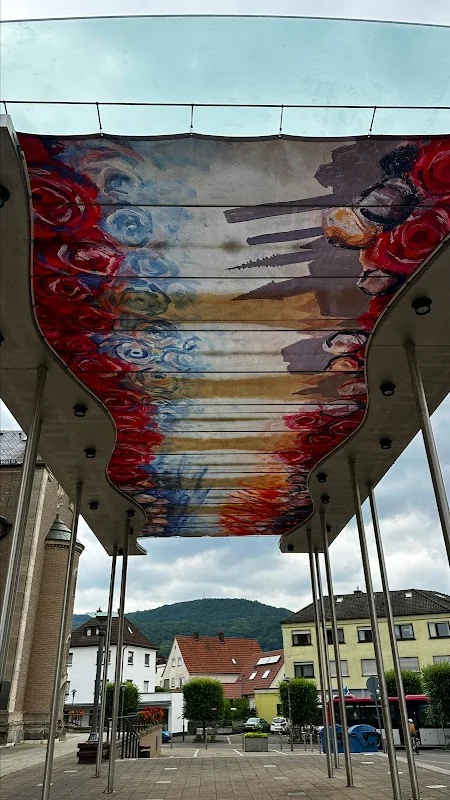
Around Stefansplatz, the Sieger-Köder-Weg shows how closely the artist's biography is connected to the town center. Sieger Köder was born in the town hall in 1925; the path description points this out with a monogram in a window on the second floor that marks the room at that time. In the ground floor, drawings by the artist are displayed on neon yellow acrylic glass, and the large entrance door of the town hall was also designed by him. This makes the administrative building itself a bearer of local history. Directly in front of the church stands a stele with the bronze likeness of Sieger Köder, created by Rudolf Kurz, which directs the gaze back over the square to the painter's roots. Thus, Stefansplatz is not just an address but a kind of stage of remembrance where church construction, town hall, and art intertwine. For visitors, this is an ideal entry point, as the most important themes of the path are already concentrated here: origin, identity, religious art, and public memory. ([wasseralfingen.aalen.de](https://wasseralfingen.aalen.de/sieger-koeder-weg-flyer.144647.267.htm))
Those who continue walking from Stefansplatz will quickly encounter more notable works in the public space. Opposite the community center is the Stephanus-Saul fountain, which Sieger Köder created in 2006; a BINGOle code is located according to Aalen Tourism at the edge of the fountain. Nearby stands the David stele, and just a few meters further begins the path to the Kocher peninsula. There, visitors encounter the Kocher mermaids by Hannes Münz, an artist who also comes from Sieger Köder's circle. On the peninsula itself stands the pilgrim made of solid iron art cast, whose index finger points towards Santiago de Compostela and at the same time to the word ALL in the mill canal flow. This connects local art with foresight and symbolic openness. This is also typical of the path: it never stands still but always draws new references. Those who walk it attentively experience a series of images in the town center of Wasseralfingen that are not only decorative but also raise questions about origin, faith, movement, and life path. For this reason, it is worthwhile to not just pass by Stefansplatz but to consciously linger there longer. ([wasseralfingen.aalen.de](https://wasseralfingen.aalen.de/sieger-koeder-weg-flyer.144647.267.htm))
Wasseralfinger Castle, Old Church, and Cemetery: the path in further course
After the town center, the Sieger-Köder-Weg continues to stations that broaden the view once again. An important destination is the Wasseralfinger Castle with its chapel. In front of the entrance stands a large marble sculpture by Rudolf Kurz titled Church Landscape, which responds in its puristic form to the simple structure of the chapel. Inside, visitors encounter stained glass windows by Willi Köble, Helmut Schuster, Roland May, and Sieger Köder, as well as a rich decoration that dates back more than four centuries. The baroque crucifix from the 17th century, the late baroque altar with the painting of Saint Wendelin, and other votive offerings make this part of the path particularly versatile. The route shows here that Köder's art does not stand in isolation but can be read together with older layers of the place. The castle thus becomes a place where sacred tradition, regional history, and modern visual language meet. ([wasseralfingen.aalen.de](https://wasseralfingen.aalen.de/sieger-koeder-weg-flyer.144647.267.htm))
The next strong destination is the Old Church. There, the Sieger-Köder-Weg initially ends; however, for particularly hiking enthusiasts, the path can be extended to the cemetery about 600 meters away. Significant traces of Sieger Köder can also be found there: the bronze cross he created in 1967 for his parents' grave, the burial fields of prisoners of war, forced laborers, and concentration camp inmates, as well as the simple grave of the artist at the southern cemetery wall. His grave was designed by his nephew Burkhard Michalsky and is oriented towards the large bronze relief on the wall, which depicts the Transfiguration on Mount Tabor. This last station gives the path a quiet, very personal dimension. Those who arrive here experience not only art but also memory, family history, and a conscious conclusion. The official path description also mentions an alternative route back past the Köder house, where a sgraffito with the Tobias and Raphael story from 1958 can be seen on the eastern gable wall of house number 17. Thus, the tour does not end abruptly but opens up further possibilities to get to know Wasseralfingen even better. ([wasseralfingen.aalen.de](https://wasseralfingen.aalen.de/sieger-koeder-weg-flyer.144647.267.htm))
Access, Parking, and Tours on the Sieger-Köder-Weg
For practical planning, the Sieger-Köder-Weg is pleasantly uncomplicated. The central starting point is at Stefansplatz 3 in 73433 Aalen-Wasseralfingen, right in the town center. According to the city of Aalen, there is a parking space opposite at Stefansplatz, accessible from the side of the road, and the area is connected to the bus stop Stephanuskirche, which is served by lines 11 and 13 to 18. This makes getting there easy both by car and by public transport. The Wasseralfingen town hall is also accessible via the rear entrance and has an elevator; the accessibility information also mentions a toilet for all. Those planning the path with limited mobility thus find important orientation points. The tour is also well organized: The Aalen Tourist Information and the town hall refer to clear contact details, and tours can be booked directly through the Catholic parish office or the Wasseralfingen town hall. Particularly helpful is that combination tours are possible, such as church plus Sieger-Köder-Weg or church, Sieger-Köder-Weg, and museum gallery in the community center. ([wasseralfingen.aalen.de](https://wasseralfingen.aalen.de/rathaus-wasseralfingen.172088.267.htm))
For visitors who do not want to walk the path alone, the tour structure is a real plus. The official description explicitly states that individual time wishes or breaks for meals or coffee are possible. This is practical for groups as well as for private cultural walks. Those who additionally want to take a look beyond the core path can plan a visit to the nearby Protestant Magdalenenkirche, which is about 500 meters from Stefansplatz and is usually open on Sundays between 9 and 12 o'clock; group tours can be arranged separately there. This further reinforces the impression that Wasseralfingen is overall very closely connected to Sieger Köder. Especially for visitors who only have half a day, this creates a clever route: start at Stefansplatz, look into St. Stephanus, take a short detour to the Kocher and the castle, and then depending on interest, visit the cemetery or Magdalenenkirche. This way, the path can be well integrated into a city visit, an excursion from Aalen, or a culture-oriented weekend. ([wasseralfingen.aalen.de](https://wasseralfingen.aalen.de/sieger-koeder-weg-flyer.144647.267.htm))
Photos, Perspectives, and the Best Tips for the Visit
Those looking for images of the Sieger Köder Weg Wasseralfingen will quickly notice that this tour is particularly photogenic because it offers very different image motifs in a small space. The west facade and the portal of St. Stephanus, the bronze likeness of Sieger Köder at Stefansplatz, the art at the town hall, as well as the stations at the Kocher peninsula and Wasseralfinger Castle usually have the strongest impact. Additionally, there are the quieter motifs at the cemetery, where the relief on the wall and the artist's grave create a very calm, almost meditative visual language. For photos, the path is interesting because one does not only document individual artworks but captures a whole series of moods: urban, ecclesiastical, landscape, and memorial. Since the tour is only about 3 kilometers long, it can easily be walked with several photo stops without losing its lightness. The change between indoor and outdoor stations also makes the experience varied. This mix of proximity and diversity is one reason why the Sieger-Köder-Weg works so well visually. ([aalen-tourismus.de](https://www.aalen-tourismus.de/sieger-koeder-weg-wasseralfingen.182524.htm))
A good visiting tip is: Take more time than the pure walking time suggests. The official indications of 40 to 90 minutes are based on the duration of the stay, and this duration is crucial here. Those who really want to look at art and architecture should not rush the path. It is particularly sensible to start with St. Stephanus, then explore Stefansplatz with the town hall and fountain, and only then continue towards Kocher and the castle. This way, the tour fits together logically. Those who want to learn more about Sieger Köder should also take advantage of the tour offers, as the individual stations are placed in a larger context there. For all those planning their visit on a Sunday, the Magdalenenkirche can also be an additional stop, provided it is open or a group visit has been arranged. In the end, the impression remains of a path that unusually closely connects art, local history, and personal memory. For this reason, it is suitable not only for art lovers but also for families, walkers, school classes, groups, and anyone who wants to understand Wasseralfingen through its images. ([aalen-tourismus.de](https://www.aalen-tourismus.de/sieger-koeder-weg-wasseralfingen.182524.htm))
Sources:
Mehr anzeigenWeniger anzeigen
Sieger-Köder-Weg Wasseralfingen | Photos & Tour
The Sieger-Köder-Weg in Wasseralfingen is not just an ordinary walk, but an art-historical tour that connects the place, its people, and the visual language of Sieger Köder. The path commemorates the painter, pastor, and religious artist born in Wasseralfingen in 1925, whose life remained deeply connected to the district. After his death in 2015, the path was created in his honor and designed as a journey of insights. Those who walk it encounter not only works by Sieger Köder himself but also works by fellow artists, art-historical treasures, and text panels with quotes that deepen the experience. Over approximately 3 kilometers, a dense cultural space emerges between Stefansplatz, the church, the town hall, the Kocher, the castle, and the cemetery. Depending on the duration of the visit, it takes about 40 to 90 minutes, but those who look closely will quickly discover that this path is much more than a route from station to station. It is an invitation to read Wasseralfingen anew as a place of memory, connection to home, and religiously influenced art. ([aalen-tourismus.de](https://www.aalen-tourismus.de/sieger-koeder-weg-wasseralfingen.182524.htm))
What makes the Sieger-Köder-Weg in Wasseralfingen special
The special charm of the Sieger-Köder-Weg lies in the fact that it cannot be reduced to a single building or a single artwork. Rather, it links the biography of an artist born in Wasseralfingen with the historical core of the district and with places that were formative for Köder himself. The official description speaks of artworks from his hometown, works by fellow artist colleagues, art-historical treasures in churches and a castle complex, as well as text panels that explain the works with thought-provoking quotes. This makes the path not only an aesthetic experience but also a substantive one. Visitors see how art, home, and faith belong together, and this connection was central for Sieger Köder himself. His attitude, the love for his homeland, for art, for God, and for fellow human beings, is palpable along the stations. Especially because the tour is small-scale, it unfolds a strong density: one walks a few steps and yet constantly shifts between interior art, sculpture, architecture, river landscape, and culture of remembrance. This makes the path one of the most impressive cultural walks in Aalen-Wasseralfingen. ([aalen-tourismus.de](https://www.aalen-tourismus.de/sieger-koeder-weg-wasseralfingen.182524.htm))
The history of its creation also gives depth to the path. The city of Aalen points out that Wasseralfingen was historically shaped by industry, iron ore processing, and a strong population increase, which led to its elevation to city status in 1951. At the same time, the local history reminds us that Wasseralfingen lost its independence with the administrative reform in 1975, but its cultural identity is to be consciously preserved. This is exactly where the Sieger-Köder-Weg comes in: it makes visible a place whose history is shaped by work, faith, art, and communal development. Those interested in local history quickly recognize that the tour is not decorative embellishment but a deliberately set identity project. It shows how a district preserves its own narrative through art and passes it on to future generations. This is an important reason why the path is also interesting for people who did not know Sieger Köder beforehand. It serves as an entry point into his work and at the same time as access to the history of Wasseralfingen. ([wasseralfingen.aalen.de](https://wasseralfingen.aalen.de/sieger-koeder-weg.144650.267.htm))
St. Stephanus at Stefansplatz: the artistic focal point of the route
The most important starting and reference point of the Sieger-Köder-Weg is the Catholic parish church of St. Stephanus at Stefansplatz. The church was built between 1881 and 1883 as a classic three-nave basilica and forms the center of the tour with its historic neighboring buildings. The artistic journey of discovery begins at the west facade and the large entrance portal, as Sieger Köder designed figure reliefs and two sculptural bronze handles on the copper surface. Inside the church, this impression continues: along the walls of both side aisles, 14 Stations of the Cross painted by Köder lead to the choir, where the so-called Wasseralfinger altar stands. This corresponds to a Gothic, convertible wing altar and includes a total of nine images with central themes of the Christian faith. Köder repeatedly connects biblical scenes with personal experiences and current references. This is precisely what makes the impact of the church so strong: it is not merely an exhibition space but a spiritual space where art and liturgy intertwine. ([wasseralfingen.aalen.de](https://wasseralfingen.aalen.de/sieger-koeder-weg-flyer.144647.267.htm))
The furnishings of St. Stephanus include additional works that make the visit particularly exciting. Sieger Köder created the bronze tabernacle, and above the altar, five tall stained glass windows by the friend artist Rudolf Haegele complement the ensemble. Helmut Schuster, a painter from Wasseralfingen and later a fellow artist, is also represented with a rose window at the organ gallery. Before leaving, the first stained glass rose window created by Köder, featuring a dove as a symbol of the Holy Spirit, catches the eye. The church space thus becomes a dense overall work, where various artists and several generations come together. The official path description also emphasizes that even the view inside awakens the desire in many visitors to linger longer. Therefore, those visiting the Sieger-Köder-Weg should not only tick off St. Stephanus as a station but understand it as the actual focal point of the path. Here, Köder's handwriting condenses in an impressive way: figurative, biblical, human, and deeply connected to Wasseralfingen. ([wasseralfingen.aalen.de](https://wasseralfingen.aalen.de/sieger-koeder-weg-flyer.144647.267.htm))
Town Hall, Stefansplatz, and the Art at the Town Center
Around Stefansplatz, the Sieger-Köder-Weg shows how closely the artist's biography is connected to the town center. Sieger Köder was born in the town hall in 1925; the path description points this out with a monogram in a window on the second floor that marks the room at that time. In the ground floor, drawings by the artist are displayed on neon yellow acrylic glass, and the large entrance door of the town hall was also designed by him. This makes the administrative building itself a bearer of local history. Directly in front of the church stands a stele with the bronze likeness of Sieger Köder, created by Rudolf Kurz, which directs the gaze back over the square to the painter's roots. Thus, Stefansplatz is not just an address but a kind of stage of remembrance where church construction, town hall, and art intertwine. For visitors, this is an ideal entry point, as the most important themes of the path are already concentrated here: origin, identity, religious art, and public memory. ([wasseralfingen.aalen.de](https://wasseralfingen.aalen.de/sieger-koeder-weg-flyer.144647.267.htm))
Those who continue walking from Stefansplatz will quickly encounter more notable works in the public space. Opposite the community center is the Stephanus-Saul fountain, which Sieger Köder created in 2006; a BINGOle code is located according to Aalen Tourism at the edge of the fountain. Nearby stands the David stele, and just a few meters further begins the path to the Kocher peninsula. There, visitors encounter the Kocher mermaids by Hannes Münz, an artist who also comes from Sieger Köder's circle. On the peninsula itself stands the pilgrim made of solid iron art cast, whose index finger points towards Santiago de Compostela and at the same time to the word ALL in the mill canal flow. This connects local art with foresight and symbolic openness. This is also typical of the path: it never stands still but always draws new references. Those who walk it attentively experience a series of images in the town center of Wasseralfingen that are not only decorative but also raise questions about origin, faith, movement, and life path. For this reason, it is worthwhile to not just pass by Stefansplatz but to consciously linger there longer. ([wasseralfingen.aalen.de](https://wasseralfingen.aalen.de/sieger-koeder-weg-flyer.144647.267.htm))
Wasseralfinger Castle, Old Church, and Cemetery: the path in further course
After the town center, the Sieger-Köder-Weg continues to stations that broaden the view once again. An important destination is the Wasseralfinger Castle with its chapel. In front of the entrance stands a large marble sculpture by Rudolf Kurz titled Church Landscape, which responds in its puristic form to the simple structure of the chapel. Inside, visitors encounter stained glass windows by Willi Köble, Helmut Schuster, Roland May, and Sieger Köder, as well as a rich decoration that dates back more than four centuries. The baroque crucifix from the 17th century, the late baroque altar with the painting of Saint Wendelin, and other votive offerings make this part of the path particularly versatile. The route shows here that Köder's art does not stand in isolation but can be read together with older layers of the place. The castle thus becomes a place where sacred tradition, regional history, and modern visual language meet. ([wasseralfingen.aalen.de](https://wasseralfingen.aalen.de/sieger-koeder-weg-flyer.144647.267.htm))
The next strong destination is the Old Church. There, the Sieger-Köder-Weg initially ends; however, for particularly hiking enthusiasts, the path can be extended to the cemetery about 600 meters away. Significant traces of Sieger Köder can also be found there: the bronze cross he created in 1967 for his parents' grave, the burial fields of prisoners of war, forced laborers, and concentration camp inmates, as well as the simple grave of the artist at the southern cemetery wall. His grave was designed by his nephew Burkhard Michalsky and is oriented towards the large bronze relief on the wall, which depicts the Transfiguration on Mount Tabor. This last station gives the path a quiet, very personal dimension. Those who arrive here experience not only art but also memory, family history, and a conscious conclusion. The official path description also mentions an alternative route back past the Köder house, where a sgraffito with the Tobias and Raphael story from 1958 can be seen on the eastern gable wall of house number 17. Thus, the tour does not end abruptly but opens up further possibilities to get to know Wasseralfingen even better. ([wasseralfingen.aalen.de](https://wasseralfingen.aalen.de/sieger-koeder-weg-flyer.144647.267.htm))
Access, Parking, and Tours on the Sieger-Köder-Weg
For practical planning, the Sieger-Köder-Weg is pleasantly uncomplicated. The central starting point is at Stefansplatz 3 in 73433 Aalen-Wasseralfingen, right in the town center. According to the city of Aalen, there is a parking space opposite at Stefansplatz, accessible from the side of the road, and the area is connected to the bus stop Stephanuskirche, which is served by lines 11 and 13 to 18. This makes getting there easy both by car and by public transport. The Wasseralfingen town hall is also accessible via the rear entrance and has an elevator; the accessibility information also mentions a toilet for all. Those planning the path with limited mobility thus find important orientation points. The tour is also well organized: The Aalen Tourist Information and the town hall refer to clear contact details, and tours can be booked directly through the Catholic parish office or the Wasseralfingen town hall. Particularly helpful is that combination tours are possible, such as church plus Sieger-Köder-Weg or church, Sieger-Köder-Weg, and museum gallery in the community center. ([wasseralfingen.aalen.de](https://wasseralfingen.aalen.de/rathaus-wasseralfingen.172088.267.htm))
For visitors who do not want to walk the path alone, the tour structure is a real plus. The official description explicitly states that individual time wishes or breaks for meals or coffee are possible. This is practical for groups as well as for private cultural walks. Those who additionally want to take a look beyond the core path can plan a visit to the nearby Protestant Magdalenenkirche, which is about 500 meters from Stefansplatz and is usually open on Sundays between 9 and 12 o'clock; group tours can be arranged separately there. This further reinforces the impression that Wasseralfingen is overall very closely connected to Sieger Köder. Especially for visitors who only have half a day, this creates a clever route: start at Stefansplatz, look into St. Stephanus, take a short detour to the Kocher and the castle, and then depending on interest, visit the cemetery or Magdalenenkirche. This way, the path can be well integrated into a city visit, an excursion from Aalen, or a culture-oriented weekend. ([wasseralfingen.aalen.de](https://wasseralfingen.aalen.de/sieger-koeder-weg-flyer.144647.267.htm))
Photos, Perspectives, and the Best Tips for the Visit
Those looking for images of the Sieger Köder Weg Wasseralfingen will quickly notice that this tour is particularly photogenic because it offers very different image motifs in a small space. The west facade and the portal of St. Stephanus, the bronze likeness of Sieger Köder at Stefansplatz, the art at the town hall, as well as the stations at the Kocher peninsula and Wasseralfinger Castle usually have the strongest impact. Additionally, there are the quieter motifs at the cemetery, where the relief on the wall and the artist's grave create a very calm, almost meditative visual language. For photos, the path is interesting because one does not only document individual artworks but captures a whole series of moods: urban, ecclesiastical, landscape, and memorial. Since the tour is only about 3 kilometers long, it can easily be walked with several photo stops without losing its lightness. The change between indoor and outdoor stations also makes the experience varied. This mix of proximity and diversity is one reason why the Sieger-Köder-Weg works so well visually. ([aalen-tourismus.de](https://www.aalen-tourismus.de/sieger-koeder-weg-wasseralfingen.182524.htm))
A good visiting tip is: Take more time than the pure walking time suggests. The official indications of 40 to 90 minutes are based on the duration of the stay, and this duration is crucial here. Those who really want to look at art and architecture should not rush the path. It is particularly sensible to start with St. Stephanus, then explore Stefansplatz with the town hall and fountain, and only then continue towards Kocher and the castle. This way, the tour fits together logically. Those who want to learn more about Sieger Köder should also take advantage of the tour offers, as the individual stations are placed in a larger context there. For all those planning their visit on a Sunday, the Magdalenenkirche can also be an additional stop, provided it is open or a group visit has been arranged. In the end, the impression remains of a path that unusually closely connects art, local history, and personal memory. For this reason, it is suitable not only for art lovers but also for families, walkers, school classes, groups, and anyone who wants to understand Wasseralfingen through its images. ([aalen-tourismus.de](https://www.aalen-tourismus.de/sieger-koeder-weg-wasseralfingen.182524.htm))
Sources:
Sieger-Köder-Weg Wasseralfingen | Photos & Tour
The Sieger-Köder-Weg in Wasseralfingen is not just an ordinary walk, but an art-historical tour that connects the place, its people, and the visual language of Sieger Köder. The path commemorates the painter, pastor, and religious artist born in Wasseralfingen in 1925, whose life remained deeply connected to the district. After his death in 2015, the path was created in his honor and designed as a journey of insights. Those who walk it encounter not only works by Sieger Köder himself but also works by fellow artists, art-historical treasures, and text panels with quotes that deepen the experience. Over approximately 3 kilometers, a dense cultural space emerges between Stefansplatz, the church, the town hall, the Kocher, the castle, and the cemetery. Depending on the duration of the visit, it takes about 40 to 90 minutes, but those who look closely will quickly discover that this path is much more than a route from station to station. It is an invitation to read Wasseralfingen anew as a place of memory, connection to home, and religiously influenced art. ([aalen-tourismus.de](https://www.aalen-tourismus.de/sieger-koeder-weg-wasseralfingen.182524.htm))
What makes the Sieger-Köder-Weg in Wasseralfingen special
The special charm of the Sieger-Köder-Weg lies in the fact that it cannot be reduced to a single building or a single artwork. Rather, it links the biography of an artist born in Wasseralfingen with the historical core of the district and with places that were formative for Köder himself. The official description speaks of artworks from his hometown, works by fellow artist colleagues, art-historical treasures in churches and a castle complex, as well as text panels that explain the works with thought-provoking quotes. This makes the path not only an aesthetic experience but also a substantive one. Visitors see how art, home, and faith belong together, and this connection was central for Sieger Köder himself. His attitude, the love for his homeland, for art, for God, and for fellow human beings, is palpable along the stations. Especially because the tour is small-scale, it unfolds a strong density: one walks a few steps and yet constantly shifts between interior art, sculpture, architecture, river landscape, and culture of remembrance. This makes the path one of the most impressive cultural walks in Aalen-Wasseralfingen. ([aalen-tourismus.de](https://www.aalen-tourismus.de/sieger-koeder-weg-wasseralfingen.182524.htm))
The history of its creation also gives depth to the path. The city of Aalen points out that Wasseralfingen was historically shaped by industry, iron ore processing, and a strong population increase, which led to its elevation to city status in 1951. At the same time, the local history reminds us that Wasseralfingen lost its independence with the administrative reform in 1975, but its cultural identity is to be consciously preserved. This is exactly where the Sieger-Köder-Weg comes in: it makes visible a place whose history is shaped by work, faith, art, and communal development. Those interested in local history quickly recognize that the tour is not decorative embellishment but a deliberately set identity project. It shows how a district preserves its own narrative through art and passes it on to future generations. This is an important reason why the path is also interesting for people who did not know Sieger Köder beforehand. It serves as an entry point into his work and at the same time as access to the history of Wasseralfingen. ([wasseralfingen.aalen.de](https://wasseralfingen.aalen.de/sieger-koeder-weg.144650.267.htm))
St. Stephanus at Stefansplatz: the artistic focal point of the route
The most important starting and reference point of the Sieger-Köder-Weg is the Catholic parish church of St. Stephanus at Stefansplatz. The church was built between 1881 and 1883 as a classic three-nave basilica and forms the center of the tour with its historic neighboring buildings. The artistic journey of discovery begins at the west facade and the large entrance portal, as Sieger Köder designed figure reliefs and two sculptural bronze handles on the copper surface. Inside the church, this impression continues: along the walls of both side aisles, 14 Stations of the Cross painted by Köder lead to the choir, where the so-called Wasseralfinger altar stands. This corresponds to a Gothic, convertible wing altar and includes a total of nine images with central themes of the Christian faith. Köder repeatedly connects biblical scenes with personal experiences and current references. This is precisely what makes the impact of the church so strong: it is not merely an exhibition space but a spiritual space where art and liturgy intertwine. ([wasseralfingen.aalen.de](https://wasseralfingen.aalen.de/sieger-koeder-weg-flyer.144647.267.htm))
The furnishings of St. Stephanus include additional works that make the visit particularly exciting. Sieger Köder created the bronze tabernacle, and above the altar, five tall stained glass windows by the friend artist Rudolf Haegele complement the ensemble. Helmut Schuster, a painter from Wasseralfingen and later a fellow artist, is also represented with a rose window at the organ gallery. Before leaving, the first stained glass rose window created by Köder, featuring a dove as a symbol of the Holy Spirit, catches the eye. The church space thus becomes a dense overall work, where various artists and several generations come together. The official path description also emphasizes that even the view inside awakens the desire in many visitors to linger longer. Therefore, those visiting the Sieger-Köder-Weg should not only tick off St. Stephanus as a station but understand it as the actual focal point of the path. Here, Köder's handwriting condenses in an impressive way: figurative, biblical, human, and deeply connected to Wasseralfingen. ([wasseralfingen.aalen.de](https://wasseralfingen.aalen.de/sieger-koeder-weg-flyer.144647.267.htm))
Town Hall, Stefansplatz, and the Art at the Town Center
Around Stefansplatz, the Sieger-Köder-Weg shows how closely the artist's biography is connected to the town center. Sieger Köder was born in the town hall in 1925; the path description points this out with a monogram in a window on the second floor that marks the room at that time. In the ground floor, drawings by the artist are displayed on neon yellow acrylic glass, and the large entrance door of the town hall was also designed by him. This makes the administrative building itself a bearer of local history. Directly in front of the church stands a stele with the bronze likeness of Sieger Köder, created by Rudolf Kurz, which directs the gaze back over the square to the painter's roots. Thus, Stefansplatz is not just an address but a kind of stage of remembrance where church construction, town hall, and art intertwine. For visitors, this is an ideal entry point, as the most important themes of the path are already concentrated here: origin, identity, religious art, and public memory. ([wasseralfingen.aalen.de](https://wasseralfingen.aalen.de/sieger-koeder-weg-flyer.144647.267.htm))
Those who continue walking from Stefansplatz will quickly encounter more notable works in the public space. Opposite the community center is the Stephanus-Saul fountain, which Sieger Köder created in 2006; a BINGOle code is located according to Aalen Tourism at the edge of the fountain. Nearby stands the David stele, and just a few meters further begins the path to the Kocher peninsula. There, visitors encounter the Kocher mermaids by Hannes Münz, an artist who also comes from Sieger Köder's circle. On the peninsula itself stands the pilgrim made of solid iron art cast, whose index finger points towards Santiago de Compostela and at the same time to the word ALL in the mill canal flow. This connects local art with foresight and symbolic openness. This is also typical of the path: it never stands still but always draws new references. Those who walk it attentively experience a series of images in the town center of Wasseralfingen that are not only decorative but also raise questions about origin, faith, movement, and life path. For this reason, it is worthwhile to not just pass by Stefansplatz but to consciously linger there longer. ([wasseralfingen.aalen.de](https://wasseralfingen.aalen.de/sieger-koeder-weg-flyer.144647.267.htm))
Wasseralfinger Castle, Old Church, and Cemetery: the path in further course
After the town center, the Sieger-Köder-Weg continues to stations that broaden the view once again. An important destination is the Wasseralfinger Castle with its chapel. In front of the entrance stands a large marble sculpture by Rudolf Kurz titled Church Landscape, which responds in its puristic form to the simple structure of the chapel. Inside, visitors encounter stained glass windows by Willi Köble, Helmut Schuster, Roland May, and Sieger Köder, as well as a rich decoration that dates back more than four centuries. The baroque crucifix from the 17th century, the late baroque altar with the painting of Saint Wendelin, and other votive offerings make this part of the path particularly versatile. The route shows here that Köder's art does not stand in isolation but can be read together with older layers of the place. The castle thus becomes a place where sacred tradition, regional history, and modern visual language meet. ([wasseralfingen.aalen.de](https://wasseralfingen.aalen.de/sieger-koeder-weg-flyer.144647.267.htm))
The next strong destination is the Old Church. There, the Sieger-Köder-Weg initially ends; however, for particularly hiking enthusiasts, the path can be extended to the cemetery about 600 meters away. Significant traces of Sieger Köder can also be found there: the bronze cross he created in 1967 for his parents' grave, the burial fields of prisoners of war, forced laborers, and concentration camp inmates, as well as the simple grave of the artist at the southern cemetery wall. His grave was designed by his nephew Burkhard Michalsky and is oriented towards the large bronze relief on the wall, which depicts the Transfiguration on Mount Tabor. This last station gives the path a quiet, very personal dimension. Those who arrive here experience not only art but also memory, family history, and a conscious conclusion. The official path description also mentions an alternative route back past the Köder house, where a sgraffito with the Tobias and Raphael story from 1958 can be seen on the eastern gable wall of house number 17. Thus, the tour does not end abruptly but opens up further possibilities to get to know Wasseralfingen even better. ([wasseralfingen.aalen.de](https://wasseralfingen.aalen.de/sieger-koeder-weg-flyer.144647.267.htm))
Access, Parking, and Tours on the Sieger-Köder-Weg
For practical planning, the Sieger-Köder-Weg is pleasantly uncomplicated. The central starting point is at Stefansplatz 3 in 73433 Aalen-Wasseralfingen, right in the town center. According to the city of Aalen, there is a parking space opposite at Stefansplatz, accessible from the side of the road, and the area is connected to the bus stop Stephanuskirche, which is served by lines 11 and 13 to 18. This makes getting there easy both by car and by public transport. The Wasseralfingen town hall is also accessible via the rear entrance and has an elevator; the accessibility information also mentions a toilet for all. Those planning the path with limited mobility thus find important orientation points. The tour is also well organized: The Aalen Tourist Information and the town hall refer to clear contact details, and tours can be booked directly through the Catholic parish office or the Wasseralfingen town hall. Particularly helpful is that combination tours are possible, such as church plus Sieger-Köder-Weg or church, Sieger-Köder-Weg, and museum gallery in the community center. ([wasseralfingen.aalen.de](https://wasseralfingen.aalen.de/rathaus-wasseralfingen.172088.267.htm))
For visitors who do not want to walk the path alone, the tour structure is a real plus. The official description explicitly states that individual time wishes or breaks for meals or coffee are possible. This is practical for groups as well as for private cultural walks. Those who additionally want to take a look beyond the core path can plan a visit to the nearby Protestant Magdalenenkirche, which is about 500 meters from Stefansplatz and is usually open on Sundays between 9 and 12 o'clock; group tours can be arranged separately there. This further reinforces the impression that Wasseralfingen is overall very closely connected to Sieger Köder. Especially for visitors who only have half a day, this creates a clever route: start at Stefansplatz, look into St. Stephanus, take a short detour to the Kocher and the castle, and then depending on interest, visit the cemetery or Magdalenenkirche. This way, the path can be well integrated into a city visit, an excursion from Aalen, or a culture-oriented weekend. ([wasseralfingen.aalen.de](https://wasseralfingen.aalen.de/sieger-koeder-weg-flyer.144647.267.htm))
Photos, Perspectives, and the Best Tips for the Visit
Those looking for images of the Sieger Köder Weg Wasseralfingen will quickly notice that this tour is particularly photogenic because it offers very different image motifs in a small space. The west facade and the portal of St. Stephanus, the bronze likeness of Sieger Köder at Stefansplatz, the art at the town hall, as well as the stations at the Kocher peninsula and Wasseralfinger Castle usually have the strongest impact. Additionally, there are the quieter motifs at the cemetery, where the relief on the wall and the artist's grave create a very calm, almost meditative visual language. For photos, the path is interesting because one does not only document individual artworks but captures a whole series of moods: urban, ecclesiastical, landscape, and memorial. Since the tour is only about 3 kilometers long, it can easily be walked with several photo stops without losing its lightness. The change between indoor and outdoor stations also makes the experience varied. This mix of proximity and diversity is one reason why the Sieger-Köder-Weg works so well visually. ([aalen-tourismus.de](https://www.aalen-tourismus.de/sieger-koeder-weg-wasseralfingen.182524.htm))
A good visiting tip is: Take more time than the pure walking time suggests. The official indications of 40 to 90 minutes are based on the duration of the stay, and this duration is crucial here. Those who really want to look at art and architecture should not rush the path. It is particularly sensible to start with St. Stephanus, then explore Stefansplatz with the town hall and fountain, and only then continue towards Kocher and the castle. This way, the tour fits together logically. Those who want to learn more about Sieger Köder should also take advantage of the tour offers, as the individual stations are placed in a larger context there. For all those planning their visit on a Sunday, the Magdalenenkirche can also be an additional stop, provided it is open or a group visit has been arranged. In the end, the impression remains of a path that unusually closely connects art, local history, and personal memory. For this reason, it is suitable not only for art lovers but also for families, walkers, school classes, groups, and anyone who wants to understand Wasseralfingen through its images. ([aalen-tourismus.de](https://www.aalen-tourismus.de/sieger-koeder-weg-wasseralfingen.182524.htm))
Sources:
Upcoming Events
No events found
Frequently Asked Questions
Reviews
No reviews found