
Aalen
Schillerhöhe 1, 73430 Aalen, Deutschland
Memorial Schillerhöhe | History & Access
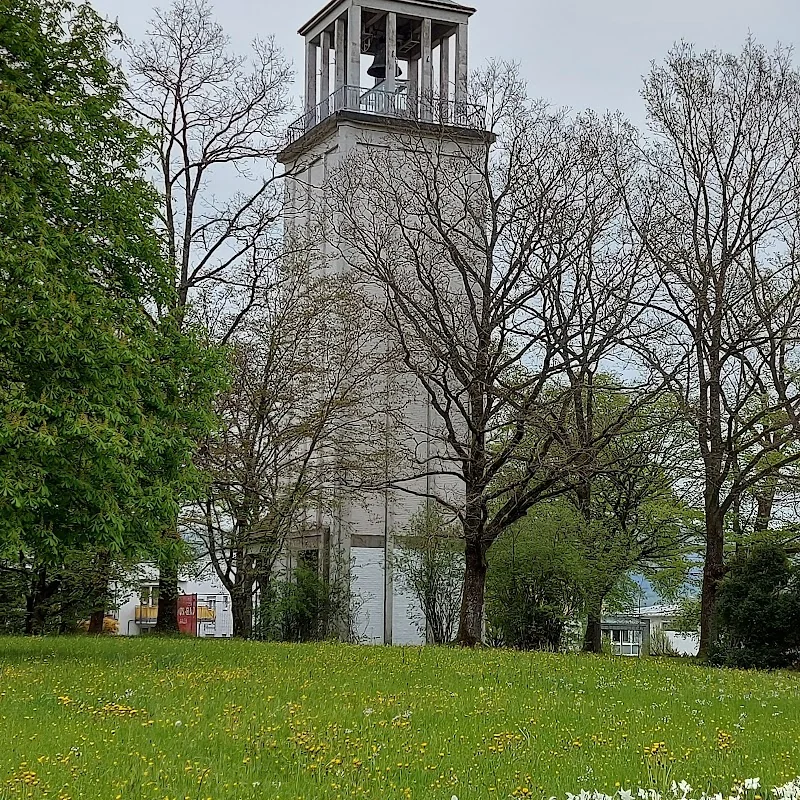
The Memorial Schillerhöhe in Aalen is much more than a single memorial site. It stands for remembrance, for the view of the city, and for a layer of Aalen's history that ranges from the Roman military camp through the old cemetery and memorial space at St. Johann Cemetery to the post-war period. Those who visit Schillerhöhe experience a place where urban identity, quiet contemplation, and a wide view come together. The memorial is located at Schillerhöhe 1, in close proximity to the town hall, and together with the public observatory and the green surroundings forms one of the most striking ensembles in this part of the city. It is precisely this mix of history, architecture, and landscape that makes the place so formative for Aalen to this day. The Schillerhöhe is particularly well-known for the daily ringing of the memorial bell at 7:45 PM, which commemorates the fallen and victims of World War II and keeps the place visible and audible in the everyday life of the city. At the same time, the facility serves as a starting point for city walks, historical contexts, and quiet visits at a deliberate pace. Therefore, those searching for Memorial Schillerhöhe Aalen are not just looking for an address, but for access to one of the city's most important landscapes of remembrance. ([aalen.de](https://www.aalen.de/mahnmal-schillerhoehe.2783.25.htm))
History of the Memorial on Schillerhöhe
The creation of the memorial is closely linked to the redesign of Aalen in the early 1950s. In 1953, the then mayor Dr. Karl Schübel commissioned the city architect Professor Emil Leo to gather ideas for a new memorial. Leo was inspired during a stay in the Alps by the fallen bell in Rovereto in Trentino, which daily commemorates the dead of World War I. From this inspiration, he developed a concept tailored for Aalen: a thirty-meter-high memorial and observation tower, inside of which a bell was to be housed. He proposed Schillerhöhe as the location. The municipal council agreed and also shaped the symbolic message of the structure. The bell was not simply understood as a technical detail, but as a consciously set sign for peace, comfort, and remembrance. Furthermore, the commemoration was explicitly intended to include those people who had come to Aalen after the war, especially refugees and displaced persons. After only six months of construction, the memorial tower was inaugurated on the Day of National Mourning in 1954. The city's history documents this year as the inauguration of the memorial with bell tower on Schillerhöhe. To this day, this decision seems remarkably modern: The memorial is not only a place of mourning but also a place of shared urban memory. Precisely because the facility serves as both an observation point and a memorial, it connects remembrance with openness instead of exclusion. This dual role makes Schillerhöhe such a strong place in the urban landscape. ([aalen.de](https://www.aalen.de/sixcms/media.php/166/Georg%20Wendt_Schillerh%C3%B6he.pdf))
Roman Roots and the Name Schillerhöhe
Schillerhöhe is historically much older than the memorial itself. As early as around 164 AD, Roman soldiers built a large cavalry fort on the site to protect the Limes, which is considered one of the largest of its kind north of the Alps. After the withdrawal of the Romans around 254, the area remained inhabited and later became part of a long history of settlement and remembrance. In the early Middle Ages, a church was built east of the Roman ruins, which we know today as St. Johann Church. In the 16th century, the people of Aalen established their urban cemetery around this little church. This early made Schillerhöhe a space of remembrance and urban history. At the latest with the war memorial of 1878 for the participants of the Franco-German War and the National Socialist abused war memorial for the fallen of World War I from 1933, the quarter became a center of urban memory culture. At the same time, the surroundings were agriculturally shaped until well into the 19th century; only after 1900 did the first residential areas emerge there. The name Schillerhöhe dates back to 1905. At that time, the bare height was to be planted with a Schiller lime tree in honor of the upcoming 100th anniversary of Friedrich Schiller's death and named after the poet. Whether such a lime tree ever stood there is unclear, but the name remained. For today's perception, this is precisely what is important: Schillerhöhe is not a randomly named hill, but a place where Roman, ecclesiastical, civic, and post-war meanings overlap. Therefore, those who visit the memorial stand on a site that has been continually recharged for almost 2000 years. ([aalen.de](https://www.aalen.de/sixcms/media.php/166/Georg%20Wendt_Schillerh%C3%B6he.pdf))
Bell, View, and Commemoration in Everyday Life
The Memorial Schillerhöhe lives not only from its history but also from its daily rhythm. Particularly formative is the ringing of the memorial bell at 7:45 PM, which explicitly connects the city of Aalen with the memory of the fallen and victims of World War II. This fixed time is deliberately chosen and anchors the memorial site in everyday life. Not only on memorial days but day by day, the place becomes audible. This is precisely where its effect lies: The memorial is not a distant museum but a part of urban life. At the same time, the tower serves a second function as an observation platform. The city administration points out during tours that one can enjoy wide views over Aalen and the Rohrwang from above. Thus, the tower connects two perspectives that reinforce each other. Looking down, one sees the historical depth of the place; looking up and into the distance, one sees the present of the city. Especially on the Day of National Mourning, during municipal memorial ceremonies, or during special tours, this symbolic dual role becomes visible. The city of Aalen regularly invites to memorial events at the memorial on Schillerhöhe and uses the place as a central point of urban remembrance. For special tours, registration is also necessary because the facilities in the tower are cramped. This shows that the memorial character here is not merely decorative but truly determines the use. Therefore, those visiting the place should not only think of the view but also of the quiet, respectful framework that supports the tower. The bell, the architecture, and the location make Schillerhöhe a very special point in Aalen: visible, audible, and historically deeply rooted. ([aalen.de](https://www.aalen.de/tag-des-offenen-denkmals.217792.25.htm))
Access, Location, and Parking at Schillerhöhe
The official address of the memorial is Schillerhöhe 1, 73430 Aalen. The city's location description makes it clear that the memorial is located near the town hall and is thus very well anchored in the urban fabric. This is practical for visitors, as the place can be connected with other destinations in Aalen, such as the town hall area, St. Johann Cemetery, or a walk over Schillerhöhe. Those arriving by car should best orient themselves to the parking options at the town hall, as the public observatory on Schillerhöhe recommends parking there. From there, the path leads up to Schillerhöhe via Sankt-Johann-Straße. This description is not only helpful for observatory guests but also provides good orientation for visiting the memorial. For pedestrians from the city center, access is also straightforward, as the quarter is located in close proximity to the city. The city also offers the option to display the location in the geodata portal, which further facilitates orientation. It should be noted that Schillerhöhe is not a remote viewpoint but part of a densely interconnected urban quarter. This makes the charm of the access: One does not arrive at an isolated place but at an ensemble that mediates between city, parking space, memorial architecture, and cultural site. Therefore, those heading to the Memorial Schillerhöhe experience no complicated journey but a well-integrated urban location with clear orientation and a short distance to the town hall. ([aalen.de](https://www.aalen.de/mahnmal-schillerhoehe.2783.25.htm))
Public Observatory and the Surroundings around the Town Hall and Limes Museum
The special atmosphere of Schillerhöhe also includes the Public Observatory Aalen, which is located directly in the neighborhood of the memorial. Its address is Schillerhöhe 2, next to the memorial and near the town hall. The observatory was established from an initiative of former students of Schubart Gymnasium and was opened in 1969 as a school and public observatory. The city of Aalen and the Carl Zeiss Foundation or the company Carl Zeiss provided the technical and structural foundation for this. Today, the observatory is operated by the Astronomical Working Group Aalen. For visitors, it is particularly interesting because it expands the experience of Schillerhöhe with a second, entirely different perspective: the view of the sky. Several times a year, there are special star tours for families, groups of six or more can come by appointment, and the public opening hours are clearly regulated. On Fridays, there are evening tours, which take place from September to April starting at 8 PM and in the brighter months starting at 9 PM; evening tours are canceled in June and July. On Sundays, solar observations take place from 2 PM to 4 PM, admission is free, and the observatory remains closed in overcast weather. It is also important to note that the dome is not heated and it can get cool during observations. The surroundings of Schillerhöhe thus become a small cultural and knowledge space. In immediate proximity are also the town hall, the Limes Museum, and other important places of the historical quarter, which describe city tours as particularly significant for the post-war decades. Therefore, those who visit the memorial can meaningfully extend the tour and combine remembrance, urban history, culture, and astronomy in a single outing. This spatial density is one of the reasons why Schillerhöhe appears so extraordinary in Aalen. ([aalen.de](https://www.aalen.de/sternwarte-aalen-schillerhoehe.3111.25.htm))
Visiting Tips, Tours, and a Respectful Walk
Those visiting the Memorial Schillerhöhe should take some time. It is not a place to just quickly check off but one that wants to be discovered in peace. The visit is particularly rewarding as part of a city tour, a memorial day, or a walk over Schillerhöhe, as historical contexts can then be much better understood. The city of Aalen repeatedly emphasizes in its contributions that the place is closely linked to the memory of war victims, the Day of National Mourning, and the transformation of urban memory culture. At the same time, it becomes clear that Schillerhöhe consists of more than just the memorial. A walk can include St. Johann Church, the old cemetery, the observatory, and the adjacent green spaces, thus providing a comprehensive impression of the quarter. For practical visits, it is important that while the city website provides the address and location, it does not specify classic daily opening hours for the memorial itself as a museum would. This suggests understanding the place primarily as a freely accessible memorial site in public space and combining visits with events or walks. Those wishing to visit the observatory should also consider the weather and time, as observations only take place in clear skies and opening hours vary seasonally. For Schillerhöhe overall, the best visit is the one that does justice to the place. This means not only taking in the view but also reading the history behind the tower. Thus, a short stop becomes a conscious experience with real depth. And therein lies the lasting value of this place for Aalen: It is a memorial, viewpoint, space of remembrance, and urban symbol at the same time. ([aalen.de](https://www.aalen.de/mahnmal-schillerhoehe.2783.25.htm))
Sources:
- City of Aalen – Memorial Schillerhöhe. ([aalen.de](https://www.aalen.de/mahnmal-schillerhoehe.2783.25.htm))
- Georg Wendt / City of Aalen – Schillerhöhe in the Aalen Yearbook Online. ([aalen.de](https://www.aalen.de/sixcms/media.php/166/Georg%20Wendt_Schillerh%C3%B6he.pdf))
- City of Aalen – View from the Memorial on Schillerhöhe. ([aalen.de](https://www.aalen.de/tag-des-offenen-denkmals.217792.25.htm))
- Observatory Aalen – Observatory on Schillerhöhe. ([aalen.de](https://www.aalen.de/sternwarte-aalen-schillerhoehe.3111.25.htm))
Mehr anzeigenWeniger anzeigen
Memorial Schillerhöhe | History & Access
The Memorial Schillerhöhe in Aalen is much more than a single memorial site. It stands for remembrance, for the view of the city, and for a layer of Aalen's history that ranges from the Roman military camp through the old cemetery and memorial space at St. Johann Cemetery to the post-war period. Those who visit Schillerhöhe experience a place where urban identity, quiet contemplation, and a wide view come together. The memorial is located at Schillerhöhe 1, in close proximity to the town hall, and together with the public observatory and the green surroundings forms one of the most striking ensembles in this part of the city. It is precisely this mix of history, architecture, and landscape that makes the place so formative for Aalen to this day. The Schillerhöhe is particularly well-known for the daily ringing of the memorial bell at 7:45 PM, which commemorates the fallen and victims of World War II and keeps the place visible and audible in the everyday life of the city. At the same time, the facility serves as a starting point for city walks, historical contexts, and quiet visits at a deliberate pace. Therefore, those searching for Memorial Schillerhöhe Aalen are not just looking for an address, but for access to one of the city's most important landscapes of remembrance. ([aalen.de](https://www.aalen.de/mahnmal-schillerhoehe.2783.25.htm))
History of the Memorial on Schillerhöhe
The creation of the memorial is closely linked to the redesign of Aalen in the early 1950s. In 1953, the then mayor Dr. Karl Schübel commissioned the city architect Professor Emil Leo to gather ideas for a new memorial. Leo was inspired during a stay in the Alps by the fallen bell in Rovereto in Trentino, which daily commemorates the dead of World War I. From this inspiration, he developed a concept tailored for Aalen: a thirty-meter-high memorial and observation tower, inside of which a bell was to be housed. He proposed Schillerhöhe as the location. The municipal council agreed and also shaped the symbolic message of the structure. The bell was not simply understood as a technical detail, but as a consciously set sign for peace, comfort, and remembrance. Furthermore, the commemoration was explicitly intended to include those people who had come to Aalen after the war, especially refugees and displaced persons. After only six months of construction, the memorial tower was inaugurated on the Day of National Mourning in 1954. The city's history documents this year as the inauguration of the memorial with bell tower on Schillerhöhe. To this day, this decision seems remarkably modern: The memorial is not only a place of mourning but also a place of shared urban memory. Precisely because the facility serves as both an observation point and a memorial, it connects remembrance with openness instead of exclusion. This dual role makes Schillerhöhe such a strong place in the urban landscape. ([aalen.de](https://www.aalen.de/sixcms/media.php/166/Georg%20Wendt_Schillerh%C3%B6he.pdf))
Roman Roots and the Name Schillerhöhe
Schillerhöhe is historically much older than the memorial itself. As early as around 164 AD, Roman soldiers built a large cavalry fort on the site to protect the Limes, which is considered one of the largest of its kind north of the Alps. After the withdrawal of the Romans around 254, the area remained inhabited and later became part of a long history of settlement and remembrance. In the early Middle Ages, a church was built east of the Roman ruins, which we know today as St. Johann Church. In the 16th century, the people of Aalen established their urban cemetery around this little church. This early made Schillerhöhe a space of remembrance and urban history. At the latest with the war memorial of 1878 for the participants of the Franco-German War and the National Socialist abused war memorial for the fallen of World War I from 1933, the quarter became a center of urban memory culture. At the same time, the surroundings were agriculturally shaped until well into the 19th century; only after 1900 did the first residential areas emerge there. The name Schillerhöhe dates back to 1905. At that time, the bare height was to be planted with a Schiller lime tree in honor of the upcoming 100th anniversary of Friedrich Schiller's death and named after the poet. Whether such a lime tree ever stood there is unclear, but the name remained. For today's perception, this is precisely what is important: Schillerhöhe is not a randomly named hill, but a place where Roman, ecclesiastical, civic, and post-war meanings overlap. Therefore, those who visit the memorial stand on a site that has been continually recharged for almost 2000 years. ([aalen.de](https://www.aalen.de/sixcms/media.php/166/Georg%20Wendt_Schillerh%C3%B6he.pdf))
Bell, View, and Commemoration in Everyday Life
The Memorial Schillerhöhe lives not only from its history but also from its daily rhythm. Particularly formative is the ringing of the memorial bell at 7:45 PM, which explicitly connects the city of Aalen with the memory of the fallen and victims of World War II. This fixed time is deliberately chosen and anchors the memorial site in everyday life. Not only on memorial days but day by day, the place becomes audible. This is precisely where its effect lies: The memorial is not a distant museum but a part of urban life. At the same time, the tower serves a second function as an observation platform. The city administration points out during tours that one can enjoy wide views over Aalen and the Rohrwang from above. Thus, the tower connects two perspectives that reinforce each other. Looking down, one sees the historical depth of the place; looking up and into the distance, one sees the present of the city. Especially on the Day of National Mourning, during municipal memorial ceremonies, or during special tours, this symbolic dual role becomes visible. The city of Aalen regularly invites to memorial events at the memorial on Schillerhöhe and uses the place as a central point of urban remembrance. For special tours, registration is also necessary because the facilities in the tower are cramped. This shows that the memorial character here is not merely decorative but truly determines the use. Therefore, those visiting the place should not only think of the view but also of the quiet, respectful framework that supports the tower. The bell, the architecture, and the location make Schillerhöhe a very special point in Aalen: visible, audible, and historically deeply rooted. ([aalen.de](https://www.aalen.de/tag-des-offenen-denkmals.217792.25.htm))
Access, Location, and Parking at Schillerhöhe
The official address of the memorial is Schillerhöhe 1, 73430 Aalen. The city's location description makes it clear that the memorial is located near the town hall and is thus very well anchored in the urban fabric. This is practical for visitors, as the place can be connected with other destinations in Aalen, such as the town hall area, St. Johann Cemetery, or a walk over Schillerhöhe. Those arriving by car should best orient themselves to the parking options at the town hall, as the public observatory on Schillerhöhe recommends parking there. From there, the path leads up to Schillerhöhe via Sankt-Johann-Straße. This description is not only helpful for observatory guests but also provides good orientation for visiting the memorial. For pedestrians from the city center, access is also straightforward, as the quarter is located in close proximity to the city. The city also offers the option to display the location in the geodata portal, which further facilitates orientation. It should be noted that Schillerhöhe is not a remote viewpoint but part of a densely interconnected urban quarter. This makes the charm of the access: One does not arrive at an isolated place but at an ensemble that mediates between city, parking space, memorial architecture, and cultural site. Therefore, those heading to the Memorial Schillerhöhe experience no complicated journey but a well-integrated urban location with clear orientation and a short distance to the town hall. ([aalen.de](https://www.aalen.de/mahnmal-schillerhoehe.2783.25.htm))
Public Observatory and the Surroundings around the Town Hall and Limes Museum
The special atmosphere of Schillerhöhe also includes the Public Observatory Aalen, which is located directly in the neighborhood of the memorial. Its address is Schillerhöhe 2, next to the memorial and near the town hall. The observatory was established from an initiative of former students of Schubart Gymnasium and was opened in 1969 as a school and public observatory. The city of Aalen and the Carl Zeiss Foundation or the company Carl Zeiss provided the technical and structural foundation for this. Today, the observatory is operated by the Astronomical Working Group Aalen. For visitors, it is particularly interesting because it expands the experience of Schillerhöhe with a second, entirely different perspective: the view of the sky. Several times a year, there are special star tours for families, groups of six or more can come by appointment, and the public opening hours are clearly regulated. On Fridays, there are evening tours, which take place from September to April starting at 8 PM and in the brighter months starting at 9 PM; evening tours are canceled in June and July. On Sundays, solar observations take place from 2 PM to 4 PM, admission is free, and the observatory remains closed in overcast weather. It is also important to note that the dome is not heated and it can get cool during observations. The surroundings of Schillerhöhe thus become a small cultural and knowledge space. In immediate proximity are also the town hall, the Limes Museum, and other important places of the historical quarter, which describe city tours as particularly significant for the post-war decades. Therefore, those who visit the memorial can meaningfully extend the tour and combine remembrance, urban history, culture, and astronomy in a single outing. This spatial density is one of the reasons why Schillerhöhe appears so extraordinary in Aalen. ([aalen.de](https://www.aalen.de/sternwarte-aalen-schillerhoehe.3111.25.htm))
Visiting Tips, Tours, and a Respectful Walk
Those visiting the Memorial Schillerhöhe should take some time. It is not a place to just quickly check off but one that wants to be discovered in peace. The visit is particularly rewarding as part of a city tour, a memorial day, or a walk over Schillerhöhe, as historical contexts can then be much better understood. The city of Aalen repeatedly emphasizes in its contributions that the place is closely linked to the memory of war victims, the Day of National Mourning, and the transformation of urban memory culture. At the same time, it becomes clear that Schillerhöhe consists of more than just the memorial. A walk can include St. Johann Church, the old cemetery, the observatory, and the adjacent green spaces, thus providing a comprehensive impression of the quarter. For practical visits, it is important that while the city website provides the address and location, it does not specify classic daily opening hours for the memorial itself as a museum would. This suggests understanding the place primarily as a freely accessible memorial site in public space and combining visits with events or walks. Those wishing to visit the observatory should also consider the weather and time, as observations only take place in clear skies and opening hours vary seasonally. For Schillerhöhe overall, the best visit is the one that does justice to the place. This means not only taking in the view but also reading the history behind the tower. Thus, a short stop becomes a conscious experience with real depth. And therein lies the lasting value of this place for Aalen: It is a memorial, viewpoint, space of remembrance, and urban symbol at the same time. ([aalen.de](https://www.aalen.de/mahnmal-schillerhoehe.2783.25.htm))
Sources:
- City of Aalen – Memorial Schillerhöhe. ([aalen.de](https://www.aalen.de/mahnmal-schillerhoehe.2783.25.htm))
- Georg Wendt / City of Aalen – Schillerhöhe in the Aalen Yearbook Online. ([aalen.de](https://www.aalen.de/sixcms/media.php/166/Georg%20Wendt_Schillerh%C3%B6he.pdf))
- City of Aalen – View from the Memorial on Schillerhöhe. ([aalen.de](https://www.aalen.de/tag-des-offenen-denkmals.217792.25.htm))
- Observatory Aalen – Observatory on Schillerhöhe. ([aalen.de](https://www.aalen.de/sternwarte-aalen-schillerhoehe.3111.25.htm))
Memorial Schillerhöhe | History & Access
The Memorial Schillerhöhe in Aalen is much more than a single memorial site. It stands for remembrance, for the view of the city, and for a layer of Aalen's history that ranges from the Roman military camp through the old cemetery and memorial space at St. Johann Cemetery to the post-war period. Those who visit Schillerhöhe experience a place where urban identity, quiet contemplation, and a wide view come together. The memorial is located at Schillerhöhe 1, in close proximity to the town hall, and together with the public observatory and the green surroundings forms one of the most striking ensembles in this part of the city. It is precisely this mix of history, architecture, and landscape that makes the place so formative for Aalen to this day. The Schillerhöhe is particularly well-known for the daily ringing of the memorial bell at 7:45 PM, which commemorates the fallen and victims of World War II and keeps the place visible and audible in the everyday life of the city. At the same time, the facility serves as a starting point for city walks, historical contexts, and quiet visits at a deliberate pace. Therefore, those searching for Memorial Schillerhöhe Aalen are not just looking for an address, but for access to one of the city's most important landscapes of remembrance. ([aalen.de](https://www.aalen.de/mahnmal-schillerhoehe.2783.25.htm))
History of the Memorial on Schillerhöhe
The creation of the memorial is closely linked to the redesign of Aalen in the early 1950s. In 1953, the then mayor Dr. Karl Schübel commissioned the city architect Professor Emil Leo to gather ideas for a new memorial. Leo was inspired during a stay in the Alps by the fallen bell in Rovereto in Trentino, which daily commemorates the dead of World War I. From this inspiration, he developed a concept tailored for Aalen: a thirty-meter-high memorial and observation tower, inside of which a bell was to be housed. He proposed Schillerhöhe as the location. The municipal council agreed and also shaped the symbolic message of the structure. The bell was not simply understood as a technical detail, but as a consciously set sign for peace, comfort, and remembrance. Furthermore, the commemoration was explicitly intended to include those people who had come to Aalen after the war, especially refugees and displaced persons. After only six months of construction, the memorial tower was inaugurated on the Day of National Mourning in 1954. The city's history documents this year as the inauguration of the memorial with bell tower on Schillerhöhe. To this day, this decision seems remarkably modern: The memorial is not only a place of mourning but also a place of shared urban memory. Precisely because the facility serves as both an observation point and a memorial, it connects remembrance with openness instead of exclusion. This dual role makes Schillerhöhe such a strong place in the urban landscape. ([aalen.de](https://www.aalen.de/sixcms/media.php/166/Georg%20Wendt_Schillerh%C3%B6he.pdf))
Roman Roots and the Name Schillerhöhe
Schillerhöhe is historically much older than the memorial itself. As early as around 164 AD, Roman soldiers built a large cavalry fort on the site to protect the Limes, which is considered one of the largest of its kind north of the Alps. After the withdrawal of the Romans around 254, the area remained inhabited and later became part of a long history of settlement and remembrance. In the early Middle Ages, a church was built east of the Roman ruins, which we know today as St. Johann Church. In the 16th century, the people of Aalen established their urban cemetery around this little church. This early made Schillerhöhe a space of remembrance and urban history. At the latest with the war memorial of 1878 for the participants of the Franco-German War and the National Socialist abused war memorial for the fallen of World War I from 1933, the quarter became a center of urban memory culture. At the same time, the surroundings were agriculturally shaped until well into the 19th century; only after 1900 did the first residential areas emerge there. The name Schillerhöhe dates back to 1905. At that time, the bare height was to be planted with a Schiller lime tree in honor of the upcoming 100th anniversary of Friedrich Schiller's death and named after the poet. Whether such a lime tree ever stood there is unclear, but the name remained. For today's perception, this is precisely what is important: Schillerhöhe is not a randomly named hill, but a place where Roman, ecclesiastical, civic, and post-war meanings overlap. Therefore, those who visit the memorial stand on a site that has been continually recharged for almost 2000 years. ([aalen.de](https://www.aalen.de/sixcms/media.php/166/Georg%20Wendt_Schillerh%C3%B6he.pdf))
Bell, View, and Commemoration in Everyday Life
The Memorial Schillerhöhe lives not only from its history but also from its daily rhythm. Particularly formative is the ringing of the memorial bell at 7:45 PM, which explicitly connects the city of Aalen with the memory of the fallen and victims of World War II. This fixed time is deliberately chosen and anchors the memorial site in everyday life. Not only on memorial days but day by day, the place becomes audible. This is precisely where its effect lies: The memorial is not a distant museum but a part of urban life. At the same time, the tower serves a second function as an observation platform. The city administration points out during tours that one can enjoy wide views over Aalen and the Rohrwang from above. Thus, the tower connects two perspectives that reinforce each other. Looking down, one sees the historical depth of the place; looking up and into the distance, one sees the present of the city. Especially on the Day of National Mourning, during municipal memorial ceremonies, or during special tours, this symbolic dual role becomes visible. The city of Aalen regularly invites to memorial events at the memorial on Schillerhöhe and uses the place as a central point of urban remembrance. For special tours, registration is also necessary because the facilities in the tower are cramped. This shows that the memorial character here is not merely decorative but truly determines the use. Therefore, those visiting the place should not only think of the view but also of the quiet, respectful framework that supports the tower. The bell, the architecture, and the location make Schillerhöhe a very special point in Aalen: visible, audible, and historically deeply rooted. ([aalen.de](https://www.aalen.de/tag-des-offenen-denkmals.217792.25.htm))
Access, Location, and Parking at Schillerhöhe
The official address of the memorial is Schillerhöhe 1, 73430 Aalen. The city's location description makes it clear that the memorial is located near the town hall and is thus very well anchored in the urban fabric. This is practical for visitors, as the place can be connected with other destinations in Aalen, such as the town hall area, St. Johann Cemetery, or a walk over Schillerhöhe. Those arriving by car should best orient themselves to the parking options at the town hall, as the public observatory on Schillerhöhe recommends parking there. From there, the path leads up to Schillerhöhe via Sankt-Johann-Straße. This description is not only helpful for observatory guests but also provides good orientation for visiting the memorial. For pedestrians from the city center, access is also straightforward, as the quarter is located in close proximity to the city. The city also offers the option to display the location in the geodata portal, which further facilitates orientation. It should be noted that Schillerhöhe is not a remote viewpoint but part of a densely interconnected urban quarter. This makes the charm of the access: One does not arrive at an isolated place but at an ensemble that mediates between city, parking space, memorial architecture, and cultural site. Therefore, those heading to the Memorial Schillerhöhe experience no complicated journey but a well-integrated urban location with clear orientation and a short distance to the town hall. ([aalen.de](https://www.aalen.de/mahnmal-schillerhoehe.2783.25.htm))
Public Observatory and the Surroundings around the Town Hall and Limes Museum
The special atmosphere of Schillerhöhe also includes the Public Observatory Aalen, which is located directly in the neighborhood of the memorial. Its address is Schillerhöhe 2, next to the memorial and near the town hall. The observatory was established from an initiative of former students of Schubart Gymnasium and was opened in 1969 as a school and public observatory. The city of Aalen and the Carl Zeiss Foundation or the company Carl Zeiss provided the technical and structural foundation for this. Today, the observatory is operated by the Astronomical Working Group Aalen. For visitors, it is particularly interesting because it expands the experience of Schillerhöhe with a second, entirely different perspective: the view of the sky. Several times a year, there are special star tours for families, groups of six or more can come by appointment, and the public opening hours are clearly regulated. On Fridays, there are evening tours, which take place from September to April starting at 8 PM and in the brighter months starting at 9 PM; evening tours are canceled in June and July. On Sundays, solar observations take place from 2 PM to 4 PM, admission is free, and the observatory remains closed in overcast weather. It is also important to note that the dome is not heated and it can get cool during observations. The surroundings of Schillerhöhe thus become a small cultural and knowledge space. In immediate proximity are also the town hall, the Limes Museum, and other important places of the historical quarter, which describe city tours as particularly significant for the post-war decades. Therefore, those who visit the memorial can meaningfully extend the tour and combine remembrance, urban history, culture, and astronomy in a single outing. This spatial density is one of the reasons why Schillerhöhe appears so extraordinary in Aalen. ([aalen.de](https://www.aalen.de/sternwarte-aalen-schillerhoehe.3111.25.htm))
Visiting Tips, Tours, and a Respectful Walk
Those visiting the Memorial Schillerhöhe should take some time. It is not a place to just quickly check off but one that wants to be discovered in peace. The visit is particularly rewarding as part of a city tour, a memorial day, or a walk over Schillerhöhe, as historical contexts can then be much better understood. The city of Aalen repeatedly emphasizes in its contributions that the place is closely linked to the memory of war victims, the Day of National Mourning, and the transformation of urban memory culture. At the same time, it becomes clear that Schillerhöhe consists of more than just the memorial. A walk can include St. Johann Church, the old cemetery, the observatory, and the adjacent green spaces, thus providing a comprehensive impression of the quarter. For practical visits, it is important that while the city website provides the address and location, it does not specify classic daily opening hours for the memorial itself as a museum would. This suggests understanding the place primarily as a freely accessible memorial site in public space and combining visits with events or walks. Those wishing to visit the observatory should also consider the weather and time, as observations only take place in clear skies and opening hours vary seasonally. For Schillerhöhe overall, the best visit is the one that does justice to the place. This means not only taking in the view but also reading the history behind the tower. Thus, a short stop becomes a conscious experience with real depth. And therein lies the lasting value of this place for Aalen: It is a memorial, viewpoint, space of remembrance, and urban symbol at the same time. ([aalen.de](https://www.aalen.de/mahnmal-schillerhoehe.2783.25.htm))
Sources:
- City of Aalen – Memorial Schillerhöhe. ([aalen.de](https://www.aalen.de/mahnmal-schillerhoehe.2783.25.htm))
- Georg Wendt / City of Aalen – Schillerhöhe in the Aalen Yearbook Online. ([aalen.de](https://www.aalen.de/sixcms/media.php/166/Georg%20Wendt_Schillerh%C3%B6he.pdf))
- City of Aalen – View from the Memorial on Schillerhöhe. ([aalen.de](https://www.aalen.de/tag-des-offenen-denkmals.217792.25.htm))
- Observatory Aalen – Observatory on Schillerhöhe. ([aalen.de](https://www.aalen.de/sternwarte-aalen-schillerhoehe.3111.25.htm))

Frequently Asked Questions
Reviews
No reviews found