
Toronto
170 Princes' Blvd, Toronto, ON M6K 3C3, Kanada
BMO Field | Capacity & Seating Chart 2026
BMO Field at Toronto's Exhibition Place is much more than a stadium: it is a place where Canadian soccer history, great event culture, and the unique waterfront location combine to create a very special experience. Since its opening in 2007, the arena has established itself as the home of Toronto FC, the Toronto Argonauts, and Canada Soccer, making it a fixed destination for fans from all over Canada. At the same time, the stadium is evolving, as a comprehensive modernization has been announced for the FIFA World Cup 26, elevating BMO Field to the international stage and giving the facility long-term additional relevance. Those searching for BMO Field Toronto, BMO Field Stadium, BMO Field Capacity, or BMO Field World Cup 2026 expect not just a pure event venue, but a place with a clear identity, strong fan base, and growing significance for sports, shows, and major events. The combination of downtown location, proximity to transit, premium offerings, and a compact, soccer-close spectator experience makes BMO Field a venue that is hard to overlook in Toronto. ([bmofield.com](https://www.bmofield.com/venue-information/history))
BMO Field World Cup 2026 and the Expansion
The most important search trend surrounding BMO Field currently revolves around the FIFA World Cup 2026 and the associated expansion. The City of Toronto and MLSE publicly announced in March 2025 that the stadium will be extensively upgraded for the tournament to serve as a premier venue for six World Cup matches. According to the official plan, the capacity will be increased to 45,000 seats, with 10,000 temporary seats on the north stand and 7,000 temporary seats on the south stand. Additionally, player areas and locker rooms will be expanded, broadcast infrastructure improved, new LED video boards installed, lighting and sound systems modernized, and Wi-Fi capacity increased. New hospitality areas, including a center-field lounge, revamped west suites, and new north suites, are also part of the package. This is particularly exciting for fans because the renovation has been planned according to the official statement so that BMO Field remains open for events during the work. This mix of ongoing operation and targeted modernization makes the stadium particularly relevant for search queries like bmo field expansion, bmo field 2026, or bmo field world cup. Toronto will host the first men's World Cup match on Canadian soil on June 12, 2026, and will also host a round of 16 match, further increasing the stadium's significance. ([bmofield.com](https://www.bmofield.com/assets/doc/RELEASE-City-of-Toronto-and-MLSE-announce-enhancements-to-BMO-Field-Toronto-Stadium-setting-the-stage-for-the-FIFA-World-Cup-26-and-beyond-27b1af4e2b.pdf))
For SEO planning, it is important to note that the topic of World Cup 2026 is not just a short-term hype but remains closely linked to the official expansion plans. Those searching for BMO Field World Cup, BMO Field World Cup 2026, or BMO Field World Cup want to know if the stadium has the necessary size, what the renovations will look like, and whether visiting is worthwhile despite the modernization. This is where the strength of the location lies: BMO Field was already a functioning, compact arena with a strong atmosphere before the expansion, and the new temporary stands enhance this quality for a major tournament without completely changing the character of the stadium. The official city statement also emphasizes the long-term benefits of the investments, as the improvements are intended not only for the tournament but also for future sports and cultural events. Thus, BMO Field is a particularly interesting example of a location whose current development can be directly translated into future demand. For content planning, snippets, and FAQ texts, terms like capacity, expansion, world cup, 2026, and stadium are not coincidences but core terms that rank high in search intent. ([bmofield.com](https://www.bmofield.com/assets/doc/RELEASE-City-of-Toronto-and-MLSE-announce-enhancements-to-BMO-Field-Toronto-Stadium-setting-the-stage-for-the-FIFA-World-Cup-26-and-beyond-27b1af4e2b.pdf))
BMO Field Seating Chart, Capacity, and Best Seats
When it comes to seating, BMO Field provides several official touchpoints that are excellent for SEO and user guidance. The BMO Field FAQ states a capacity of over 30,000 seats for soccer and football, increasing to around 34,000 after the expansion, while the World Cup modernization aims to bring the arena to 45,000 seats. The reason the location appears in search queries like bmo field seating chart or bmo field toronto capacity is also due to the clear structure of the stands: The official site offers virtual seating charts for Toronto FC and the Toronto Argonauts, and for other events, BMO Field refers to the Ticketmaster view. So, those who want to know before purchasing whether they will be closer to the field, in a corner with a better view, or in a premium area can find central orientation there. Accessible seating is also particularly important, as the FAQ explains that accessible seating is offered from various positions, is barrier-free, and can be equipped with removable seating materials for wheelchairs. These seats are marked with an A in the sectors. Additionally, BMO Field has six elevators that take fans to the upper levels, and the facility features a roof structure that covers the east, west, and south stands. Those seeking stadium comfort should also not overlook the premium offerings: The BMO Club offering is located at field level in the east stand, just a few steps from the pitch, and combines exclusive views, early entry, private restrooms, and all-inclusive food & beverage without alcohol. For users searching for best seats, seating chart, capacity, or premium seats, this is exactly the information that makes the difference between a general stadium description and a real purchasing decision. ([bmofield.com](https://www.bmofield.com/faqs/))
From an editorial perspective, it is worthwhile to always explain capacity in the context of usage. In everyday life, BMO Field is a rather compact, very soccer-close stadium that stands for atmosphere rather than sheer mass. For the FIFA World Cup 26, however, it will become a significantly larger stage with temporary additional seats that elevate the venue to an international level. This combination of proximity and growth makes the location so strong. Those looking for a classic large-city stadium with long walking distances, complicated sightlines, and unclear structure will not find it here. BMO Field focuses on short distances, clear sectors, and an atmosphere where even medium stands are still strongly integrated. The official seating charts therefore help not only with ticket purchases but also with expectation management: Fans see early on whether they are heading for the north, south, east, or west side, which areas are designated for Toronto FC or Argonauts, and where accessible entrances are located. In combination with the premium offerings, family-friendly sightlines, and the World Cup expansion, a search field emerges that meets multiple needs simultaneously: classic seating questions, event planning, VIP interest, and accessibility. This is ideal from an SEO perspective, as these subtopics are among the most searched information needs surrounding BMO Field. ([bmofield.com](https://www.bmofield.com/faqs/))
BMO Field Directions and Parking at Exhibition Place
Those searching for directions to BMO Field or parking at BMO Field usually want quick, reliable, and as stress-free information as possible. The official FAQ is very clear here: BMO Field is located on the Exhibition Place grounds, just a few minutes west of downtown Toronto. The facility is bordered by the Gardiner Expressway to the north, Lake Shore Boulevard to the south, Dufferin Street to the west, and Strachan Avenue to the east. The stadium points out that while more than 5,000 parking spaces are available at Exhibition Place, these spaces are shared with several events, and parking is therefore not guaranteed. Especially during major events like the Canadian National Exhibition or Caribana, it can get tight, which is why BMO Field explicitly recommends public transportation. The usual day rates are also mentioned in the FAQ: 30 CAD for Toronto FC games and 25 CAD for Toronto Argonauts games. For train travel, the GO Transit stop Exhibition is particularly convenient, as it is just a short walk from the stadium and one station west of Union Station on the Lakeshore West line. With the TTC, you can reach the stadium via the 509 Harbourfront streetcar from Union Station, the 511 Bathurst streetcar from Bathurst Station, or the 29 Dufferin bus from Dufferin Station. Additionally, there is a mobility shuttle that picks up fans every 15 minutes from the corner of Manitoba Drive and Nova Scotia Avenue, directly across from the Exhibition GO Station, and takes them to the desired gates. ([bmofield.com](https://www.bmofield.com/faqs/))
For visitors with special requirements, practical details are also helpful. The FAQ describes accessible parking options in Exhibition Place Lot 2, which is located south of Gate 3. Those being dropped off or picked up can do so at Gate 1 by the ticket office or at Gate 3 on the south side near Princes' Blvd, although actual access may be restricted depending on the event. In practice, this means: those who arrive early have an advantage, and those using transit often save time and nerves. This recommendation is not only convenient but also logical, as BMO Field is situated in an area that is regularly used by several major events simultaneously. This is why it is important for search queries like bmo field parking, bmo field directions, or directions and parking to not only provide an address but also explain the system behind it: shared parking spaces, event-dependent closures, clear public transport connections, and a shuttle service for visitors who want to keep the last leg as short as possible. The location near Lake Ontario also plays a role, as the stadium points out that it can often be several degrees cooler there than in other parts of the city. So, those arriving by car or train should consider not only the traffic route but also the weather conditions. This mix of practical travel assistance and real event conditions makes the search area around parking and directions so strong. ([bmofield.com](https://www.bmofield.com/faqs/))
BMO Field History: From 2007 to Major Finals
The history of BMO Field is one of the most important building blocks for long-form content because it gives the stadium character and places today's search queries in a larger context. According to the official history page, BMO Field is Canada's first soccer-specific stadium. It was built in Exhibition Place in Toronto, cost 62.9 million dollars, and was financed through a public partnership between three levels of government and Maple Leaf Sports and Entertainment. In its first summer season, the arena served as Canada's National Soccer Stadium, hosting the FIFA U-20 World Cup and attracting over 260,000 fans in twelve matches. Even then, it was evident that the stadium was not only intended for league games but for large, atmospherically dense events. In September 2007, Genesis even played there in front of a sold-out crowd of over 28,000 spectators. Since its opening, BMO Field has welcomed more than a million fans and experienced a wide mix of events, including the Grey Cup 2016, the MLS Cup 2016, the FIFA U-20 Women’s World Cup 2014, as well as international rugby and lacrosse games. This development is important because it shows that the stadium was envisioned early on as more than just a soccer venue. For search engines, this is a strong signal: BMO Field is not just a stadium but a multipurpose venue with a documented event history. ([bmofield.com](https://www.bmofield.com/venue-information/history))
The architectural development is also part of the story. In 2010, natural grass was installed, complemented by a modern heating system that supports grass growth in cooler spring and fall months. In 2014, the largest expansion phase to date began, aiming to bring the stadium closer to the standard of large European soccer arenas. When Phase 1 was completed on May 10, 2015, 8,400 additional seats had been created, along with new and modernized clubs and suites. Later adjustments were added to accommodate the Toronto Argonauts starting from the 2016 CFL season. This is central to today's perception because BMO Field has thus become known not only as a soccer venue but also as a classic outdoor football stadium. Those searching for bmo field photos will therefore find not just a simple sports building but an arena that has visibly changed: from a compact soccer field to a modern, expanded venue with a roof, hospitality, and event infrastructure. The history also explains why the stadium attracts so many search queries today: it has the right mix of tradition, renovation, multiple uses, and major events. This is why a description with historical data, expansion phases, and event references works so well for users who are looking for not only tickets but also context. ([bmofield.com](https://www.bmofield.com/venue-information/history))
BMO Field Events, Teams, and Premium Experiences
BMO Field is particularly relevant because not only one team plays here, but several sporting identities come together. The FAQ lists Toronto FC, the Toronto Argonauts, and Canada Soccer as the main components of the venue. This is important for visitors because it means that game days, seating areas, and ticket pathways can vary. For Toronto FC fans, the arena is home to a Major League Soccer club, while the Argonauts give the stadium its classic CFL character. Additionally, Canada Soccer serves as a national anchor, giving the venue significance beyond the club level. The official website offers separate sections for event searches for Upcoming Events, Calendar, Ticket Information, Toronto FC, Toronto Argonauts, Canada Soccer, and FIFA World Cup 2026. This clearly shows that BMO Field is organized as a multipurpose location and does not only function on game days. Those searching for bmo field stadium or bmo field toronto often want to know if concerts, international tournaments, or special events take place there. The answer is a clear yes: The history documents major soccer tournaments, finals, international rugby and lacrosse matches, as well as concerts. Additionally, the event operation for regular tickets, which are available outside of TFC and Argonauts games according to the FAQ, is well organized. The ticket office is located at the northeast corner of the stadium near Gate 1, opens three hours before events, and remains open until the start of the second half; it is also cashless and accepts debit and credit cards. ([bmofield.com](https://www.bmofield.com/faqs/))
In terms of premium offerings, BMO Field focuses on a clear, modern orientation. The BMO Club offering is located at field level in the east stand, just a few steps from the pitch, and combines proximity to the action with all-inclusive food & beverage without alcohol, VIP events, private restrooms, and early entry. This is interesting not only for corporate guests but also for fans seeking a higher-quality experience without losing the stadium atmosphere. Additionally, there are other premium areas like KLM Tunnel Club, LG | West Club, and suites that are prominently listed on the website. This is relevant for SEO because users search for terms like premium seats, suites, club seats, or best seats, and the location thus meets several needs. The stadium is also well-prepared gastronomically and service-oriented: Fan Services stations are located at Gate 1, Gate 3, and on the Upper East Concourse at Section 207, and the stadium has a quiet zone for prayer, nursing, or retreat. This service quality is a real added value that is often overlooked in descriptions but strongly shapes the perception on-site. Together with the long event history and the different team identities, this creates an image of BMO Field as a lively, multifunctional, and continuously evolving venue. ([bmofield.com](https://www.bmofield.com/premium-seating/bmo-club))
BMO Field Photos, Atmosphere, and Practical Visitor Tips
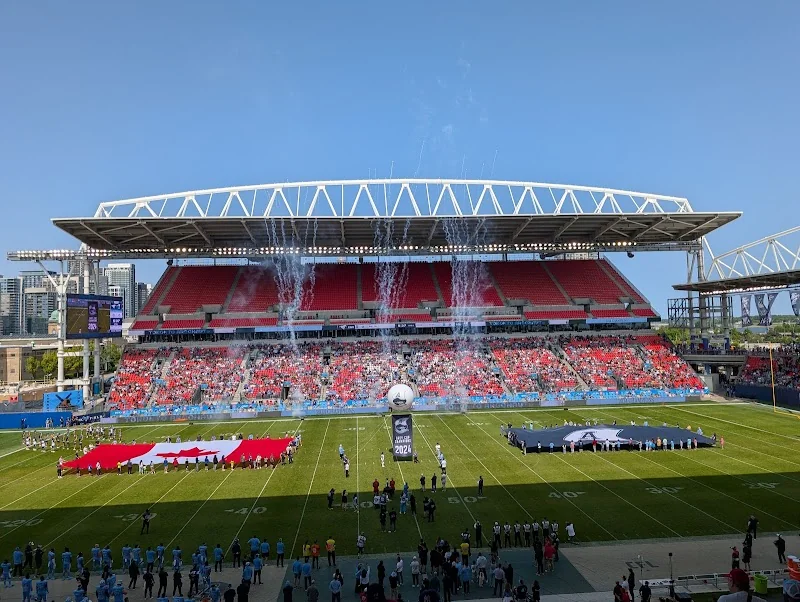
Those searching for BMO Field photos often mean not just pictures but the atmosphere, architecture, and view of the venue itself. BMO Field scores here with its location in Exhibition Place, the open stadium feel, and proximity to the water. The official FAQ reminds that it can often be several degrees cooler at Lake Ontario than in other parts of the city, which significantly affects the visit depending on the season. The roof structure also plays a role in the atmosphere: The four super columns support the roof, which protects the seating areas in the east, west, and south stands while still maintaining the stadium's airy, open character. This is an exciting mix because BMO Field thus appears both weather-protected and typically North American open. For visitors, this means bringing weatherproof clothing, especially for spring or late fall games, and considering the stadium side when choosing tickets. The location directly at Exhibition Place also ensures that the environment is very dynamic during major events, which is often particularly visible in photos and social media posts. The combination of city, lake, stands, and lighting situation is one of the reasons why the stadium works so well visually. ([bmofield.com](https://www.bmofield.com/faqs/))
Practically speaking, it is worthwhile to know the service and security information before the visit. BMO Field offers accessible seating, barrier-free access, elevators, and special parking options in Exhibition Place Lot 2. For fans in need of assistance, fan services, mobility shuttles, and clear contact points are available. The stadium also has a large, established fan infrastructure: merchandise locations in the stadium, a cashless ticket office, clear gate structures, and uniform communication regarding safety and code of conduct. For many visitors, this is crucial because a good stadium experience depends not only on what happens on the field but also on the ease of the entire process. Those photographing or visiting the location should therefore not only look at the aesthetic aspects but also at the arrival process, access to the gates, and the right mix of seating, weather, and service. Especially in a stadium that combines historical significance, ongoing modernization, and a high density of events, this balance is important. BMO Field beautifully demonstrates how a modern stadium can function in everyday life: compact, well-connected, emotional, and organized at the same time. This makes the location interesting for fans, seekers, and visitors alike, whether they are buying tickets, searching for pictures, or simply wanting to know what an evening in the stadium really feels like. ([bmofield.com](https://www.bmofield.com/faqs/))
Sources:
Show moreShow less
BMO Field | Capacity & Seating Chart 2026
BMO Field at Toronto's Exhibition Place is much more than a stadium: it is a place where Canadian soccer history, great event culture, and the unique waterfront location combine to create a very special experience. Since its opening in 2007, the arena has established itself as the home of Toronto FC, the Toronto Argonauts, and Canada Soccer, making it a fixed destination for fans from all over Canada. At the same time, the stadium is evolving, as a comprehensive modernization has been announced for the FIFA World Cup 26, elevating BMO Field to the international stage and giving the facility long-term additional relevance. Those searching for BMO Field Toronto, BMO Field Stadium, BMO Field Capacity, or BMO Field World Cup 2026 expect not just a pure event venue, but a place with a clear identity, strong fan base, and growing significance for sports, shows, and major events. The combination of downtown location, proximity to transit, premium offerings, and a compact, soccer-close spectator experience makes BMO Field a venue that is hard to overlook in Toronto. ([bmofield.com](https://www.bmofield.com/venue-information/history))
BMO Field World Cup 2026 and the Expansion
The most important search trend surrounding BMO Field currently revolves around the FIFA World Cup 2026 and the associated expansion. The City of Toronto and MLSE publicly announced in March 2025 that the stadium will be extensively upgraded for the tournament to serve as a premier venue for six World Cup matches. According to the official plan, the capacity will be increased to 45,000 seats, with 10,000 temporary seats on the north stand and 7,000 temporary seats on the south stand. Additionally, player areas and locker rooms will be expanded, broadcast infrastructure improved, new LED video boards installed, lighting and sound systems modernized, and Wi-Fi capacity increased. New hospitality areas, including a center-field lounge, revamped west suites, and new north suites, are also part of the package. This is particularly exciting for fans because the renovation has been planned according to the official statement so that BMO Field remains open for events during the work. This mix of ongoing operation and targeted modernization makes the stadium particularly relevant for search queries like bmo field expansion, bmo field 2026, or bmo field world cup. Toronto will host the first men's World Cup match on Canadian soil on June 12, 2026, and will also host a round of 16 match, further increasing the stadium's significance. ([bmofield.com](https://www.bmofield.com/assets/doc/RELEASE-City-of-Toronto-and-MLSE-announce-enhancements-to-BMO-Field-Toronto-Stadium-setting-the-stage-for-the-FIFA-World-Cup-26-and-beyond-27b1af4e2b.pdf))
For SEO planning, it is important to note that the topic of World Cup 2026 is not just a short-term hype but remains closely linked to the official expansion plans. Those searching for BMO Field World Cup, BMO Field World Cup 2026, or BMO Field World Cup want to know if the stadium has the necessary size, what the renovations will look like, and whether visiting is worthwhile despite the modernization. This is where the strength of the location lies: BMO Field was already a functioning, compact arena with a strong atmosphere before the expansion, and the new temporary stands enhance this quality for a major tournament without completely changing the character of the stadium. The official city statement also emphasizes the long-term benefits of the investments, as the improvements are intended not only for the tournament but also for future sports and cultural events. Thus, BMO Field is a particularly interesting example of a location whose current development can be directly translated into future demand. For content planning, snippets, and FAQ texts, terms like capacity, expansion, world cup, 2026, and stadium are not coincidences but core terms that rank high in search intent. ([bmofield.com](https://www.bmofield.com/assets/doc/RELEASE-City-of-Toronto-and-MLSE-announce-enhancements-to-BMO-Field-Toronto-Stadium-setting-the-stage-for-the-FIFA-World-Cup-26-and-beyond-27b1af4e2b.pdf))
BMO Field Seating Chart, Capacity, and Best Seats
When it comes to seating, BMO Field provides several official touchpoints that are excellent for SEO and user guidance. The BMO Field FAQ states a capacity of over 30,000 seats for soccer and football, increasing to around 34,000 after the expansion, while the World Cup modernization aims to bring the arena to 45,000 seats. The reason the location appears in search queries like bmo field seating chart or bmo field toronto capacity is also due to the clear structure of the stands: The official site offers virtual seating charts for Toronto FC and the Toronto Argonauts, and for other events, BMO Field refers to the Ticketmaster view. So, those who want to know before purchasing whether they will be closer to the field, in a corner with a better view, or in a premium area can find central orientation there. Accessible seating is also particularly important, as the FAQ explains that accessible seating is offered from various positions, is barrier-free, and can be equipped with removable seating materials for wheelchairs. These seats are marked with an A in the sectors. Additionally, BMO Field has six elevators that take fans to the upper levels, and the facility features a roof structure that covers the east, west, and south stands. Those seeking stadium comfort should also not overlook the premium offerings: The BMO Club offering is located at field level in the east stand, just a few steps from the pitch, and combines exclusive views, early entry, private restrooms, and all-inclusive food & beverage without alcohol. For users searching for best seats, seating chart, capacity, or premium seats, this is exactly the information that makes the difference between a general stadium description and a real purchasing decision. ([bmofield.com](https://www.bmofield.com/faqs/))
From an editorial perspective, it is worthwhile to always explain capacity in the context of usage. In everyday life, BMO Field is a rather compact, very soccer-close stadium that stands for atmosphere rather than sheer mass. For the FIFA World Cup 26, however, it will become a significantly larger stage with temporary additional seats that elevate the venue to an international level. This combination of proximity and growth makes the location so strong. Those looking for a classic large-city stadium with long walking distances, complicated sightlines, and unclear structure will not find it here. BMO Field focuses on short distances, clear sectors, and an atmosphere where even medium stands are still strongly integrated. The official seating charts therefore help not only with ticket purchases but also with expectation management: Fans see early on whether they are heading for the north, south, east, or west side, which areas are designated for Toronto FC or Argonauts, and where accessible entrances are located. In combination with the premium offerings, family-friendly sightlines, and the World Cup expansion, a search field emerges that meets multiple needs simultaneously: classic seating questions, event planning, VIP interest, and accessibility. This is ideal from an SEO perspective, as these subtopics are among the most searched information needs surrounding BMO Field. ([bmofield.com](https://www.bmofield.com/faqs/))
BMO Field Directions and Parking at Exhibition Place
Those searching for directions to BMO Field or parking at BMO Field usually want quick, reliable, and as stress-free information as possible. The official FAQ is very clear here: BMO Field is located on the Exhibition Place grounds, just a few minutes west of downtown Toronto. The facility is bordered by the Gardiner Expressway to the north, Lake Shore Boulevard to the south, Dufferin Street to the west, and Strachan Avenue to the east. The stadium points out that while more than 5,000 parking spaces are available at Exhibition Place, these spaces are shared with several events, and parking is therefore not guaranteed. Especially during major events like the Canadian National Exhibition or Caribana, it can get tight, which is why BMO Field explicitly recommends public transportation. The usual day rates are also mentioned in the FAQ: 30 CAD for Toronto FC games and 25 CAD for Toronto Argonauts games. For train travel, the GO Transit stop Exhibition is particularly convenient, as it is just a short walk from the stadium and one station west of Union Station on the Lakeshore West line. With the TTC, you can reach the stadium via the 509 Harbourfront streetcar from Union Station, the 511 Bathurst streetcar from Bathurst Station, or the 29 Dufferin bus from Dufferin Station. Additionally, there is a mobility shuttle that picks up fans every 15 minutes from the corner of Manitoba Drive and Nova Scotia Avenue, directly across from the Exhibition GO Station, and takes them to the desired gates. ([bmofield.com](https://www.bmofield.com/faqs/))
For visitors with special requirements, practical details are also helpful. The FAQ describes accessible parking options in Exhibition Place Lot 2, which is located south of Gate 3. Those being dropped off or picked up can do so at Gate 1 by the ticket office or at Gate 3 on the south side near Princes' Blvd, although actual access may be restricted depending on the event. In practice, this means: those who arrive early have an advantage, and those using transit often save time and nerves. This recommendation is not only convenient but also logical, as BMO Field is situated in an area that is regularly used by several major events simultaneously. This is why it is important for search queries like bmo field parking, bmo field directions, or directions and parking to not only provide an address but also explain the system behind it: shared parking spaces, event-dependent closures, clear public transport connections, and a shuttle service for visitors who want to keep the last leg as short as possible. The location near Lake Ontario also plays a role, as the stadium points out that it can often be several degrees cooler there than in other parts of the city. So, those arriving by car or train should consider not only the traffic route but also the weather conditions. This mix of practical travel assistance and real event conditions makes the search area around parking and directions so strong. ([bmofield.com](https://www.bmofield.com/faqs/))
BMO Field History: From 2007 to Major Finals
The history of BMO Field is one of the most important building blocks for long-form content because it gives the stadium character and places today's search queries in a larger context. According to the official history page, BMO Field is Canada's first soccer-specific stadium. It was built in Exhibition Place in Toronto, cost 62.9 million dollars, and was financed through a public partnership between three levels of government and Maple Leaf Sports and Entertainment. In its first summer season, the arena served as Canada's National Soccer Stadium, hosting the FIFA U-20 World Cup and attracting over 260,000 fans in twelve matches. Even then, it was evident that the stadium was not only intended for league games but for large, atmospherically dense events. In September 2007, Genesis even played there in front of a sold-out crowd of over 28,000 spectators. Since its opening, BMO Field has welcomed more than a million fans and experienced a wide mix of events, including the Grey Cup 2016, the MLS Cup 2016, the FIFA U-20 Women’s World Cup 2014, as well as international rugby and lacrosse games. This development is important because it shows that the stadium was envisioned early on as more than just a soccer venue. For search engines, this is a strong signal: BMO Field is not just a stadium but a multipurpose venue with a documented event history. ([bmofield.com](https://www.bmofield.com/venue-information/history))
The architectural development is also part of the story. In 2010, natural grass was installed, complemented by a modern heating system that supports grass growth in cooler spring and fall months. In 2014, the largest expansion phase to date began, aiming to bring the stadium closer to the standard of large European soccer arenas. When Phase 1 was completed on May 10, 2015, 8,400 additional seats had been created, along with new and modernized clubs and suites. Later adjustments were added to accommodate the Toronto Argonauts starting from the 2016 CFL season. This is central to today's perception because BMO Field has thus become known not only as a soccer venue but also as a classic outdoor football stadium. Those searching for bmo field photos will therefore find not just a simple sports building but an arena that has visibly changed: from a compact soccer field to a modern, expanded venue with a roof, hospitality, and event infrastructure. The history also explains why the stadium attracts so many search queries today: it has the right mix of tradition, renovation, multiple uses, and major events. This is why a description with historical data, expansion phases, and event references works so well for users who are looking for not only tickets but also context. ([bmofield.com](https://www.bmofield.com/venue-information/history))
BMO Field Events, Teams, and Premium Experiences
BMO Field is particularly relevant because not only one team plays here, but several sporting identities come together. The FAQ lists Toronto FC, the Toronto Argonauts, and Canada Soccer as the main components of the venue. This is important for visitors because it means that game days, seating areas, and ticket pathways can vary. For Toronto FC fans, the arena is home to a Major League Soccer club, while the Argonauts give the stadium its classic CFL character. Additionally, Canada Soccer serves as a national anchor, giving the venue significance beyond the club level. The official website offers separate sections for event searches for Upcoming Events, Calendar, Ticket Information, Toronto FC, Toronto Argonauts, Canada Soccer, and FIFA World Cup 2026. This clearly shows that BMO Field is organized as a multipurpose location and does not only function on game days. Those searching for bmo field stadium or bmo field toronto often want to know if concerts, international tournaments, or special events take place there. The answer is a clear yes: The history documents major soccer tournaments, finals, international rugby and lacrosse matches, as well as concerts. Additionally, the event operation for regular tickets, which are available outside of TFC and Argonauts games according to the FAQ, is well organized. The ticket office is located at the northeast corner of the stadium near Gate 1, opens three hours before events, and remains open until the start of the second half; it is also cashless and accepts debit and credit cards. ([bmofield.com](https://www.bmofield.com/faqs/))
In terms of premium offerings, BMO Field focuses on a clear, modern orientation. The BMO Club offering is located at field level in the east stand, just a few steps from the pitch, and combines proximity to the action with all-inclusive food & beverage without alcohol, VIP events, private restrooms, and early entry. This is interesting not only for corporate guests but also for fans seeking a higher-quality experience without losing the stadium atmosphere. Additionally, there are other premium areas like KLM Tunnel Club, LG | West Club, and suites that are prominently listed on the website. This is relevant for SEO because users search for terms like premium seats, suites, club seats, or best seats, and the location thus meets several needs. The stadium is also well-prepared gastronomically and service-oriented: Fan Services stations are located at Gate 1, Gate 3, and on the Upper East Concourse at Section 207, and the stadium has a quiet zone for prayer, nursing, or retreat. This service quality is a real added value that is often overlooked in descriptions but strongly shapes the perception on-site. Together with the long event history and the different team identities, this creates an image of BMO Field as a lively, multifunctional, and continuously evolving venue. ([bmofield.com](https://www.bmofield.com/premium-seating/bmo-club))
BMO Field Photos, Atmosphere, and Practical Visitor Tips
Those searching for BMO Field photos often mean not just pictures but the atmosphere, architecture, and view of the venue itself. BMO Field scores here with its location in Exhibition Place, the open stadium feel, and proximity to the water. The official FAQ reminds that it can often be several degrees cooler at Lake Ontario than in other parts of the city, which significantly affects the visit depending on the season. The roof structure also plays a role in the atmosphere: The four super columns support the roof, which protects the seating areas in the east, west, and south stands while still maintaining the stadium's airy, open character. This is an exciting mix because BMO Field thus appears both weather-protected and typically North American open. For visitors, this means bringing weatherproof clothing, especially for spring or late fall games, and considering the stadium side when choosing tickets. The location directly at Exhibition Place also ensures that the environment is very dynamic during major events, which is often particularly visible in photos and social media posts. The combination of city, lake, stands, and lighting situation is one of the reasons why the stadium works so well visually. ([bmofield.com](https://www.bmofield.com/faqs/))
Practically speaking, it is worthwhile to know the service and security information before the visit. BMO Field offers accessible seating, barrier-free access, elevators, and special parking options in Exhibition Place Lot 2. For fans in need of assistance, fan services, mobility shuttles, and clear contact points are available. The stadium also has a large, established fan infrastructure: merchandise locations in the stadium, a cashless ticket office, clear gate structures, and uniform communication regarding safety and code of conduct. For many visitors, this is crucial because a good stadium experience depends not only on what happens on the field but also on the ease of the entire process. Those photographing or visiting the location should therefore not only look at the aesthetic aspects but also at the arrival process, access to the gates, and the right mix of seating, weather, and service. Especially in a stadium that combines historical significance, ongoing modernization, and a high density of events, this balance is important. BMO Field beautifully demonstrates how a modern stadium can function in everyday life: compact, well-connected, emotional, and organized at the same time. This makes the location interesting for fans, seekers, and visitors alike, whether they are buying tickets, searching for pictures, or simply wanting to know what an evening in the stadium really feels like. ([bmofield.com](https://www.bmofield.com/faqs/))
Sources:
BMO Field | Capacity & Seating Chart 2026
BMO Field at Toronto's Exhibition Place is much more than a stadium: it is a place where Canadian soccer history, great event culture, and the unique waterfront location combine to create a very special experience. Since its opening in 2007, the arena has established itself as the home of Toronto FC, the Toronto Argonauts, and Canada Soccer, making it a fixed destination for fans from all over Canada. At the same time, the stadium is evolving, as a comprehensive modernization has been announced for the FIFA World Cup 26, elevating BMO Field to the international stage and giving the facility long-term additional relevance. Those searching for BMO Field Toronto, BMO Field Stadium, BMO Field Capacity, or BMO Field World Cup 2026 expect not just a pure event venue, but a place with a clear identity, strong fan base, and growing significance for sports, shows, and major events. The combination of downtown location, proximity to transit, premium offerings, and a compact, soccer-close spectator experience makes BMO Field a venue that is hard to overlook in Toronto. ([bmofield.com](https://www.bmofield.com/venue-information/history))
BMO Field World Cup 2026 and the Expansion
The most important search trend surrounding BMO Field currently revolves around the FIFA World Cup 2026 and the associated expansion. The City of Toronto and MLSE publicly announced in March 2025 that the stadium will be extensively upgraded for the tournament to serve as a premier venue for six World Cup matches. According to the official plan, the capacity will be increased to 45,000 seats, with 10,000 temporary seats on the north stand and 7,000 temporary seats on the south stand. Additionally, player areas and locker rooms will be expanded, broadcast infrastructure improved, new LED video boards installed, lighting and sound systems modernized, and Wi-Fi capacity increased. New hospitality areas, including a center-field lounge, revamped west suites, and new north suites, are also part of the package. This is particularly exciting for fans because the renovation has been planned according to the official statement so that BMO Field remains open for events during the work. This mix of ongoing operation and targeted modernization makes the stadium particularly relevant for search queries like bmo field expansion, bmo field 2026, or bmo field world cup. Toronto will host the first men's World Cup match on Canadian soil on June 12, 2026, and will also host a round of 16 match, further increasing the stadium's significance. ([bmofield.com](https://www.bmofield.com/assets/doc/RELEASE-City-of-Toronto-and-MLSE-announce-enhancements-to-BMO-Field-Toronto-Stadium-setting-the-stage-for-the-FIFA-World-Cup-26-and-beyond-27b1af4e2b.pdf))
For SEO planning, it is important to note that the topic of World Cup 2026 is not just a short-term hype but remains closely linked to the official expansion plans. Those searching for BMO Field World Cup, BMO Field World Cup 2026, or BMO Field World Cup want to know if the stadium has the necessary size, what the renovations will look like, and whether visiting is worthwhile despite the modernization. This is where the strength of the location lies: BMO Field was already a functioning, compact arena with a strong atmosphere before the expansion, and the new temporary stands enhance this quality for a major tournament without completely changing the character of the stadium. The official city statement also emphasizes the long-term benefits of the investments, as the improvements are intended not only for the tournament but also for future sports and cultural events. Thus, BMO Field is a particularly interesting example of a location whose current development can be directly translated into future demand. For content planning, snippets, and FAQ texts, terms like capacity, expansion, world cup, 2026, and stadium are not coincidences but core terms that rank high in search intent. ([bmofield.com](https://www.bmofield.com/assets/doc/RELEASE-City-of-Toronto-and-MLSE-announce-enhancements-to-BMO-Field-Toronto-Stadium-setting-the-stage-for-the-FIFA-World-Cup-26-and-beyond-27b1af4e2b.pdf))
BMO Field Seating Chart, Capacity, and Best Seats
When it comes to seating, BMO Field provides several official touchpoints that are excellent for SEO and user guidance. The BMO Field FAQ states a capacity of over 30,000 seats for soccer and football, increasing to around 34,000 after the expansion, while the World Cup modernization aims to bring the arena to 45,000 seats. The reason the location appears in search queries like bmo field seating chart or bmo field toronto capacity is also due to the clear structure of the stands: The official site offers virtual seating charts for Toronto FC and the Toronto Argonauts, and for other events, BMO Field refers to the Ticketmaster view. So, those who want to know before purchasing whether they will be closer to the field, in a corner with a better view, or in a premium area can find central orientation there. Accessible seating is also particularly important, as the FAQ explains that accessible seating is offered from various positions, is barrier-free, and can be equipped with removable seating materials for wheelchairs. These seats are marked with an A in the sectors. Additionally, BMO Field has six elevators that take fans to the upper levels, and the facility features a roof structure that covers the east, west, and south stands. Those seeking stadium comfort should also not overlook the premium offerings: The BMO Club offering is located at field level in the east stand, just a few steps from the pitch, and combines exclusive views, early entry, private restrooms, and all-inclusive food & beverage without alcohol. For users searching for best seats, seating chart, capacity, or premium seats, this is exactly the information that makes the difference between a general stadium description and a real purchasing decision. ([bmofield.com](https://www.bmofield.com/faqs/))
From an editorial perspective, it is worthwhile to always explain capacity in the context of usage. In everyday life, BMO Field is a rather compact, very soccer-close stadium that stands for atmosphere rather than sheer mass. For the FIFA World Cup 26, however, it will become a significantly larger stage with temporary additional seats that elevate the venue to an international level. This combination of proximity and growth makes the location so strong. Those looking for a classic large-city stadium with long walking distances, complicated sightlines, and unclear structure will not find it here. BMO Field focuses on short distances, clear sectors, and an atmosphere where even medium stands are still strongly integrated. The official seating charts therefore help not only with ticket purchases but also with expectation management: Fans see early on whether they are heading for the north, south, east, or west side, which areas are designated for Toronto FC or Argonauts, and where accessible entrances are located. In combination with the premium offerings, family-friendly sightlines, and the World Cup expansion, a search field emerges that meets multiple needs simultaneously: classic seating questions, event planning, VIP interest, and accessibility. This is ideal from an SEO perspective, as these subtopics are among the most searched information needs surrounding BMO Field. ([bmofield.com](https://www.bmofield.com/faqs/))
BMO Field Directions and Parking at Exhibition Place
Those searching for directions to BMO Field or parking at BMO Field usually want quick, reliable, and as stress-free information as possible. The official FAQ is very clear here: BMO Field is located on the Exhibition Place grounds, just a few minutes west of downtown Toronto. The facility is bordered by the Gardiner Expressway to the north, Lake Shore Boulevard to the south, Dufferin Street to the west, and Strachan Avenue to the east. The stadium points out that while more than 5,000 parking spaces are available at Exhibition Place, these spaces are shared with several events, and parking is therefore not guaranteed. Especially during major events like the Canadian National Exhibition or Caribana, it can get tight, which is why BMO Field explicitly recommends public transportation. The usual day rates are also mentioned in the FAQ: 30 CAD for Toronto FC games and 25 CAD for Toronto Argonauts games. For train travel, the GO Transit stop Exhibition is particularly convenient, as it is just a short walk from the stadium and one station west of Union Station on the Lakeshore West line. With the TTC, you can reach the stadium via the 509 Harbourfront streetcar from Union Station, the 511 Bathurst streetcar from Bathurst Station, or the 29 Dufferin bus from Dufferin Station. Additionally, there is a mobility shuttle that picks up fans every 15 minutes from the corner of Manitoba Drive and Nova Scotia Avenue, directly across from the Exhibition GO Station, and takes them to the desired gates. ([bmofield.com](https://www.bmofield.com/faqs/))
For visitors with special requirements, practical details are also helpful. The FAQ describes accessible parking options in Exhibition Place Lot 2, which is located south of Gate 3. Those being dropped off or picked up can do so at Gate 1 by the ticket office or at Gate 3 on the south side near Princes' Blvd, although actual access may be restricted depending on the event. In practice, this means: those who arrive early have an advantage, and those using transit often save time and nerves. This recommendation is not only convenient but also logical, as BMO Field is situated in an area that is regularly used by several major events simultaneously. This is why it is important for search queries like bmo field parking, bmo field directions, or directions and parking to not only provide an address but also explain the system behind it: shared parking spaces, event-dependent closures, clear public transport connections, and a shuttle service for visitors who want to keep the last leg as short as possible. The location near Lake Ontario also plays a role, as the stadium points out that it can often be several degrees cooler there than in other parts of the city. So, those arriving by car or train should consider not only the traffic route but also the weather conditions. This mix of practical travel assistance and real event conditions makes the search area around parking and directions so strong. ([bmofield.com](https://www.bmofield.com/faqs/))
BMO Field History: From 2007 to Major Finals
The history of BMO Field is one of the most important building blocks for long-form content because it gives the stadium character and places today's search queries in a larger context. According to the official history page, BMO Field is Canada's first soccer-specific stadium. It was built in Exhibition Place in Toronto, cost 62.9 million dollars, and was financed through a public partnership between three levels of government and Maple Leaf Sports and Entertainment. In its first summer season, the arena served as Canada's National Soccer Stadium, hosting the FIFA U-20 World Cup and attracting over 260,000 fans in twelve matches. Even then, it was evident that the stadium was not only intended for league games but for large, atmospherically dense events. In September 2007, Genesis even played there in front of a sold-out crowd of over 28,000 spectators. Since its opening, BMO Field has welcomed more than a million fans and experienced a wide mix of events, including the Grey Cup 2016, the MLS Cup 2016, the FIFA U-20 Women’s World Cup 2014, as well as international rugby and lacrosse games. This development is important because it shows that the stadium was envisioned early on as more than just a soccer venue. For search engines, this is a strong signal: BMO Field is not just a stadium but a multipurpose venue with a documented event history. ([bmofield.com](https://www.bmofield.com/venue-information/history))
The architectural development is also part of the story. In 2010, natural grass was installed, complemented by a modern heating system that supports grass growth in cooler spring and fall months. In 2014, the largest expansion phase to date began, aiming to bring the stadium closer to the standard of large European soccer arenas. When Phase 1 was completed on May 10, 2015, 8,400 additional seats had been created, along with new and modernized clubs and suites. Later adjustments were added to accommodate the Toronto Argonauts starting from the 2016 CFL season. This is central to today's perception because BMO Field has thus become known not only as a soccer venue but also as a classic outdoor football stadium. Those searching for bmo field photos will therefore find not just a simple sports building but an arena that has visibly changed: from a compact soccer field to a modern, expanded venue with a roof, hospitality, and event infrastructure. The history also explains why the stadium attracts so many search queries today: it has the right mix of tradition, renovation, multiple uses, and major events. This is why a description with historical data, expansion phases, and event references works so well for users who are looking for not only tickets but also context. ([bmofield.com](https://www.bmofield.com/venue-information/history))
BMO Field Events, Teams, and Premium Experiences
BMO Field is particularly relevant because not only one team plays here, but several sporting identities come together. The FAQ lists Toronto FC, the Toronto Argonauts, and Canada Soccer as the main components of the venue. This is important for visitors because it means that game days, seating areas, and ticket pathways can vary. For Toronto FC fans, the arena is home to a Major League Soccer club, while the Argonauts give the stadium its classic CFL character. Additionally, Canada Soccer serves as a national anchor, giving the venue significance beyond the club level. The official website offers separate sections for event searches for Upcoming Events, Calendar, Ticket Information, Toronto FC, Toronto Argonauts, Canada Soccer, and FIFA World Cup 2026. This clearly shows that BMO Field is organized as a multipurpose location and does not only function on game days. Those searching for bmo field stadium or bmo field toronto often want to know if concerts, international tournaments, or special events take place there. The answer is a clear yes: The history documents major soccer tournaments, finals, international rugby and lacrosse matches, as well as concerts. Additionally, the event operation for regular tickets, which are available outside of TFC and Argonauts games according to the FAQ, is well organized. The ticket office is located at the northeast corner of the stadium near Gate 1, opens three hours before events, and remains open until the start of the second half; it is also cashless and accepts debit and credit cards. ([bmofield.com](https://www.bmofield.com/faqs/))
In terms of premium offerings, BMO Field focuses on a clear, modern orientation. The BMO Club offering is located at field level in the east stand, just a few steps from the pitch, and combines proximity to the action with all-inclusive food & beverage without alcohol, VIP events, private restrooms, and early entry. This is interesting not only for corporate guests but also for fans seeking a higher-quality experience without losing the stadium atmosphere. Additionally, there are other premium areas like KLM Tunnel Club, LG | West Club, and suites that are prominently listed on the website. This is relevant for SEO because users search for terms like premium seats, suites, club seats, or best seats, and the location thus meets several needs. The stadium is also well-prepared gastronomically and service-oriented: Fan Services stations are located at Gate 1, Gate 3, and on the Upper East Concourse at Section 207, and the stadium has a quiet zone for prayer, nursing, or retreat. This service quality is a real added value that is often overlooked in descriptions but strongly shapes the perception on-site. Together with the long event history and the different team identities, this creates an image of BMO Field as a lively, multifunctional, and continuously evolving venue. ([bmofield.com](https://www.bmofield.com/premium-seating/bmo-club))
BMO Field Photos, Atmosphere, and Practical Visitor Tips
Those searching for BMO Field photos often mean not just pictures but the atmosphere, architecture, and view of the venue itself. BMO Field scores here with its location in Exhibition Place, the open stadium feel, and proximity to the water. The official FAQ reminds that it can often be several degrees cooler at Lake Ontario than in other parts of the city, which significantly affects the visit depending on the season. The roof structure also plays a role in the atmosphere: The four super columns support the roof, which protects the seating areas in the east, west, and south stands while still maintaining the stadium's airy, open character. This is an exciting mix because BMO Field thus appears both weather-protected and typically North American open. For visitors, this means bringing weatherproof clothing, especially for spring or late fall games, and considering the stadium side when choosing tickets. The location directly at Exhibition Place also ensures that the environment is very dynamic during major events, which is often particularly visible in photos and social media posts. The combination of city, lake, stands, and lighting situation is one of the reasons why the stadium works so well visually. ([bmofield.com](https://www.bmofield.com/faqs/))
Practically speaking, it is worthwhile to know the service and security information before the visit. BMO Field offers accessible seating, barrier-free access, elevators, and special parking options in Exhibition Place Lot 2. For fans in need of assistance, fan services, mobility shuttles, and clear contact points are available. The stadium also has a large, established fan infrastructure: merchandise locations in the stadium, a cashless ticket office, clear gate structures, and uniform communication regarding safety and code of conduct. For many visitors, this is crucial because a good stadium experience depends not only on what happens on the field but also on the ease of the entire process. Those photographing or visiting the location should therefore not only look at the aesthetic aspects but also at the arrival process, access to the gates, and the right mix of seating, weather, and service. Especially in a stadium that combines historical significance, ongoing modernization, and a high density of events, this balance is important. BMO Field beautifully demonstrates how a modern stadium can function in everyday life: compact, well-connected, emotional, and organized at the same time. This makes the location interesting for fans, seekers, and visitors alike, whether they are buying tickets, searching for pictures, or simply wanting to know what an evening in the stadium really feels like. ([bmofield.com](https://www.bmofield.com/faqs/))
Sources:
Upcoming Events
No events found
Frequently Asked Questions
Reviews
Yiz
30. November 2025
Honestly first experience here. What a game. Bathrooms seemed clean and a few times presence of custodian. Bit of food options. It's definitely a walk depending on the open gate entrance. Covering: depending on seats- you may have a bit of covering. However- it is an open air field - you still will feel the elements. Dress weather appropriate. Children: as added protection, saw some children had either snow suits or snow pants to keep extra warm. Don't forget your gloves! Safety: during a thunderstorm/ lightning - break momentarily. That was a pleasant surprise. Overall, would love to be here for a spring game.
Pranav Sidharthan
30. September 2025
This was my first experience watching a soccer match inside a stadium, and as a huge soccer fan, I was so excited to see Inter Miami play against Toronto. We had been planning this for a month, and it was truly worth it. The stadium was excellent, and the seats gave a perfect view of the match. The atmosphere was energetic and full of life. The only downside was that some of the staff checking tickets at the entrance seemed a bit rude, as if we were trying to enter without tickets. Apart from that, everything else was great. The place was clean and well organized, and even with such a big crowd, the washrooms were well maintained. It was an amazing experience overall, and I can’t wait to watch another football match with such an incredible crowd.
Briana Burton
3. December 2025
Great venue. Very organized and quick to get in and out. Security is efficient. Food prices are crazy but that’s expected (Diet Coke was almost $9). Great access too off of Go Transit.
Katarina Petrinec
14. September 2025
We went to the Argos game yesterday had a great time! Food and drinks are a bit pricey wish they had combos in place for a family size. Purchased popcorn and water instead to munch on something. Overall the atmosphere at the game was fun, everything was organized, staff were friendly the bathrooms well maintained. Security was located everywhere there was no irrational behaviour from the crowd which was very nice to see! The final score 31 Argos to 30 Edmonton very interesting fourth quarter!
Sanmeet Gurudatta
6. August 2025
Going to this place once to watch a game is definitely worth. that atmosphere is awesome. The crowd is cheerful. There are lights all around and there are plenty of food options available. One mistake we did was taking taxi from Union Station to BMO field, which took us a lot of time it would have been smarter to take a train.