
Aalen
Stadionweg 5, 73430 Aalen, Deutschland
Bediani-Arena | Program & Seating Plan
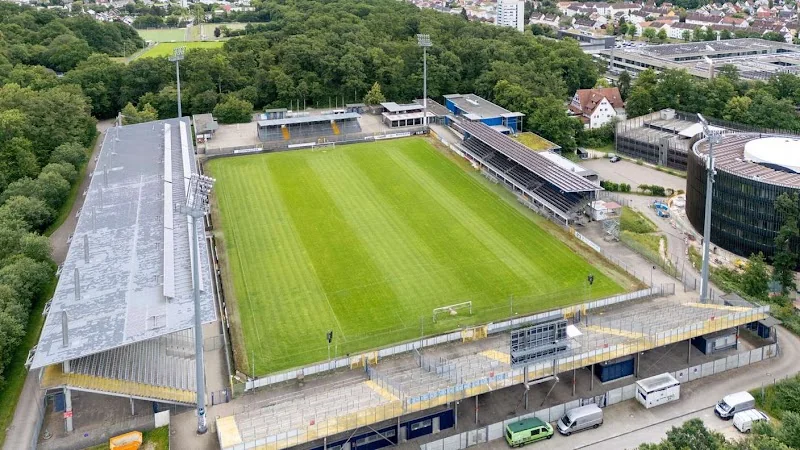
The Bediani-Arena is the football stadium of VfR Aalen and one of the prominent sports venues in the city. It is located on Stadionweg in Aalen's Rohrwang and combines the regular match operations of the club with a long history of great football moments. For visitors, practical questions are at the forefront: When is the next home game, what does the seating plan look like, where are the best seats, how does entry work, and what options are available for getting there? This overview consolidates the most important information about the Bediani-Arena Aalen.
The stadium currently has 11,088 seats. The capacity is distributed across 4,667 completely covered seats and 6,421 standing places, of which 1,000 are covered. The owner of the arena is the city of Aalen. VfR Aalen uses the venue as its home stadium. The compact layout creates a direct proximity to the pitch, which particularly contributes to an intense atmosphere during league matches and cup encounters. The current name Bediani-Arena has been in use since 2026 and refers to the new naming partner Bediani. For fans, guests, and organizers, the stadium is thus both a familiar football location and a venue with a new designation.
Bediani-Arena Program and VfR Aalen Home Games
The most important search topic regarding the Bediani-Arena is the current program. The focus is on the home games of VfR Aalen. The club plays its competitive matches in Aalen and hosts teams from the respective league, cup competitions, or other official competitions, depending on the schedule. For visitors, it is advisable to check not only the match day but also the exact kick-off time, the respective opponent, and any entry regulations. Match dates can be rescheduled, for example, due to security requirements, TV broadcasts, cup rounds, or organizational adjustments.
The Bediani-Arena is primarily focused on football. Its stands, standing areas, access points, and ticket structures are therefore tailored to match day operations. The visit does not start only with the kick-off: Many fans consciously plan their arrival earlier to avoid waiting times, have tickets ready, and reach the appropriate block without time pressure. Especially for matches with high demand or traditional encounters, arriving before the official start can be worthwhile.
The program includes not only regular VfR home games but also special football events. The city of Aalen reports on junior international matches, European Championship matches in women's football, and other significant encounters that have already taken place in the arena. Additionally, there have been matches with regional attention in the past. The semi-final of the DFL League Cup between VfB Stuttgart and Borussia Dortmund on July 21, 2003, is considered one of the early major events of the modernized venue. On September 4, 2003, a national team match between Germany and Russia took place as part of Team 2006.
Even outside the classic league operations, the arena can serve as a venue for community and sports-related events. One example is the Advent singing announced in Aalen, where clubs, choirs, the youth band, and the municipal orchestra perform together. Such events show that the stadium is not solely perceived as a backdrop for 90 minutes of football. Nevertheless, VfR Aalen remains the central point of reference for the program and the identity of the Bediani-Arena. Therefore, those looking for Bediani-Arena events should first check the club calendar and then the city's event notices.
Bediani-Arena Seating Plan and Best Seats
The seating plan of the Bediani-Arena is particularly important for selecting the right ticket. The stadium consists of various stands and sector areas with seating and standing places. According to the current information from VfR Aalen, there are 4,667 seats that are completely covered. This provides the seating areas with a protected environment, which is a practical advantage during matches with changeable weather. The 6,421 standing places are primarily aimed at fans who want to experience the dynamic atmosphere and immediate support of the team.
There is no blanket answer to the question of the best seats, as the ideal position depends on personal preferences. Those who want to tactically and comprehensively overview the game usually prefer a more central seat with an elevated viewpoint. Those seeking emotional closeness to the active fans tend to choose a designated standing area. Families, older visitors, and guests who value a fixed seat and weather protection can benefit from the covered seating stands. However, the actual view depends on the specific block, row, event, and respective ticket category.
The official stadium plan also serves an important organizational function. Due to the sector separation, visitors receive tickets for specific blocks only at the designated ticket booths. The plan shows where these booths are located and at which access gates visitors with already purchased tickets or season tickets can enter the stadium. The Bediani-Arena also has an electronic access control system. Therefore, tickets should be readily available upon arrival to ensure a smooth entry process.
For visiting fans, it is particularly important to pay attention to the sector indicated on the ticket and not automatically choose the nearest entrance. Depending on the match, pathways, security areas, and the allocation of individual blocks may be adjusted. The binding instructions from VfR Aalen or the respective organizer take precedence over general descriptions. The seating plan not only helps with seat selection but also with orientation on-site. Those who know early on which entrance, which ticket booth, and which block are relevant can start the match day more relaxed.
Tickets, Ticket Booths, and Entry to the Bediani-Arena
Tickets for the Bediani-Arena primarily relate to home games of VfR Aalen and are offered depending on the event through the sales channels indicated by the club. Prices, discounts, advance sale points, and possible day ticket booths may vary from match to match. Therefore, a uniform price indication would not be reliable. Visitors should use the respective advance sale and check whether the ticket is for a seat, a standing place, a home sector, or a guest area.
The stadium regulations and the general ticket business conditions of VfR Aalen are decisive for the visit. They regulate, among other things, the conditions for entry, behavior in the stadium, security requirements, and the use of the admission ticket. Visitors should particularly pay attention to prohibited items, bag regulations, and possible special provisions for risk matches. Such requirements can influence the checks at the entrance. Those who arrive without unnecessary luggage and have the ticket ready digitally or printed facilitate the process.
The ticket booth structure of the Bediani-Arena is sector-based. Due to the separation of individual stadium areas, tickets for the respective blocks are issued at the designated ticket booths. This means that an arbitrary entrance does not necessarily lead to the booked area. The official stadium plan should therefore be viewed before arrival. For season ticket holders and fans with advance sale tickets, there are designated access gates where the electronic access control system checks the card.
For highly demanded matches, purchasing in advance is recommended. This is especially true for games against traditional opponents, cup matches, and dates when many visiting fans are expected. An advance sale ticket can not only increase the security of one's seat but also reduce waiting time at the day ticket booth. Nevertheless, fans should pay attention to the entry times indicated on the ticket and any short-term notices from the club. Proof may be required for discounts. The organizer decides which groups of people are entitled to a discount.
The address of the VfR Aalen office is located at Bediani-Arena next to the east stand. For general club and ticket inquiries, the club provides its own contact options. Since opening hours and sales modalities may change, visitors should check current information directly with VfR Aalen. This helps avoid misunderstandings regarding price, block, booth, or entry.
Access and Parking at the Bediani-Arena in Aalen
The Bediani-Arena is located on Stadionweg in Aalen. The current club address is Stadionweg 5/1, 73430 Aalen; the city description states Stadionweg 5. Visitors should pay attention to the specific event address when using navigation systems and during ticket checks. The location in the Rohrwang area makes the stadium a well-accessible destination for fans from Aalen and the surrounding region.
For driving, it is advisable to plan enough time. On match days, traffic around the arena can be significantly higher than on regular days. This is especially true before kick-off and after the match ends. The city of Aalen points out several parking spaces at the entrance. However, it should not be assumed that a free parking space will be available directly at the stadium for every event. The actual situation depends on visitor numbers, security measures, concurrent events, and temporary traffic regulations.
Those arriving by car should pay attention to the signage on-site and not rely solely on a single digital map view. During matches, certain pathways may be reserved for pedestrians, emergency vehicles, or visiting fans. Additionally, parking areas may change in their use or be temporarily closed. Arriving early offers advantages: it reduces time pressure, facilitates orientation, and creates a buffer for the walk from the vehicle to the correct stadium entrance.
Traveling by public transport can be a practical alternative. The city of Aalen mentions the bus stop Eichenhof as a nearby stop. It is served by line 32. Before the visit, departure times, connections, and the return journey should be checked, as match operations often take place in the evening and not every connection runs at the same frequency. After the match, there may also be many passengers departing simultaneously.
For visitors with mobility impairments, the city of Aalen provides several relevant notices. Block A has a covered platform for ten wheelchair users with accompanying persons. Access to the platform is via a ramp with about a ten percent incline. Additionally, several parking spaces at the entrance are mentioned. Since the specific accessibility can depend on the event, entry regulations, and available capacity, affected visitors should coordinate their requirements as early as possible with the club or organizer. This can clarify which entrance, which seating area, and what support are planned for the event day.
Capacity, Stands, and Facilities of the Bediani-Arena
The current total capacity of the Bediani-Arena is 11,088 seats. This number consists of 4,667 seats and 6,421 standing places. All seats are covered. Of the standing places, 1,000 are covered. Thus, the stadium combines fixed, weather-protected seating areas with spacious standing sectors that enable a vibrant football atmosphere. The capacity is aligned with regular stadium operations and can be utilized differently depending on the event, security concept, or construction requirements.
The stadium is owned by the city of Aalen. VfR Aalen is the main user and shapes the match operations. The club's office is located next to the east stand. Therefore, the east side is a central point of orientation for fans. Furthermore, the Bediani-Arena has an electronic access control system. This system supports controlled entry and is combined with sector-based access points and ticket booths.
The city of Aalen also describes various improvements that were implemented during the expansion in 2014. These included a new east stand with covered standing places, additional containers for kiosks and toilets, reinforced fences and emergency exits, an extended security center, improvements in video transmission, and measures for the speaker system, lighting, and electricity. These details show that the arena has been shaped not only by its spectator capacity but also by the requirements of modern match operations.
The current capacity is below the historical expansion level of 14,500 spectator places. The higher number was associated with the expansion for VfR Aalen's second division season in 2014. After the later dismantling of a mobile stand, the capacity was reduced. Therefore, for today's visitors, the current number of 11,088 seats is decisive. Historical figures should not be confused with the currently permitted capacity.
Accessibility and visitor comfort are also components of the stadium's facilities. In addition to the wheelchair platform in Block A, the city of Aalen mentions a toilet in the VfR club restaurant and mobility notices for the journey. The actual use of individual facilities may depend on the event day and organizational requirements. For special requirements, prior contact is advisable.
History and Special Football Moments in Aalen
The history of the venue goes back much further than the current name Bediani-Arena. The facility has been referred to as a stadium since 1949. Over the decades, it has had various names, including Municipal Forest Stadium, VfR Stadium in Rohrwang, Scholz Arena, Ostalb Arena, and Centus Arena. The current name Bediani-Arena refers to the naming partner Bediani, which has been in place since 2026. The changing names reflect different phases of development, marketing, and sporting use.
An important modernization step took place in 2001. The information from VfR Aalen mentions a total expansion in that year. The city of Aalen subsequently describes the venue as the site of several sporting highlights. On July 21, 2003, the semi-final of the DFL League Cup between VfB Stuttgart and Borussia Dortmund took place. Around 11,200 spectators experienced this match live. Thus, the stadium early on gained a regional stage and showed that it was also suitable for matches with high public interest.
On September 4, 2003, the national team match of Team 2006 between Germany and Russia followed. The match took place in a lively atmosphere with 6,000 spectators. Other special events included junior international matches and European Championship matches in women's football. These dates expanded the significance of the arena beyond regular club football. For Aalen, they meant the opportunity to experience international and national football directly on-site.
VfR Aalen also wrote important chapters of its club history in the stadium. The promotion to the 2nd Bundesliga for the 2012/13 season led to additional requirements for the venue. After a roughly six-week expansion, the stadium was prepared for the second division season in 2014. The new east stand was inaugurated on August 8, 2014, during the match against FC St. Pauli. The stand offered 3,335 covered standing places and was intended for Aalen fans.
Another outstanding match was the DFB Cup match of VfR Aalen against FC Schalke 04 on August 16, 2010. Despite an early red card, Aalen narrowly lost 1:2. Such encounters shape the memory of an arena more than mere capacity figures. They connect the stadium, club, and city with concrete moments that are passed down by fans. Today, the Bediani-Arena stands for both the current home venue of VfR Aalen and a sports history in which league football, cup evenings, and international encounters come together.
Stadium Experience, Orientation, and Practical Tips
A visit to the Bediani-Arena is particularly pleasant when the most important processes are clarified in advance. This includes the right ticket, the correct sector, the journey, and a time buffer for entry. The arena is not a completely anonymous large stadium but a comparatively compact football venue. This creates proximity to the pitch and to the fans. At the same time, the sector-based organization means that visitors should take the access indicated on their ticket seriously.
The atmosphere varies depending on the seat choice. Seats offer a fixed, covered location and a good opportunity to follow the game closely. Standing places convey more of the communal experience of match day. Those coming with children, older relatives, or persons with limited mobility should plan the appropriate area and the pathways from the parking lot or bus stop to the entrance in advance. When selecting the best seats, not only the view of the pitch matters, but also whether one wants to sit, stand, be covered, or be close to certain fan groups.
For orientation on-site, the stadium plan, ticket, and signage are crucial. The stadium plan shows the blocks, ticket booths, and access gates. The electronic access control system requires that admission tickets be readily available. Depending on the event, there may be additional security checks. Therefore, visitors should avoid large bags and prohibited items and adhere to the stadium regulations.
The Bediani-Arena is also a place where the history of VfR Aalen can be experienced directly. The east stand, the office next to the arena, and the various sectors make it clear that not only individual matches take place here but also regular club operations. For away fans, visiting the stadium offers the opportunity to get to know Aalen football up close. For home fans, the arena is a familiar meeting point where generations of spectators share the same stands, pathways, and match day rituals.
Those wishing to pass on information after the visit should distinguish between verified stadium data and personal assessments. The capacity, the covered seats, the address, and the bus stop are concrete points of orientation. The question of the best seats or the strongest atmosphere, on the other hand, remains individual. This very mix of verifiable facts and personal stadium feeling makes the Bediani-Arena interesting. It is large enough for significant matches, yet compact enough to experience football directly and without great distance.
Sources:
Mehr anzeigenWeniger anzeigen
Bediani-Arena | Program & Seating Plan
The Bediani-Arena is the football stadium of VfR Aalen and one of the prominent sports venues in the city. It is located on Stadionweg in Aalen's Rohrwang and combines the regular match operations of the club with a long history of great football moments. For visitors, practical questions are at the forefront: When is the next home game, what does the seating plan look like, where are the best seats, how does entry work, and what options are available for getting there? This overview consolidates the most important information about the Bediani-Arena Aalen.
The stadium currently has 11,088 seats. The capacity is distributed across 4,667 completely covered seats and 6,421 standing places, of which 1,000 are covered. The owner of the arena is the city of Aalen. VfR Aalen uses the venue as its home stadium. The compact layout creates a direct proximity to the pitch, which particularly contributes to an intense atmosphere during league matches and cup encounters. The current name Bediani-Arena has been in use since 2026 and refers to the new naming partner Bediani. For fans, guests, and organizers, the stadium is thus both a familiar football location and a venue with a new designation.
Bediani-Arena Program and VfR Aalen Home Games
The most important search topic regarding the Bediani-Arena is the current program. The focus is on the home games of VfR Aalen. The club plays its competitive matches in Aalen and hosts teams from the respective league, cup competitions, or other official competitions, depending on the schedule. For visitors, it is advisable to check not only the match day but also the exact kick-off time, the respective opponent, and any entry regulations. Match dates can be rescheduled, for example, due to security requirements, TV broadcasts, cup rounds, or organizational adjustments.
The Bediani-Arena is primarily focused on football. Its stands, standing areas, access points, and ticket structures are therefore tailored to match day operations. The visit does not start only with the kick-off: Many fans consciously plan their arrival earlier to avoid waiting times, have tickets ready, and reach the appropriate block without time pressure. Especially for matches with high demand or traditional encounters, arriving before the official start can be worthwhile.
The program includes not only regular VfR home games but also special football events. The city of Aalen reports on junior international matches, European Championship matches in women's football, and other significant encounters that have already taken place in the arena. Additionally, there have been matches with regional attention in the past. The semi-final of the DFL League Cup between VfB Stuttgart and Borussia Dortmund on July 21, 2003, is considered one of the early major events of the modernized venue. On September 4, 2003, a national team match between Germany and Russia took place as part of Team 2006.
Even outside the classic league operations, the arena can serve as a venue for community and sports-related events. One example is the Advent singing announced in Aalen, where clubs, choirs, the youth band, and the municipal orchestra perform together. Such events show that the stadium is not solely perceived as a backdrop for 90 minutes of football. Nevertheless, VfR Aalen remains the central point of reference for the program and the identity of the Bediani-Arena. Therefore, those looking for Bediani-Arena events should first check the club calendar and then the city's event notices.
Bediani-Arena Seating Plan and Best Seats
The seating plan of the Bediani-Arena is particularly important for selecting the right ticket. The stadium consists of various stands and sector areas with seating and standing places. According to the current information from VfR Aalen, there are 4,667 seats that are completely covered. This provides the seating areas with a protected environment, which is a practical advantage during matches with changeable weather. The 6,421 standing places are primarily aimed at fans who want to experience the dynamic atmosphere and immediate support of the team.
There is no blanket answer to the question of the best seats, as the ideal position depends on personal preferences. Those who want to tactically and comprehensively overview the game usually prefer a more central seat with an elevated viewpoint. Those seeking emotional closeness to the active fans tend to choose a designated standing area. Families, older visitors, and guests who value a fixed seat and weather protection can benefit from the covered seating stands. However, the actual view depends on the specific block, row, event, and respective ticket category.
The official stadium plan also serves an important organizational function. Due to the sector separation, visitors receive tickets for specific blocks only at the designated ticket booths. The plan shows where these booths are located and at which access gates visitors with already purchased tickets or season tickets can enter the stadium. The Bediani-Arena also has an electronic access control system. Therefore, tickets should be readily available upon arrival to ensure a smooth entry process.
For visiting fans, it is particularly important to pay attention to the sector indicated on the ticket and not automatically choose the nearest entrance. Depending on the match, pathways, security areas, and the allocation of individual blocks may be adjusted. The binding instructions from VfR Aalen or the respective organizer take precedence over general descriptions. The seating plan not only helps with seat selection but also with orientation on-site. Those who know early on which entrance, which ticket booth, and which block are relevant can start the match day more relaxed.
Tickets, Ticket Booths, and Entry to the Bediani-Arena
Tickets for the Bediani-Arena primarily relate to home games of VfR Aalen and are offered depending on the event through the sales channels indicated by the club. Prices, discounts, advance sale points, and possible day ticket booths may vary from match to match. Therefore, a uniform price indication would not be reliable. Visitors should use the respective advance sale and check whether the ticket is for a seat, a standing place, a home sector, or a guest area.
The stadium regulations and the general ticket business conditions of VfR Aalen are decisive for the visit. They regulate, among other things, the conditions for entry, behavior in the stadium, security requirements, and the use of the admission ticket. Visitors should particularly pay attention to prohibited items, bag regulations, and possible special provisions for risk matches. Such requirements can influence the checks at the entrance. Those who arrive without unnecessary luggage and have the ticket ready digitally or printed facilitate the process.
The ticket booth structure of the Bediani-Arena is sector-based. Due to the separation of individual stadium areas, tickets for the respective blocks are issued at the designated ticket booths. This means that an arbitrary entrance does not necessarily lead to the booked area. The official stadium plan should therefore be viewed before arrival. For season ticket holders and fans with advance sale tickets, there are designated access gates where the electronic access control system checks the card.
For highly demanded matches, purchasing in advance is recommended. This is especially true for games against traditional opponents, cup matches, and dates when many visiting fans are expected. An advance sale ticket can not only increase the security of one's seat but also reduce waiting time at the day ticket booth. Nevertheless, fans should pay attention to the entry times indicated on the ticket and any short-term notices from the club. Proof may be required for discounts. The organizer decides which groups of people are entitled to a discount.
The address of the VfR Aalen office is located at Bediani-Arena next to the east stand. For general club and ticket inquiries, the club provides its own contact options. Since opening hours and sales modalities may change, visitors should check current information directly with VfR Aalen. This helps avoid misunderstandings regarding price, block, booth, or entry.
Access and Parking at the Bediani-Arena in Aalen
The Bediani-Arena is located on Stadionweg in Aalen. The current club address is Stadionweg 5/1, 73430 Aalen; the city description states Stadionweg 5. Visitors should pay attention to the specific event address when using navigation systems and during ticket checks. The location in the Rohrwang area makes the stadium a well-accessible destination for fans from Aalen and the surrounding region.
For driving, it is advisable to plan enough time. On match days, traffic around the arena can be significantly higher than on regular days. This is especially true before kick-off and after the match ends. The city of Aalen points out several parking spaces at the entrance. However, it should not be assumed that a free parking space will be available directly at the stadium for every event. The actual situation depends on visitor numbers, security measures, concurrent events, and temporary traffic regulations.
Those arriving by car should pay attention to the signage on-site and not rely solely on a single digital map view. During matches, certain pathways may be reserved for pedestrians, emergency vehicles, or visiting fans. Additionally, parking areas may change in their use or be temporarily closed. Arriving early offers advantages: it reduces time pressure, facilitates orientation, and creates a buffer for the walk from the vehicle to the correct stadium entrance.
Traveling by public transport can be a practical alternative. The city of Aalen mentions the bus stop Eichenhof as a nearby stop. It is served by line 32. Before the visit, departure times, connections, and the return journey should be checked, as match operations often take place in the evening and not every connection runs at the same frequency. After the match, there may also be many passengers departing simultaneously.
For visitors with mobility impairments, the city of Aalen provides several relevant notices. Block A has a covered platform for ten wheelchair users with accompanying persons. Access to the platform is via a ramp with about a ten percent incline. Additionally, several parking spaces at the entrance are mentioned. Since the specific accessibility can depend on the event, entry regulations, and available capacity, affected visitors should coordinate their requirements as early as possible with the club or organizer. This can clarify which entrance, which seating area, and what support are planned for the event day.
Capacity, Stands, and Facilities of the Bediani-Arena
The current total capacity of the Bediani-Arena is 11,088 seats. This number consists of 4,667 seats and 6,421 standing places. All seats are covered. Of the standing places, 1,000 are covered. Thus, the stadium combines fixed, weather-protected seating areas with spacious standing sectors that enable a vibrant football atmosphere. The capacity is aligned with regular stadium operations and can be utilized differently depending on the event, security concept, or construction requirements.
The stadium is owned by the city of Aalen. VfR Aalen is the main user and shapes the match operations. The club's office is located next to the east stand. Therefore, the east side is a central point of orientation for fans. Furthermore, the Bediani-Arena has an electronic access control system. This system supports controlled entry and is combined with sector-based access points and ticket booths.
The city of Aalen also describes various improvements that were implemented during the expansion in 2014. These included a new east stand with covered standing places, additional containers for kiosks and toilets, reinforced fences and emergency exits, an extended security center, improvements in video transmission, and measures for the speaker system, lighting, and electricity. These details show that the arena has been shaped not only by its spectator capacity but also by the requirements of modern match operations.
The current capacity is below the historical expansion level of 14,500 spectator places. The higher number was associated with the expansion for VfR Aalen's second division season in 2014. After the later dismantling of a mobile stand, the capacity was reduced. Therefore, for today's visitors, the current number of 11,088 seats is decisive. Historical figures should not be confused with the currently permitted capacity.
Accessibility and visitor comfort are also components of the stadium's facilities. In addition to the wheelchair platform in Block A, the city of Aalen mentions a toilet in the VfR club restaurant and mobility notices for the journey. The actual use of individual facilities may depend on the event day and organizational requirements. For special requirements, prior contact is advisable.
History and Special Football Moments in Aalen
The history of the venue goes back much further than the current name Bediani-Arena. The facility has been referred to as a stadium since 1949. Over the decades, it has had various names, including Municipal Forest Stadium, VfR Stadium in Rohrwang, Scholz Arena, Ostalb Arena, and Centus Arena. The current name Bediani-Arena refers to the naming partner Bediani, which has been in place since 2026. The changing names reflect different phases of development, marketing, and sporting use.
An important modernization step took place in 2001. The information from VfR Aalen mentions a total expansion in that year. The city of Aalen subsequently describes the venue as the site of several sporting highlights. On July 21, 2003, the semi-final of the DFL League Cup between VfB Stuttgart and Borussia Dortmund took place. Around 11,200 spectators experienced this match live. Thus, the stadium early on gained a regional stage and showed that it was also suitable for matches with high public interest.
On September 4, 2003, the national team match of Team 2006 between Germany and Russia followed. The match took place in a lively atmosphere with 6,000 spectators. Other special events included junior international matches and European Championship matches in women's football. These dates expanded the significance of the arena beyond regular club football. For Aalen, they meant the opportunity to experience international and national football directly on-site.
VfR Aalen also wrote important chapters of its club history in the stadium. The promotion to the 2nd Bundesliga for the 2012/13 season led to additional requirements for the venue. After a roughly six-week expansion, the stadium was prepared for the second division season in 2014. The new east stand was inaugurated on August 8, 2014, during the match against FC St. Pauli. The stand offered 3,335 covered standing places and was intended for Aalen fans.
Another outstanding match was the DFB Cup match of VfR Aalen against FC Schalke 04 on August 16, 2010. Despite an early red card, Aalen narrowly lost 1:2. Such encounters shape the memory of an arena more than mere capacity figures. They connect the stadium, club, and city with concrete moments that are passed down by fans. Today, the Bediani-Arena stands for both the current home venue of VfR Aalen and a sports history in which league football, cup evenings, and international encounters come together.
Stadium Experience, Orientation, and Practical Tips
A visit to the Bediani-Arena is particularly pleasant when the most important processes are clarified in advance. This includes the right ticket, the correct sector, the journey, and a time buffer for entry. The arena is not a completely anonymous large stadium but a comparatively compact football venue. This creates proximity to the pitch and to the fans. At the same time, the sector-based organization means that visitors should take the access indicated on their ticket seriously.
The atmosphere varies depending on the seat choice. Seats offer a fixed, covered location and a good opportunity to follow the game closely. Standing places convey more of the communal experience of match day. Those coming with children, older relatives, or persons with limited mobility should plan the appropriate area and the pathways from the parking lot or bus stop to the entrance in advance. When selecting the best seats, not only the view of the pitch matters, but also whether one wants to sit, stand, be covered, or be close to certain fan groups.
For orientation on-site, the stadium plan, ticket, and signage are crucial. The stadium plan shows the blocks, ticket booths, and access gates. The electronic access control system requires that admission tickets be readily available. Depending on the event, there may be additional security checks. Therefore, visitors should avoid large bags and prohibited items and adhere to the stadium regulations.
The Bediani-Arena is also a place where the history of VfR Aalen can be experienced directly. The east stand, the office next to the arena, and the various sectors make it clear that not only individual matches take place here but also regular club operations. For away fans, visiting the stadium offers the opportunity to get to know Aalen football up close. For home fans, the arena is a familiar meeting point where generations of spectators share the same stands, pathways, and match day rituals.
Those wishing to pass on information after the visit should distinguish between verified stadium data and personal assessments. The capacity, the covered seats, the address, and the bus stop are concrete points of orientation. The question of the best seats or the strongest atmosphere, on the other hand, remains individual. This very mix of verifiable facts and personal stadium feeling makes the Bediani-Arena interesting. It is large enough for significant matches, yet compact enough to experience football directly and without great distance.
Sources:
Upcoming Events
VfR Aalen – FC-Astoria Walldorf
Advent Singing 2026
Frequently Asked Questions
Reviews
No reviews found