How Aalen Is Changing – Art in the Stadtoval
How Aalen Can Change: New Cultural Venues, Art in Public Spaces, and Ideas for the Coming Years
Aalen plans to interlink culture and urban development even more closely: from the cultural quarter at the train station to art in public spaces and the communication of Roman history at the UNESCO World Heritage Limes. This overview bundles the most important places and shows how you will likely be able to experience upcoming offerings.
What It's About: Urban Development with Culture (Looking Ahead)
As Aalen continues to grow and densify spatially in the coming years, it will be crucial where encounters happen: in squares, halls, underpasses, museums, and along paths between the train station, city center, and new quarters. This is exactly where the current direction, which the city repeatedly emphasizes in its public information and planning goals, comes in: Culture should not only be “program” but infrastructure—that is, a permanently usable network of places, offerings, and low-threshold access points.
The following overview focuses on developments that are relevant for the future: Which cultural venues are likely to play a key role, how art can serve as orientation in public spaces, and how a well-planned cultural day in Aalen can be put together from this.
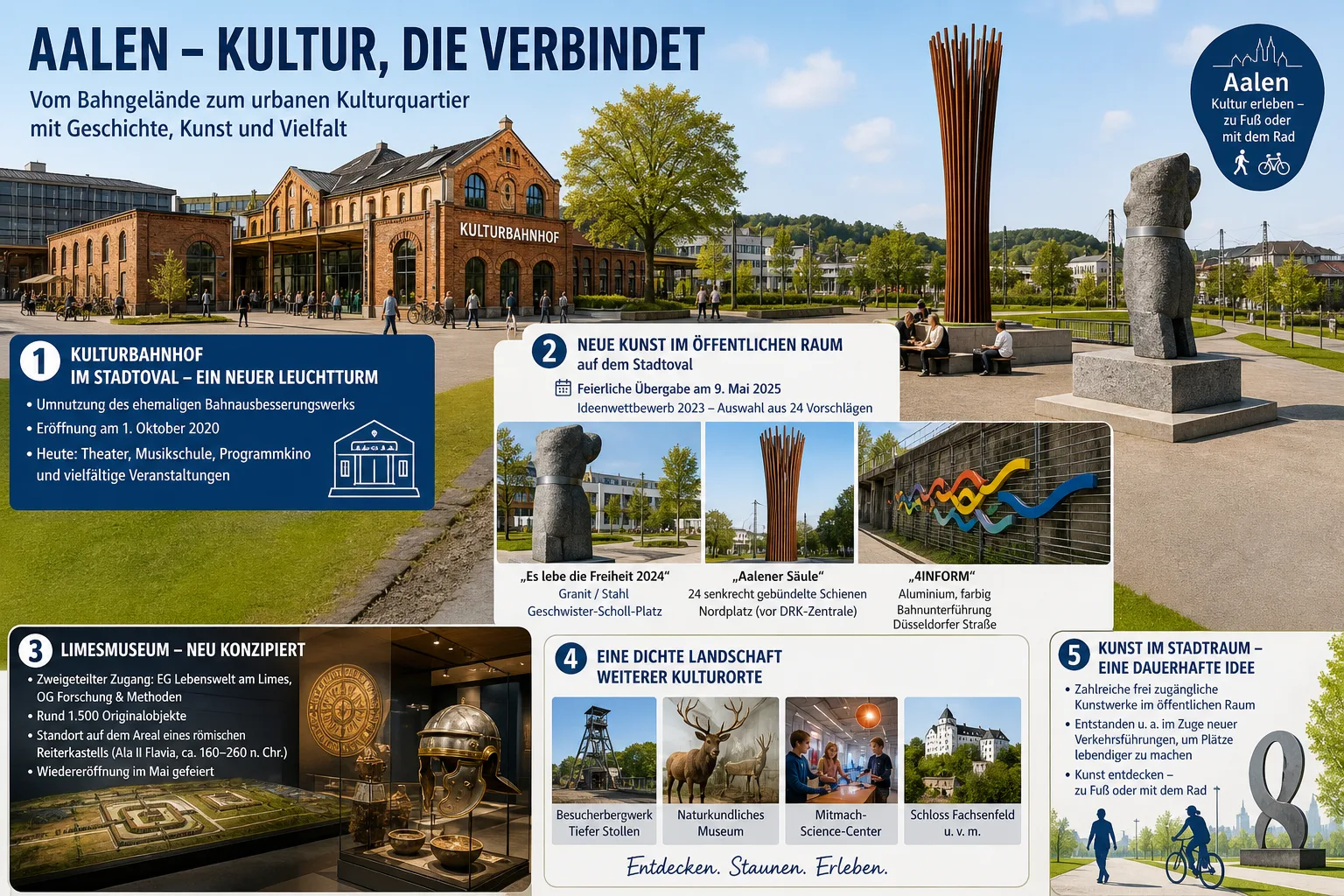
Cultural Quarter at the Train Station: Why the “Cultural Station” Can Function as an Anchor
Around the train station, the following applies in many cities: those who bundle attractive uses here make culture visible and accessible for commuters, families, and visitors. For Aalen, a cultural location in the vicinity of the train station is particularly effective because it shortens routes (arrival without a car), connects everyday life and evening programs, and makes the transition into new quarters an “entry” into the city.
For the coming years, it is crucial that such a cultural anchor not only hosts individual events but brings together several functions on a permanent basis:
- Regular operation (e.g., rehearsals, courses, film, exhibitions), so the place is lively even on weekdays.
- Flexible spaces for changing formats (readings, club evenings, children's activities, guest performances), so different target groups have space.
- Public quality of stay in the surrounding area (seating, safe crossings, good lighting), so the place works even between events.
If these building blocks work together, a cultural quarter at the train station becomes a reliable meeting point—and not just an address you visit “now and then.”
Art in the Quarter and in Transitional Spaces: Sculptures as Signposts for Future Urban Spaces
In newly emerging or rapidly changing quarters, what usually develops over decades is often initially missing: familiar paths, identity-forming corners, clear “anchor points.” Art in public spaces can take on a practical role here in the future—as orientation, as a conversation starter, and as a visible sign that a place is not only built but also culturally intended.
For Aalen, this can become especially important in typical transitional spaces that many people pass through daily:
- Squares (meeting point, break, market and event spaces)
- Underpasses (sense of security, design, quality of stay)
- Paths between train station, quarter, and city center (orientation and “readable” routes)
For visitors, this means: Instead of just heading for “one destination,” you can soon experience Aalen as a walkable exhibition—with stations that work without a ticket and regardless of opening hours. For the city, this is also a long-term tool: artworks remain after construction phases are over and give new streets and squares a recognizable face.
Limes Museum & UNESCO World Heritage: How Roman History Can Become Even More Accessible in the Future
In the coming years, it is expected that cultural mediation will increasingly rely on multilingual, more accessible, and interactive formats—especially where a place (like the Limes) is not only locally but internationally relevant. The Limes Museum Aalen is located in an environment closely linked to the UNESCO World Heritage Upper Germanic-Raetian Limes; this creates a natural mandate: to tell history in a way that is equally understandable for school classes, families, tourists, and experts.
Practically, this often means for future museum and mediation offerings:
- Clearer tours (short overview vs. in-depth stations)
- Hands-on elements (materials, reconstructions, interactive stations)
- Outdoor references (linking exhibition and site, themed walks)
- Program work (holiday activities, lectures, action days)
If you visit Aalen in the future, it is therefore worthwhile to plan a museum visit and city route together: Roman history as a start to the day, followed by art in public spaces and an evening cultural event in the quarter.
Other Cultural Venues in Aalen: How Individual Destinations Become a Network
A city appears particularly vibrant culturally when large institutions and smaller venues work together: with coordinated times, easily accessible information, and formats for different budgets. For Aalen, it will be especially relevant in the coming years how well these places can be connected as combinable building blocks—even without a car.
Typical building blocks that can complement each other well (depending on season and program) are:
- Exhibitions (short, weather-independent, easy to plan)
- Industrial and technical sites (tours, demonstrations, mediation)
- Nature and family offerings (interactive formats, holiday programs)
- Evening culture (theater, film, concerts, readings)
As a guide for planning: first set the fixed points (e.g., an evening event), then choose a route with two to three stations during the day—this leaves room for travel, breaks, and spontaneous discoveries.
How You Can Plan Future Culture Days in Aalen (Sample Routes)
Route A: “Train Station – Quarter – City Center” (compact, easy on foot)
- Arrival by train, start at the station.
- Quarter tour focusing on art in public spaces (squares, underpasses, path axes).
- City center break (café/square), then small galleries or changing exhibitions (depending on the program).
- Evening program at a central cultural venue (theater/film/concert, depending on the schedule).
Route B: “Romans – City – Present” (focus on history)
- Museum & World Heritage context: introduction to Roman history at the Limes.
- City route as a contrast: contemporary art in public spaces and modern architecture in development areas.
- Conclusion with an event (lecture, tour, concert—depending on the calendar).
Important: For specific dates, always check the current schedules and opening times on the official websites of the city and the respective institutions.
Transparency & Topicality
This article describes cultural developments in Aalen with a view to the coming years and typical planning practice (quarter culture, art in public spaces, UNESCO mediation). Specific dates, programs, and implementations may change. The information published by the city of Aalen and the individual institutions is binding.