Experience Interreligious Events & Festivals in Aalen
Interreligious Events & Cultural Festivals in Aalen (Outlook)
8 min readLaura Müller
What does it feel like when a central square becomes a long table – and when different languages, traditions, and faiths naturally find space side by side? In Aalen, interreligious dialogue is not just discussed, but made tangible in public formats: in discussion groups, at cultural and encounter festivals, on open house days, and in nature-based celebrations.
This overview shows which recurring interreligious events and cultural festivals typically play a role in Aalen in the coming months and the next year – including practical tips on how to find suitable dates and how to participate respectfully.
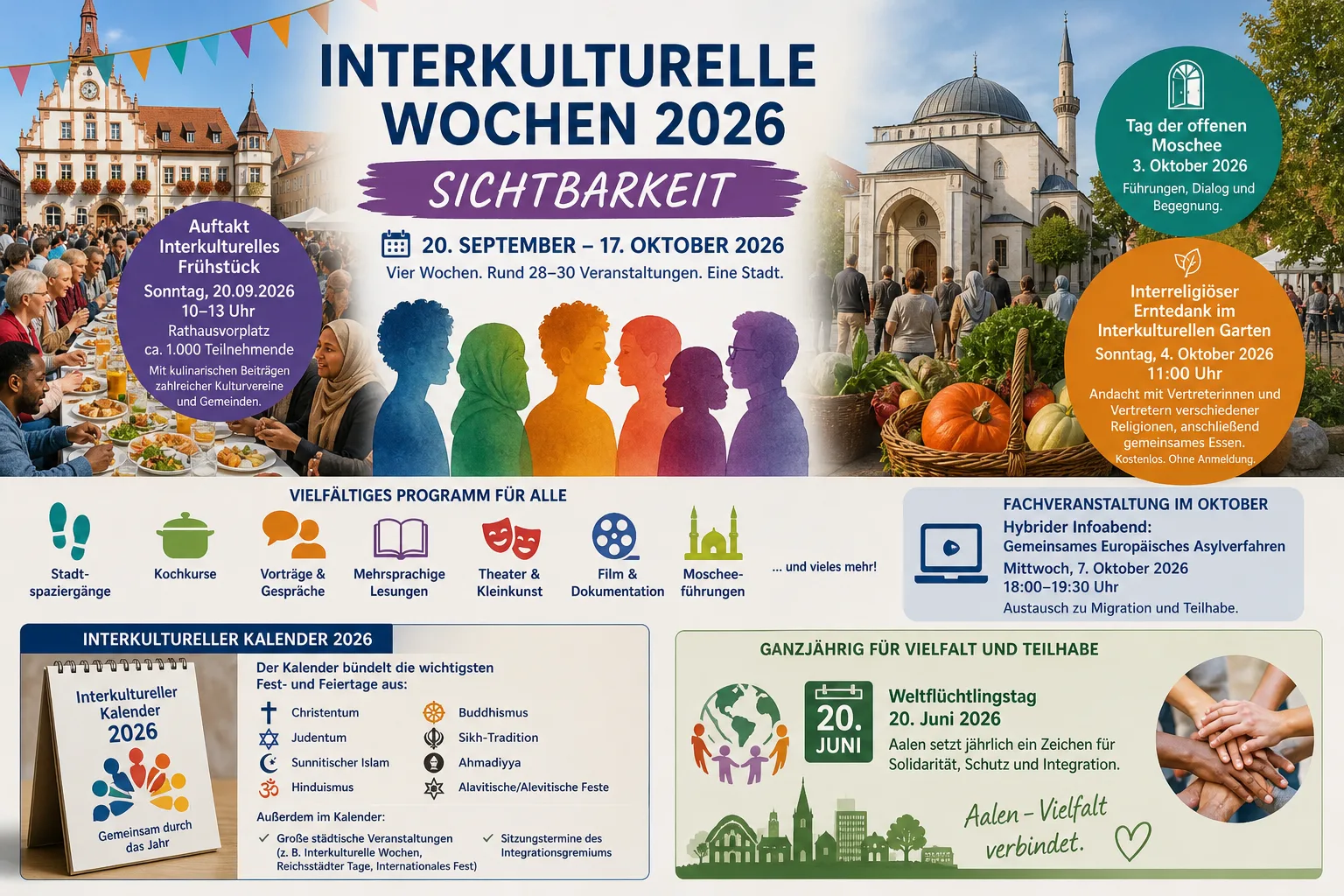
Intercultural Weeks in Aalen: Stage of Diversity
The Intercultural Weeks (IKW) are considered an important date in Aalen's event calendar. They bundle events on diversity, cohesion, participation and respect within a period (often in late summer or autumn). In practice, this results in a program mix of culture, education, and dialogue – open to people with and without religious affiliation.
Typical program points you can expect for Aalen in the next IKW season are:
- City walks to religious, cultural, or historical sites
- Readings, theater and music formats with an intercultural focus
- Film evenings with moderated discussion
- Tours through prayer and meeting rooms (e.g., mosques) with Q&A sessions
- Workshops and lectures on migration, integration, and social cohesion
- Encounter formats such as open tables, joint cooking, or participatory activities
If you are specifically looking for interreligious events, it is worth filtering the IKW program for terms like “dialogue,” “religions,” “faith,” “prayer house,” “mosque,” “synagogue,” “church,” “temple,” or “interreligious.” Many formats are deliberately low-threshold: you usually do not need prior knowledge, but rather openness and respectful curiosity.
Intercultural Breakfast & Open Mosque Day
Intercultural Breakfast: Encounter in the Heart of the City
A particularly accessible format is an intercultural breakfast or an open table in public space (often on central squares). For upcoming dates, you can expect that associations, initiatives, and religious communities will offer food and opportunities for conversation – often accompanied by music or short cultural contributions.
Simple rules help everyone feel comfortable:
- Ask before photographing food or taking pictures of people.
- Respect notes on halal, kosher, vegetarian/vegan, and allergens.
- If you talk about religious topics: listen first, then ask questions – do not judge.
Open Mosque Day on October 3: A Nationwide Occasion, Locally Experienced
The Open Mosque Day takes place annually on October 3. In Aalen and the surrounding area, it is also a suitable date to get to know mosque communities, ask questions, and gain insights into community life, architecture, and religious practice.
For the next October 3, the following elements are typically to be expected (depending on the community and program):
- Welcome and brief introduction to the premises
- Tours through prayer rooms and meeting areas
- Discussion rounds on everyday life, holidays, and community work
- Information tables and encounters over tea or small snacks
Practical: Pay attention to notes on shoes, appropriate clothing, and photo rules. The goal is dialogue at eye level – it is perfectly fine to ask questions for understanding as long as they are phrased respectfully.
Interreligious Formats in the Intercultural Garden
An Intercultural Garden is particularly suitable for formats that combine nature, community, and gratitude. For the coming year, such settings often feature events related to harvest time, sustainability, or community – for example, interreligious impulses, open encounter afternoons, or cultural participatory festivals.
Why these places work so well for interreligious encounters:
- Shared activities (gardening, sharing, cooking) facilitate conversations without a “stage feeling.”
- Symbolism of harvest, gratitude, and responsibility for resources is accessible in many traditions.
- Low-barrier participation: Outdoors, during the day, often without formal hurdles.
If you want to participate, find out in advance about duration, what to bring (e.g., your own cup/bowl), and whether there are program points with quiet moments where consideration (e.g., silence) is desired.
Intercultural Calendar: Orientation on Festivals and Holidays
An intercultural calendar helps to make religious and cultural holidays visible throughout the year. For schools, associations, businesses, and anyone planning events, this is practical: dates can be set so that central holidays of different traditions are taken into account.
Intercultural calendars often include (depending on edition and publisher) among others:
- Christian holidays (e.g., Christmas, Easter)
- Jewish holidays (e.g., Rosh Hashanah, Yom Kippur)
- Muslim holidays (e.g., Eid al-Fitr, Eid al-Adha)
- Other traditions (e.g., Hindu, Buddhist, or Sikh festivals)
For Aalen, this means: If you want to specifically experience interreligious events and cultural festivals, you can combine calendar knowledge with local programs – this way you can recognize when thematically suitable weeks, dialogue evenings, or encounter festivals are particularly likely.
World Refugee Day, Expert Forums & Quiet Dialogue Formats
Interreligious encounters are not only about big festivals. Recurring action days and information formats also create spaces for dialogue and social orientation.
World Refugee Day on June 20
World Refugee Day on June 20 is an international day of remembrance and action. For Aalen, events are generally conceivable around this date that inform about causes of flight, protection, and integration – often with the involvement of civil society initiatives, counseling centers, cultural organizations, and sometimes religious communities (e.g., through pastoral care or support services).
Expert Forums, Information Evenings & Discussion Groups
In addition to festivals, expert events (lectures, panels, hybrid information evenings) are relevant if you want to understand backgrounds – for example, on integration, anti-discrimination, religious freedom, or legal frameworks. Such formats are especially helpful if you work in schools, associations, social work, or volunteering, or simply want to be well-informed.
“Quiet” Encounters in Everyday Life
In addition to publicly advertised dates, there are often smaller discussion spaces that are less outward-facing but have a lasting impact: neighborhood meetings, open community cafés, themed evenings, or cultural participatory activities. Those seeking sustainable connections often find the most continuous contacts here.
What Interreligious Festivals Bring to Aalen Society
Interreligious events and cultural festivals can – if well designed – be more than “colorful program items.” They create tangible benefits for coexistence:
- Encounter instead of assumptions: Personal conversations reduce uncertainties and prejudices.
- Orientation: Those who know local actors find suitable counseling, cultural, or volunteering opportunities more quickly.
- Participation: Low-threshold formats also invite people who otherwise rarely take part in city events.
- City culture: Diversity becomes visible as part of identity – not as a marginal topic.
For visitors: Such formats are a direct way to get to know Aalen beyond classic sights – through people, stories, music, food, and exchange.
How to Plan Your Visit: Annual Cycle & Tips
If you want to specifically experience interreligious events and cultural festivals in Aalen, a simple annual plan along recurring anchor dates and program focuses helps:
- Spring: Many traditions have important holidays; also, cultural and encounter formats in the open air often start up again.
- June 20: World Refugee Day as a possible focus for information, exchange, and solidarity actions.
- Late summer/autumn: Time window in which Intercultural Weeks often take place and many encounter opportunities are bundled.
- October 3: Open Mosque Day as a reliable fixed date for insights and dialogue.
- Autumn/harvest time: Good phase for nature-related encounter formats (e.g., garden festivals, thanksgiving and sharing activities).
For current dates, it is best to use official city event calendars, Intercultural Weeks programs, announcements from cultural organizations, as well as notices from participating communities and associations. This way you get reliable information on times, accessibility, languages, registration, and consideration rules.